The Advertising Research Foundation is hosting its Audience Measurement 3.0 conference this week in New York City. The theme they are using to promote the conference is "Catch Me If You Can."
The tagline reminds me of a toy we have for our 9-month old baby called the "Move and Crawl Ball" by vtech. You set it down on the floor and it rolls around while the baby tries to catch it, almost taunting the unsuspecting infant with "Wee! Catch me if you can!". Allyn got it as a gift from her great-grandparents and she loves it.
It's an apt parallel to how increasingly active and agile audiences go about their lives while advertisers try to "catch" their attention with their advertising initiatives.
Given this "Catch Me If You Can!" dynamic it's not a coincidence that I'll be speaking on a panel on consumer-to-consumer conversations at a conference devoted to advertising. The title of the panel is "Putting a Ruler on Buzz."
If you want to download the paper I'll be presenting you can do so from the ChatThreads ChatterBox blog.
Catch me in New York... if you can! :-)
-->
Tags: WOM word of mouth Word-of-Mouth Marketing marketing communication
Sunday, June 22, 2008
Catch Me If You Can! Sneak Peek at ARF Presentation


Thursday, May 08, 2008
Introducing the Conversation Value™ Model and Preview of WOMM-U Sessions
As mentioned in an earlier post I'm speaking at WOMM-U today and tomorrow about WOM measurement and how to scale WOM programs. On the WOMM-U website WOMMA bills my session as "Your CMO says: 'If I gave you X dollars more for WOM, what would I get?'"*
The purpose of this post is to give a preview of how I plan to address this topic and it coincides with some exciting news with ChatThreads regarding the announcement of a new WOM ROI metric. We call it "Conversation Value™" and it's a measure of the revenue impact of consumer conversations.
I've been working on this model with Dr. Barak Libai, who has been a visiting professor of marketing at MIT and a professor at Tel Aviv's Faculty of Mangement (and also a fellow member of WOMMA's Academic Advisory Board).
The Conversation Value™ Model incorporates consumers' WOM behavior into a life-time value (LTV) model, which allows companies to quantify the bottom-line value of each conversation about a brand.
The two categories of inputs are LTV-related and WOM-related. (We feel that if you calculate the value of a customer just based on a LTV model that you actually underestimate the value a customer brings to the firm because it doesn't take into account their WOM.)
For LTV inputs we calculate the average value a customer brings to the firm through their own purchase behavior, adjusted based on a discount rate that takes into account the time value of money (money now is worth more than money later).
The WOM inputs are collected via ChatThreads' analytics platform. The inputs include generational relay rates (the number of people told from Generation 0 to Generation 1, Generation 1 to Generation 2, etc.), which is a measure of reach, as well as generational purchase rates (the percentage of people who report purchasing the product or service at each generation).
The value of each conversation, or "conversation value", is calculated by combining the life time value and WOM referral value and dividing this by the number of conversations with unique people. The "net present conversation value" is computed by subtracting the costs for the marketing initiative from the conversation value figure.
You end up with a dollar amount, like $1.20, for example, and this number means that each time a person had a conversation with a new person as part of a marketing initiative (whether it's an advocacy or influencer WOM program, or a more traditional event marketing or sampling program) the company made $1.20. The value could be a negative number as well which means the initiative failed to generate a positive ROI. Companies can track this number over time and work to optimize their initiatives in order to increase their conversation value.
Interestingly, conversation values can range dramatically by cateogry and by each of the inputs to the model, such as the profitability of each unit sold and generational relay and purchase rates.
Something else that's really cool is how you can run simulations to understand what happens if, for example, each program participant reached just one more person at each generation, or purchased X% more. Or what happens if you decided to scale the program larger (for example, by engaging additional program participants). Additionally, you can use the model to look at cost per conversion so that you can compare an initiative designed to generate WOM to other media channels. This will give media planners, buyers, and marketers a clearer sense of how to allocate their resources.
We are developing Conversation Value™ Models for ChatThreads' clients and will be releasing some research reports and white papers in the near future. For the time being you can come to my interactive sessions in Miami. Hope to see you here!
* BTW, the hypothetical CMO's statement above may make it seem like you can just buy WOM or have a successful WOM program by just throwing around some additional money. I don't think this is what the conference organizers intended when they wrote their short blurb, but I'll certainly dispel this notion when I discuss it today. What they were getting at, I think, is understanding the impact of resource allocation and how to go about it in thoughtful and strategic ways (or, this is how CMOs probably should be talking about it anyway!).
-->
Tags: WOM word of mouth Word-of-Mouth Marketing marketing communication Conversation Value
Thursday, April 24, 2008
WOMM-U: Bienvenidos a Miami!
 With all due respect to Will Smith, I am looking forward to receiving this greeting while at WOMMA's WOMM-U event.
I'll be a faculty member (a tough stretch for me, I know) facilitating one of the highly interactive sessions on "How Does WOM Scale?" where we'll discuss issues of scalability, measurement, and optimization for WOM initiatives.
These are small group discussions of 10-12 people and will be driven by questions and comments from the group members. I will bring some talking points, however, based on exciting new research I've been doing with ChatThreads as it relates to these issues.
Dr. Kate Niederhoffer, VP of Measurement Science at Nielsen Online, will be the other faculty member/facilitator on the same topic.
It all goes down May 8-9, 2008.
Hope to see you there!
PS -- Don't worry. There won't be any grades and I won't bring my red pen with me. :-)
-->
Tags: WOM word of mouth Word-of-Mouth Marketing marketing communication
Monday, February 04, 2008
Why I Don't Do Karaoke
 Tonight I spoke in Dr. Felicia Lassk's MBA-level Marketing Research class at Northeastern. Dr. Lassk is a colleague in the business school and I've had the chance to speak in a few of her classes over the past couple years and I'm honored she keeps inviting me back :-)
The topic tonight was how to measure WOM online and offline. The students, who were very receptive and participatory (especially for a night class when the day after a disappointing loss by the Patriots in the SuperBowl), will be reading the Harvard Business Review case study on Intelliseek next week, so I was sure to talk about some of the work their company does (now part of Nielsen BuzzMetrics/Nielsen Online). I also discussed the diary-based syndicated research from the Keller Fay Group. And she also asked me to talk about my own research on the generational spread of WOM and the new company ChatThreads. All of which I was happy to do.
Owing to the fact that it was a night class I wanted to provide a little bit of relevant entertainment early on and so I showed the "A Comcast Technician Sleeping On My Couch" YouTube video as a segue into discussions about social media monitoring and analysis. Unfortunately, though, the audio in the room wasn't working. The Brian Finkelstein video is set to "I Need Some Sleep" by the Eels, and missing the audio is a bit of a bummer. I tried to sing it, but after the first few notes I employed my well-honed skills in audience adaptation and decided I should stop abruptly (the look of horror on their faces was the give-away).
So, I told them I'd pass along the links to Dr. Lassk so they can watch the video, and one of my favorite spin-offs ("Cancelling Comcast") that illustrates a humorous take on how companies are training their call center employees in the age of social media.
Thanks to Dr. Lassk and her class for a great evening!
-->
Tags: WOM word of mouth Word-of-Mouth Marketing buzz marketing viral marketing marketing communication
Monday, November 05, 2007
My Presentation at UGA Connect 2007

The good people at UGA have uploaded my presentation at the Connect conference to Slide Share. Be sure to check out the other presentations from the PR and social media conference, including Kevin Dugan's keynote on the opening night and Dr. Robert Sprague's talk on the legal issues surrounding WOM and social media.
-->
Tags: WOM word of mouth Word-of-Mouth Marketing UGA Connect 2007
Saturday, October 20, 2007
Live from Athens! (Georgia, that is)
 In Athens at the University of Georgia for the Connect Public Relations and Social Media Conference.
The conference kicked off last night with Kevin Dugan talking about the new world of social media and the opportunities, and potential dark side, it presents for PR professionals. His talk was titled "We>Me" and did a nice job to set up some of the core issues with social media: transparency, human connection, having clear goals for working with social media technologies rather than just the "shiny tools" themselves. He also asked us to consider "what is content?" -- PR traditionally considers just "text" as content but he feels it's much broader including audio, video, links, comments, etc.
I speak at 10:30 am on "Organizing for Conversation: What Research Needs to Tell Us". I will discuss my four phase model of conversational engagement which focuses on how organizations come to understand what it means to "join in the conversation".
Here are the official social media venues: conference blog, Flickr pics, and Twitter feeds.
Should be fun!
-->
Tags: WOM word of mouth Word-of-Mouth Marketing buzz marketing viral marketing marketing communication UGA Connect 2007 Conference
Wednesday, June 13, 2007
Bon Nuit Geneve
 I just had a wonderful experience in Geneva, Switzerland where I spoke at the Marketing and Direct Focus Europe 2007 conference hosted by Baptie and Company. I gave the keynote address on the second day which is traditionally reserved for an academic offering her/his view on the state of marketing (thanks to Paul Marsden for the referral). This conference was focused on the B2B sector, and specifically the technology industry. I feel like I contributed a lot to the conference -- I spoke on the implications of Web 2.0 to companies and the four phase model of conversational marketing that I've been developing (oblivious, monitoring, listening and responding, and joining in) -- but ultimately I feel like I took away more than I contributed.
The people there were incredibly smart, representing marketing professionals for many of the large and middle-sized tech firms in Europe, Middle East, and Africa. Attendees included Google, Microsoft, HP, Siemens, Alcatel-Lucent, and Oracle just to name a few of the larger firms.
The Chatham House Rule applied to the workshops and presentations -- which is the UK version of "What happens in Vegas stays in Vegas" -- so I won't go into a lot of the details about what the main themes and take-aways were. However, I will comment on my reflections for how Web 2.0 played out at the conference.
I found that many companies were focusing on Web 2.0 and the implications to their business. This is quite understandable and happens anytime something as powerful as this cultural shift comes along. However, I couldn't help but think that people were focusing too much on how to leverage Web 2.0 technologies, like Second Life, LinkedIn, YouTube, etc., without a clear articulation of WHY they would even want to leverage them. That is, I think it's more productive to START WITH the goals they would like to accomplish, and then think of the range of ways these goals could be accomplished, perhaps including Web 2.0 technologies and perhaps not. It's a subtle, but I think important point.
As I mentioned above, I found this conference extremely valuable for my understanding of the B2B tech sector in Europe and the people extremely pleasant. People were genuine and willing to share their own insights with others. It was a wonderful experience. Thanks to Rod Baptie and crew for their incredible efforts at organizing this conference. I look forward to the opportunity to participate in such an event again!
-->
Tags: WOM word of mouth Word-of-Mouth Marketing buzz marketing viral marketing marketing communication
Saturday, June 02, 2007
New Media Acadmic Summit 2007
I'm very excited to announce that I will be participating on a panel at the New Media Academic Summit 2007 in New York City next week. It's hosted by Edelman and PRWeek is the media partner.
As stated on the summit website, the summit will...
...convene business leaders, academics, journalists, bloggers and communications professionals to discuss the challenges facing universities in preparing the next generation of graduates.The agenda is terrific and includes such topics as:
The Changing Media LandscapeI'll be on the "Enabling the Digital Generation" panel which is billed as a "brainstorming session [that] looks at the digital Q of college graduates and expectations employers have of a college graduate’s digital knowledge." My co-panelists are David Weinberger from Harvard's Berkman Center for Internet & Society and John Edelman, Managing Director of Global Human Resources at Edelman.
Engaging Consumers Through Social Networks
Co-Creating Content
Building Corporate Reputation from the Inside Out
Advocacy and Grassroots Engagement
The Era of Citizen Journalism
Ethics and Rules of Engagement in New Media
Enabling the Digital Generation
What's Next for New Media
There look to be about 80 participants from a number of leading academic programs across the country. I'm told they will be webcasting each session so be sure to check it out!
-->
Tags: WOM word of mouth Word-of-Mouth Marketing buzz marketing viral marketing marketing communication New Media Academic Summit 2007
Thursday, March 22, 2007
From Superman to Super Talk
 Today I'm in Las Vegas at the Bally's Hotel and Casino for the "From Superman to Super Talk" conference hosted by Icosystem, an innovative company based in Cambridge, MA. This day-long conference is poised to advance the art and science of WOM marketing measurement and modeling, especially through the use of complexity science to model complex human processes like consumer behavior.
After some opening remarks by Paolo Gaudiano, Chief Technology Officer at Icosystem, I lead off a series of presentations. My talk is entitled "State-of-the-Art Research Efforts in Word-of-Mouth". I'll be talking about three main topics: 1) how WOM and social media are being tracked and measured, 2) how to measure conversational reach and outcomes from WOM marketing programs (I'll be providing a sneak peek at some research from one of my latest projects -- stay tuned for more), and 3) the opportunities and limitations of using likelihood to recommend measures as an organizational discipline and to tie to key business outcomes.
I'm very excited to hear the other presenters as well. The CEO and Chief Scientific Officer of Icosystem, Eric Bonabeau, will be presenting, as well as folks from GSD&M Advertising, Humana, BzzAgent, and The Monitor Group. The final session is a panel discussion on existing solutions for WOM marketing, facilitated by Ken Nicholson, the former CEO of Veridiem. Definitely check out the agenda for details.
-->
Tags: WOM word of mouth Word-of-Mouth Marketing buzz marketing viral marketing marketing communication
Tuesday, March 06, 2007
First WOMM Conference Turkey (& My Presentation Slides)


 Kudos to the MediaCat team for hosting the First Word-of-Mouth Marketing Conference in Turkey. It was truly impressive. The conference was well organized and the meeting room was impressively designed and branded (per the picture above). The lobby outside was chock full of vendors, even with a booth giving away free cigarettes (very odd to see this being from the States).
The room was packed full, with some people standing in the back of the room (though later someone pointed out there were a few seats available so they could sit down). I don't have the final count but 400-500 were expected and given the room was full I would assume the numbers were somewhere in the range.
Representatives from a number of the major brands in Turkey were present and at various levels of the corporate food chain. There were also two invited bloggers chronicling the event -- I'll try to find links to their pages***. And, there were even a couple of PhD students who drove 7 1/2 hours just to see the presentations.
A PDF file of my slides are posted at my download page (after the registration screen navigate to "Presentations").
If this conference is any indication, Turkey is definitely ready for WOM!
Download My Presentation
*** Here are the links to the Turkish bloggers at the event: Alemsah Ozturk and Alper Akcan Here's their presentation. Thanks to Hilal Betin for providing these links!
-->
Tags: WOM word of mouth Word-of-Mouth Marketing buzz marketing viral marketing marketing communication
Sunday, December 10, 2006
What Some Leading Academic Researchers on Word of Mouth Marketing Are Up To
 On Monday, I'll be giving the "State of Word of Mouth Research and Measurement" talk at WOMMA's Research Symposium. I'll be reviewing some of the latest academic research that affects the WOM marketing industry and offering a modest proposal of research priorities for the upcoming year.
You can find my a copy of my presentation handouts here.
As part of the research for my presentation I interviewed some of WOMMA's academic advisory board members, some of the leading researchers working on WOM. I asked them to give me a description of their current projects. Some of their projects have been published already while others are in the earlier stages as working papers.
Because I won't have time to discuss all of this in my presentation Monday morning, I am attaching this PDF file as a supplement to my talk. To learn more about the WOMMA Advisory Board members please visit the Advisors page on WOMMA's website. And to learn more about other industry and academic research studies please download the WOM Bibliography Project from my download page.
Please note that this is a very selective and partial list so it's not meant to exlucde anyone. Any other folks who are doing interesting work in this area should feel free to contribute an update in the comments section to this post.
Also be sure to check out the latest research book published by WOMMA: Measuring Word of Mouth, Volume 2. (Disclosure: I served as the workgroup leader editing this volume).
Download presentation supplement
-->
Tags: WOM word of mouth Word-of-Mouth Marketing buzz marketing viral marketing marketing communication WOM research
Saturday, October 28, 2006
Gimci, Nicolas Cage, and WOM Marketing in South Korea


This dispatch comes from Seoul, South Korea. I have been here for the past few days at the invitation of Ms. Inus Hwang, CEO of Advantage Marketing Lab and founder of Azoomma.com, an online community dedicated to Korean housewives (currently there are about 600,000 members). I met Ms. Hwang last year at the 1st International WOM Marketing Conference in Hamburg, Germany. Since that time they have changed their name from Azoomma Marketing Lab to Advantage Marketing Lab as they broaden their WOM marketing program offerings for other products and services beyond Korean housewives.
For this trip I was invited to speak at the 3rd Annual Korean WOM Marketing Conference, which took place on Thursday. There were over 100 brand managers, press, and academics in attendance at the event. Apparently Seth Godin's book Purple Cow has been pretty popular here, and more and more companies are beginning to use WOM marketing techniques (see this article from the European magazine, Infomag, for a brief overview of the media and marketing landscape in South Korea including how WOM, buzz, and community marketing are being used [note that the article confuses terminology quite a bit]). There are a few other WOM firms in the country now, and at least two are WOMMA members. Additionally, about two weeks ago, there was a big article in a Korean newspaper about the Net Promoter Score, which was the first introduction to the metric for a lot of companies in South Korea.
The title of my talk was "Will the Real Word-of-Mouth Marketing Please Stand Up?". In my presentation I discussed five common misunderstandings that people have of WOM marketing:
Misunderstanding #1: WOM Marketing = Buzz Marketing = Viral Marketing (confusion about terminology and thinking that buzz and viral marketing represent the only forms of WOM marketing)While in Korea I also learned a great deal about the culture, people, and cuisine. In terms of cuisine, for example, I have learned to appreciate Gimci, which is fermented vegetables and a staple of Korean meals. The sequencing of foods that are eaten is also very smart (for example, eating noodles or rice after meat, followed by tea, really helps to settle the stomach). My Korean vocabulary now stands at about 10 words (hello, thank you, nice to meet you, good bye, etc.). I learned about "bang culture" which is where there are a number of public rooms devoted to PC gaming, DVD viewing, conversations, and singing (see the recent article in the New York Sunday times on PC bangs; bang literally means "room"). I have also learned that many people in Korea think I look like Nicolas Cage (I guess I should take that as a compliment!).
Misunderstanding #2: WOM Works Best in Stealth Mode (there have already been cases here of stealth marketing)
Misunderstanding #3: WOM Is Only Used for Launching New Products and Services (this is partially related to Misunderstanding #1 in that companies tend to focus on the shorter-term WOM strategies rather than the longer-term principles and techniques, such as community, evangelist, and grassroots marketing)
Misunderstanding #4: WOM Versus Advertising (the sense is that if you do WOM marketing you don't also use advertising or vice versa)
Misunderstanding #5: WOM Cannot Be Measured (here I discussed a number of differnt ways firms are measuring WOM marketing programs and ROI)
Ms. Hwang and her staff at Advantage Marketing Lab have been wonderful hosts and it has been a memorable experience for me. Hopefully I will have the chance to visit again soon!
-->
Tags: WOM word of mouth Word-of-Mouth Marketing buzz marketing viral marketing marketing communication
Thursday, March 23, 2006
Slides for Talk: "Consumer-Generated Media: The Birth and Rise of the Word-of-Mouth Industry"
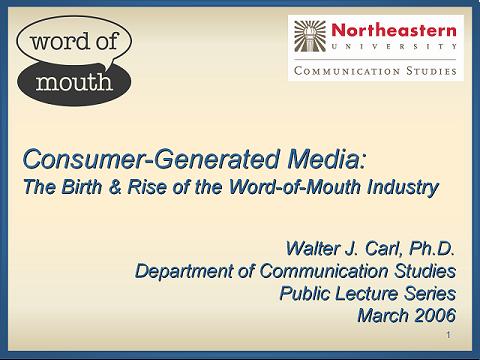 First of all, thanks to those who expressed interest in attending my recent public lecture on the birth and rise of the word-of-mouth industry. I had planned, and tried, to record it for a podcast but there were some technical difficulties :-(
So, I've added in very brief annotations to my slides to give a sense of what some of my points were. (The presentation was about 50 minutes so you might not have wanted to hear the whole thing anyway!). The annotations do make the slides a bit "busy" so I apologize in advance.
I would recommend looking through these if you are new to this emerging industry, though some of you with more familiarity might want to take a peek as well.
I certainly welcome comments and questions.
Download annotated slides here (PDF file; 4MB)
Tags --> consumer generated media word of mouth wom
---
This work is licensed under a Creative Commons Attribution-NonCommercial-NoDerivs 2.5 License.
Saturday, March 18, 2006
Consumer-Generated Media: The Birth of the Word-of-Mouth Industry
Here's an announcement that just went out on the Northeastern University e-mail system...
Please join Dr. Walter Carl of the Communication Studies Department for a public lecture:
Consumer-Generated Media: The Birth of the Word-of-Mouth Industry
Word-of-mouth and consumer generated media are hot topics now as companies struggle to break through a mediascape cluttered with advertisements, deal with a growing distrust of corporate-affiliated messages, figure out a consumer market that demands greater control and engagement, and try to understand how new communication technologies amplify peer-to-peer communication and influence, both in the online and offline worlds. In his talk Dr. Carl will discuss the resurgence of interest in word-of-mouth and how his research intersects with two of the biggest challenges facing this nascent industry: ethics and measurement standards. To learn more you can visit Dr. Carl's research blog at http://www.wom-study.blogspot.com
Wednesday, March 22, 2006
335 Shillman
Activities Period: 12:00 p.m. - 1:15 p.m.
For More Information Please Contact Meaghan Sinclair at m.sinclair@neu.edu
Tags --> consumer generated media word of mouth wom
Monday, May 02, 2005
Word-of-Mouth and the "Magic" of Everyday Talk: Focusing on the Process Not the Individual
This is the first of a number of posts where I will write about findings or conclusions from recent research projects on word-of-mouth (WOM) communication and buzz marketing practices. A more comprehensive discussion of these issues can be found in a manuscript I recently submitted for publication in an academic journal (more details in the coming months). For the time being, though, the theme of this posting is about how existing research on WOM has a tendency to focus more on the individual rather than on the relationships and communication processes between people.
I should note at the start that there's nothing intrinsically wrong with focusing on any one level of analysis rather than another; it's just that we need to be aware of how each perspective we take reveals certain understandings while concealing others.
There are a number of research traditions that seek to identify and label certain individuals or groups of people who engage in more WOM communication than others. For instance, there is a line of research that looks at "market mavens" (1). These people can be distinguished from the rest of the population based on the general level of expertise they have about the marketplace (rather than specific product knowledge) and also based on how they share, or are sought out for, this information. There is another tradition that looks at "Influential Americans," or people who are especially active in their local communities (2). Research has shown that both groups of people are sought out more frequently for information, as well as provide more information, to their friends and family members than members of the general population. Such findings have led some commentators to dub these people as "magical" (3).
Both lines of research offer interesting insights and compelling evidence for their positions. However, if we only focus on the individual-level of analysis -- that is, certain individuals or groups of individuals who do X, Y or Z, more or less than other individuals -- then we can get distracted from more fundamental communication and relationship processes. That is, the processes that make these people seem "magical" get obscured. The magic does not come from the people as individuals, but rather from underlying mundane, routine communication with others in their network of relationships.
For example, research has shown how seemingly trivial kinds of communication -- such as chit-chat, small talk, gossip, "chopping the carrots" (4), etc. -- form the basis for what we often consider "bigger" issues. Take social support, or the process we engage in when seeking or providing support to others. Communication scholars have shown that we base our decision to go to certain people when we need emotional support for the "big" issues in our lives on the multiple interactions we have with people on conversations on "small" matters, often unrelated to social support (5). It is through these interactions about other matters that we build a foundation of trust and gain a sense of who might be good in a situation when we need help. Even more interestingly, though, the everyday talk itself has been shown to be a crucial form of support. Through these mundane interactions we get confirmation of ourselves and how we make sense of the world.
The same principle of everyday communication applies to brand-related WOM. What makes certain individuals influential in our lives is all the conversations with them that are not brand, product, or service-related. It is through the everyday, mundane talk that leads us to go to them for "marketing"-related information, to trust their judgments, to respect their opinions, etc. We can conclude from this, then, that it is not the indivudals themselves who are influential, but rather what is influential is the process of everyday communication in networks of relationships.
What does this mean for curious people who want to better understand WOM and buzz marketing? First, invest time in learning about how everyday talk and relationships work (here's a chapter I wrote with a colleague to provide a helpful overview; this link opens a 3MB PDF file, beware!). I will also be reporting on studies of actual WOM conversations and how people move into, around, and out of, WOM "episodes" (sequences of evaluative talk about organizations, brands, products, and services). Second, if you are a company or a buzz marketing agency, focus on ways to engage with your consumer audience in ways meaningful to them on non-marketing topics. It is these interactions that will build the basis for brand, product, or service-related topics and decisions.
In the end, what makes word-of-mouth marketing powerful is not really about the marketing of a specific brand, product, or service. Instead, the "magic" grows out of people engaging one another, and often about topics on other matters.
NOTE: There is a lot of interesting research that takes a social network perspective to explain WOM behavior. See Reference (6) below for an early academic study on the topic, and also Emmanuel Rosen's book, The Anatomy of Buzz for a provocative and accessible discussion. Although social network research offers tremendously useful insights into the WOM process, it has a tendency to focus on just the structural position of people in a network (such as a "hub" or "bridge") rather than the underlying everyday communication and relationship dynamics that I discuss in this post.
References for this Posting
(1) Higie, R. A., Feick, L. F., & Price, L. L. (1987). Types and amount of word-of-mouth communications about retailers. Journal of Retailing, 63(3), 260-278. back
(2) Keller, E., & Berry, J. (2003). The influentials. New York: The Free Press. back
(3) Walker, R. (2004, December 5, 2004). The hidden (in plain sight) persuaders. The New York Times Magazine, p. 69. back
(4) "Chopping the carrots" is a phrase used by Dr. Julia Wood, a communication and relationships scholar, to refer to reviewing the day's events when doing mundane activities, such as chopping carrots for the evening meal. The phrase is also a chapter in a recently published volume (Composing Relationships: Communication In Everyday Life), edited by Dr. Julia Wood and Dr. Steve Duck, on the importance of everyday communication in our lives. back
(5) Leatham, G. B. & Duck, S. W. (1990). Conversations with friends and the dynamics of social support. In S. W. Duck and W. R. C. Silver (Eds.), Personal Relationships and Social Support (pp. 1-29). London: Sage. back
(6) Brown, J. J., & Reingen, P. H. (1987). Social ties and word-of-mouth referral behavior. Journal of Consumer Research, 14, 350-362. back
---
This work is licensed under a Creative Commons License.


