Showing posts with label To Tell Or Not To Tell?. Show all posts

Monday, May 19, 2008

New Academic Research on WOM: The Role of Disclosure in Organized Word-of-Mouth Marketing Programs

As a follow-up to my earlier post, I am excited to announce the release of my latest journal publication on word-of-mouth marketing communication. This piece was published in the Journal of Marketing Communications titled "The Role of Disclosure in Organized Word-of-Mouth Marketing Programs". If this title sounds like a familiar topic for me you'd be right as it is the the academic version of my industry research report "To Tell Or Not To Tell?: Assessing the Practical Benefits of Disclosure for Word-of-Mouth Marketing Agents and Their Conversational Partners”" published in January 2006. At the time the research received a lot of attention in mainstream and social media being cited in Advertising Age, The Atlantic Monthly, The Boston Globe, and Business Week, among others.

The publication of the academic journal article also comes out at a fortuitous time and venue. By timing, I'm speaking of the latest legal and public policies coming out of the UK concerning the issues of transparency and disclosure in advertising and marketing practices By venue, I mean that the editorial board of the journal has a heavy contingent of UK and European-based scholars.

(By the way, see the Word of Mouth Marketing Association's position on this important topic. It turns out this new UK legislation was not targeted at organized word of mouth marketing programs in particular but it cast a much wider net in terms of unfair marketing and advertising practices in an effort to protect consumers from deception and other unethical practices).

OK, so to the content of the article. Here's the abstract:

Prevailing views of organized word-of-mouth (WOM) marketing programs suggest that disclosing corporate affiliation reduces perceived credibility and hampers campaign effectiveness. To test this view we surveyed WOM marketing agents and their conversational partners (CP) after a WOM marketing episode. Results indicate that when disclosure occurred – defined as when the CP was aware they were talking with a person participating in an organized WOM marketing program – agents were rated as more credible, CPs had fewer negative feelings about the agent’s corporate affiliation, and CPs told more people about the brand being discussed. These counter-intuitive results can be explained in part by the existing personal relationship between the agent and CP and invite us to consider how personal relationships may moderate the impact and potential business advantages of disclosure in organized WOM marketing programs.
If you read the To Tell or Not To Tell? report I STRONGLY encourage you to read the academic version of the article because it goes into a lot more detail and nuance about the research, the results, and the limitations.

The main difference is that the academic venue afforded more of an opportunity to underscore the importance that the underlying relationship plays in explaining the counter-intuitive results of the research. In fact the results that support the business case for disclosure -- higher perception of source credibility, higher relay rates when disclosure occurs (meaning more people were subsequently told about the product), and minimizing the potential for "backlash" if a person doesn't disclose but then the person they're talking with later finds out they were part of an organized marketing program) -- can be explained in large part by the pre-existing relationship between the people talking. The act of disclosure played a role in explaining the phenomena but not as much as the type of relationship between the people talking.

This implies that the same results may not be as salient when you're talking with someone you don't know very well, or at all, and disclose that you're participating in a marketing program. In these situations, because people may not know anything else about you as a person and your motives, then this disclosure may indeed diminish the program participant's credibility and diminish the perceived sincerity and effectiveness of the recommendation. And this is precisely the reason why there are consumer protections in place, and that's because non-disclosure may indeed make a difference in how people perceive the brand-related communication, even if there aren't any spurious motives (as in many things, perception is the reality).

But if you have an existing relationship (for example, friend, family member, co-worker) the act of disclosure is welcomed or a non-issue because this bit of information is contextualized by the history of all the other interactions the people have shared.

I believe there are a lot of significant implications to this research and underscores the importance of understanding the many contextual features that affect how people interpret each others' communication.

If you think you'd find this article interesting you can download it from the publisher's website here or a pre-press version from my download page (but if you're going to cite the paper be sure to cite the published version).

-->
Tags:

Friday, January 19, 2007

Response to Justin Kirby's Comments About To Tell Or Not To Tell? Report

Recently Justin Kirby of Viralmeister posted on his blog, and left a comment on my blog post, regarding concerns he had about the methodology of my research report "To Tell Or Not To Tell?" So that other interested readers could follow along I wanted to "promote" his comment to its own blog post and respond. I apologize in advance for this being a long post but I think it's important to address each concern in detail (and besides, it's an occupational hazard for me to provide verbose explanations -- ask my students, they'll tell you).

Justin was responding to my post on a recent study by Alain Samson at the London School of Economics (I pull excerpts for the sake of space; see Justin's full post):

... To his credit Dr Carl does point out that not everyone is cheer leading the Net Promoter Score and makes some valid points about the need to see the methods and results used in the analysis in order to assess the merits of this latest research from the London School of Economics. ... Anyway, I was mildly amused about Dr Carl’s stance on methodology because I felt the same way about his research on Bzzagent’s model (To Tell or Not to Tell), which by his own admission was based on Bzzagent’s internal analysis of the 270,000 word-of-mouth reports from their own agents. I’d love to see how Dr Carl adjusted for bias of not only Bzzagent’s internal analysis of the reports, which is far from objective, but also the bias of the reports from a ‘trained’ group who are both directed and incentivised to spread the word.

I just wonder where the control group was because I’m dubious about solely using a panel which has been designed to leverage the Hawthorn[e] Effect rather than a more conventional research panel that tries to adjust for this kind of bias. Maybe Dr Carl could put me right on this because I can’t help thinking that facts were fitted to theories about disclosure which fly in the face of Attribution Theory.

I'd like to take the opportunity to respond to Justin's comments to clarify his valid points from apparent misunderstandings of my research. For a quick overview of the main findings of the To Tell Or Not To Tell? report please read here (the full report can be downloaded as well).

First, the To Tell Or Not To Tell? (TTONTT) report was not based on "BzzAgent's internal analysis of the 270,000 word-of-mouth reports from their own agents." This was mistakenly reported in a ClickZ article entitled "BzzAgent to Agents: Spill the Beans, Or Else." I wrote a blog post to clarify the mistake in that article, which Justin linked to, so I would encourage Justin and other interested readers to re-read that post. As I wrote in that post, BzzAgent prepared their own white paper citing internal reports of their agents; none of the findings from TTONTT relied on those reports so there was no bias to adjust for regarding a separate analysis conducted by BzzAgent.

Second, Justin was concerned about the "bias of the reports from a ‘trained’ group who are both directed and incentivised to spread the word." Here again, this is a misunderstanding of the TTONTT methodology. I employed a dyadic methodology that relied on surveys completed by BzzAgents (not the internal reporting done by BzzAgents as part of a campaign, but surveys completed as part of this specific TTONTT research project) and their conversational partners (the people they talked with about the brand, product, or service). To account for any potential bias in the BzzAgent's responses to the TTONTT survey we validated their responses with their conversational partners' responses. So, for example, if a BzzAgent said they disclosed but the Conversational Partner said they didn't disclose, this was noted as a discrepancy, and the discrepancy results were fully reported and accounted for in the analysis on pages 10-11 of the report.

Third, Justin wondered where the control group was because he is:
dubious about solely using a panel which has been designed to leverage the Hawthorn[e] Effect rather than a more conventional research panel that tries to adjust for this kind of bias. Maybe Dr Carl could put me right on this because I can’t help thinking that facts were fitted to theories about disclosure which fly in the face of Attribution Theory.
Justin's point about a control group is valid and I appreciate the opportunity to respond. The TTONTT report was part of a larger project where we were trying to understand multiple perspectives on the same interaction -- the BzzAgent's and the Conversational Partners' (many studies rely on just one person's perspective) -- and also to determine how Conversational Partners were affected by talking with a participant in a word-of-mouth marketing program. And then, in addition, the study was to look at what role disclosure of the agent's affiliation with a WOM marketing company might be.

The study did not employ a control group where we gave instructions to some agents to disclose their identity, other agents to not disclose their identity, and then another group where no instructions regarding disclosure were given (the third group here could be used as a control group). The reason for not doing this was because it would have violated BzzAgent's policy surrounding disclosure, which required agents to disclose their identity (see page 8 of report). Instead, what we did was to conduct the analysis by comparing two groups after we collected the data: 1) Conversational Partners who knew they were talking with someone affiliated with a word-of-mouth marketing company and 2) Conversational Partners who did not know the agent's affiliation. NOTE: I relied on the Conversational Partners' responses (that is, non-Agents) for most of the analyses, except when I conducted the discrepancy analyses where I matched the BzzAgent's survey response to the Conversational Partners' survey responses.

By doing this post-hoc analysis, rather than using a field-based quasi-experimental design, or a laboratory-based experiment, this study has limitations, as all studies do (and there are other limitations to the study as well, all discussed in the report on pages 20-21). For example, we found that there was no difference between the outcome variables between the two groups (no difference in a conversational partner's likelihood to inquire further, to use the product/service, to buy the product/service, or to tell others about the product/service). But we did find that people who knew of the agent's affiliation told more people about the product/service. Because we didn't use an experimental design we can't conclude that disclosing agent affiliation led to higher pass-along or relay rates (more people being told). We can only say that conversational partners reported higher pass-along rates in conversations where they knew they were talking with someone affiliated with a WOM marketing program. However, while noting this limitation there are a number of important results that are, as Justin rightly points out, at odds with what we would expect from attribution theory (see my blog post responding to some of these counter-intuitive results; for readers unfamiliar with attribution theory as it relates to WOM, see Greg Nyilasi's chapter in the Connected Marketing book that Justin edited with Paul Marsden).

I was surprised myself by a number of results from this study -- this is the great thing about conducting original research -- so it would be inaccurate to say "that facts were fitted to theories about disclosure which fly in the face of Attribution Theory." But when you dig deeper into the analysis you find something that's pretty interesting and it's that attribution theory may still apply, as long as you take into account the relationship between the BzzAgent and the Conversational Partner. Here's what I mean...

If you're talking with a stranger or acquaintance -- people you don't know particularly well, or at all -- and the only thing you know about them is that they're part of a particular kind of WOM marketing campaign, then you might be more likely to question the person's credibility to give an unbiased opinion or an opinion that may not be in your best interest (in fact, some of the data I had about interactions with strangers actually trended in this direction; however since most BzzAgents speak with friends and family members (see page 6), rather than going up to strangers, we didn't have enough strangers to make valid statistical comparisons). However, if you know a person in a range of different contexts and have talked with them before, and know from those interactions that they generally have your best interests at heart, you're much less likely to question their sincerity when they share their opinion about the brand, product, or service. I think that because there was a high number of "stong-tie" relationships between the BzzAgents and Conversational Partners, this explains a good bit about why the results turned out the way they did (both BzzAgent's internal research and my own research partnering with them shows that the majority of the conversations are with already-known others).

Finally, Justin also expressed concern about a using a business model that's designed to leverage the Hawthorne Effect (meaning that people's behaviors will be affected by the act of giving people attention and making people feel more involved, which is what many WOM markting programs seek to do in order to stimulate WOM; interested readers should see Paul Marsden's chapter on product seeding programs in Connected Marketing). Here, again, I would reiterate that I surveyed Conversational Partners, in addition to the BzzAgents, who were not affiliated with the WOM marketing company. I would also offer that the study should be repeated with a wide range of different models and techniques of WOM marketing programs.

I hope that there are still a few readers who have made it to this point of the blog post! :-) I apologize for the length of this, but I appreciate the opportunity to clarify the study and I invite others to challenge the results and engage with the study so that we can achieve a better understanding of the role of disclosure in WOM marketing programs.

Justin, does this address all of your concerns?

Download the full version of the To Tell Or Not To Tell? report, as well as other papers I've written, for free at my download page


UPDATE (01/22/2007): Justin Kirby has posted a response to my response.

-->
Tags:

Wednesday, March 15, 2006

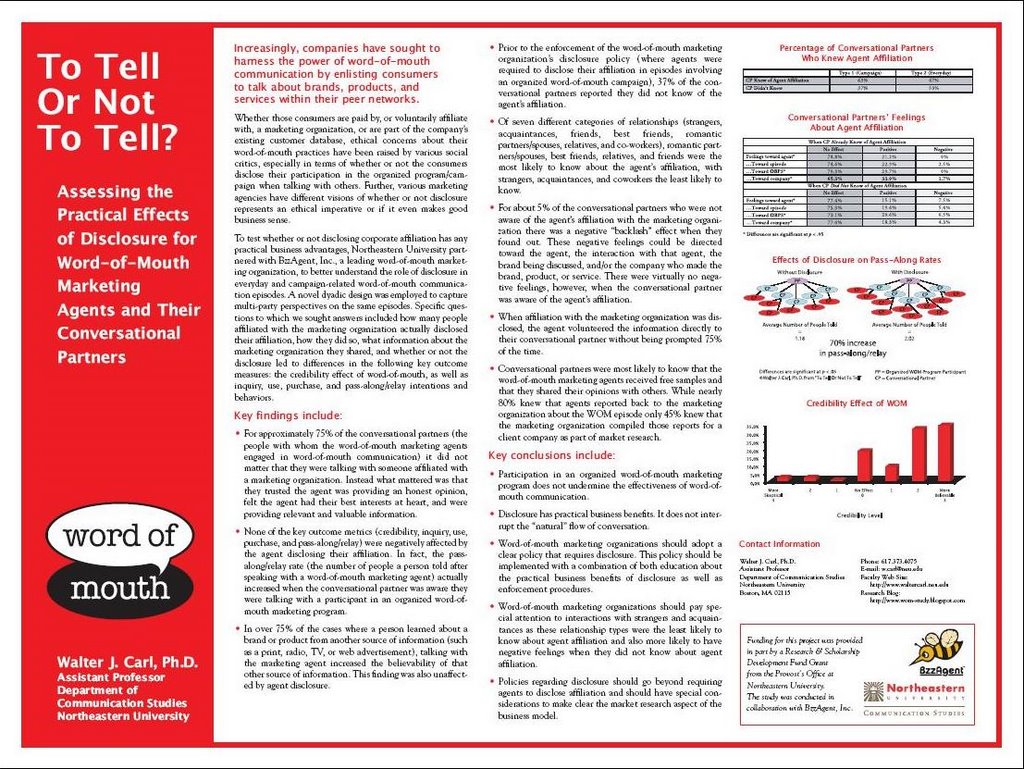
To Tell Or Not To Tell? Poster Presentation at Northeastern University's Research Expo 2006

I'll be presenting a poster of my research on the role of disclosure in organized word-of-mouth marketing programs at Northeastern University's Research Expo today. The Research Expo showcases the work of faculty members and students at NU over the past year.

Wednesday, January 25, 2006

To Tell Or Not To Tell?: Question About If Inundation and Repetitive Experiences With WOM Agents Decreases Credibility

Over the past few days I've had the chance to talk with bloggers, journalists, and authors about findings in the "To Tell Or Not To Tell?" report. One issue that has surfaced in a couple of the interviews relates to what happens if, and/or when, people start to become inundated with agents who participate in organized WOM marketing programs; will non-agents become less accepting of the message? [Note that "agent" is being used here generically to refer to any participant in an organized WOM marketing program].

I wanted to reproduce a specific exchange I had over e-mail about this issue (it's actually a follow-up to my last post with Isaac from Chapell Associates). What follows is the question and then my response.

In the Ad Age article covering the release of your study, you're quoted as saying:
“There’s a sense if there’s an organized word-of-mouth marketing program there must be something interesting about it...There’s a sense that a company wouldn’t do this unless there was something interesting or new about the product.”
Correct me if I'm wrong, but part of this seems to be that consumers aren't used to being approached as part of a WOM program - so it seems important and exciting. This makes sense to me, but it makes me wonder: if WOM became more prevalent, and consumers got many a "recomendation" via WOM agent, would they be less accepting of the messages?

This is, to some degree, a question of inundation - how much WOM are consumers willing to accept? Are repeated experiences with WOM likely to increase or decrease their trust of the recommendations provided by WOM agents?
Here's my response:
Thanks for your question and you raise a valid point. First, let me respond with some background to the quotation that appeared on AdAge.com. I was asked to explain why I thought the number of pass-alongs (how many people a person told after talking with a WOM agent) was higher when there was disclosure. I think there may be three reasons: 1) conversational quality scores were also higher when there was disclosure (that is, those conversations were rated as more informal, personal, relaxed, and in-depth); 2) credibility scores were higher, specifically that there were higher ratings of trustworthiness (being genuine and ethical) and goodwill (feeling like the other person had their own interests at heart); and 3) there's a sense of being "in the know" when you receive information that's part of an organized WOMM program (because it might be a new product or something especially interesting about an existing one in order to warrant being part of an organized program). The AdAge quotation came from my explanation of this third point.

I provide this background because I think organized WOMM programs will only be effective when they incorporate the three bedrock principles of all WOM: trustworthiness, goodwill, and relevance. That is, WOM works because we feel the other person has our best interests at heart and we view them as a reliable, trustworthy source of relevant information.

In terms of your question about how much WOM are people willing to accept, I think we need to reflect on how WOM is being used here. WOM can be seen as part of a larger philosophy of engagement, listenting, responsiveness, involvement, etc. as well as a specific set of activities or tactics (such as a campaign). I think you're talking about the latter in your question and I don't know what the threshold is for exposure to organized WOMM campaigns. But again, I think it all goes back to if people perceive the program is facilitating the exchange of relevant, credible information within the context of a trusted relationship.

I also don't know if repeated experiences with a WOMM program lead to more or less credibility in a message or towards a specific person. But I think this one is easier to answer because it would probably be like any other experience and depend on the quality of the recommendation and the relevance of that recommendation to our lives. If people's experience with organized WOMM programs help them to make better decisions, feel more in the know, feel like they can help others better, etc., then I think repeated experiences will lead to higher credibility. If the converse is true then I think people will begin to lose any belief in the value of the organized WOMM programs.

One final comment, you write about people not accustomed to being approached by WOM agents, but I don't know if this is really how it works, at least based on my research. That is, it's not like agents are going around like a salesperson might, door-to-door, and trying to make contact with a certain number of people (granted, some participants might do this or some companies might encourage their participants to do this, but if they are, I think this is a very unwise approach). Rather, the brand-related talk is more likely to come up in relevant points of existing conversations. For example, based on some recent findings, only 24% of campaign-related WOM episodes were planned in advance by the agent, suggesting that 76% came up spontaneously, or at least without an existing idea that they were going to talk about it. And then we'd need to look at the 24% that were planned because an agent might be looking forward to telling someone about the brand, either because of a positive or negative experience with it (that is, as opposed to "plotting" a time to enter it into a conversation). So in sum, to the extent that agents are going up to people and talking about the brand when it's not relevant to the other person, or not a relevant point in the conversation, then I think there is a problem, and people will not accept this type of model and will have a strong desire to "tune out."
Thanks, and again, let's keep the discussion going!

---

Creative Commons License

This work is licensed under a Creative Commons License.


Tags:

Saturday, January 21, 2006

Explanation for Counter-Intuitive Findings in "To Tell Or Not To Tell?"

I've had a great response from the blogosphere to my research report on disclosure and organized word-of-mouth marketing programs (see also the AdAge.com article). Some people are surprised by what seem to be counter-intuitive findings in the study, especially in terms of why consumers might not be more skeptical after learning of a person's commercial affiliation through their participation in an organized WOM marketing program. For example, Isaac from the Chapell Associates blog posted this:

I must to say I'm surprised by the report's findings. Intuitively, we like to think of recommendations as just someone liking a product and then telling others about it - "here, try this brand of coffee, I really like it," not "here, try this brand of coffee, the company that makes it tells me it's really good." To be totally honest: I can't see why consumers, having been told that someone has a commercial relationship with an advertiser, wouldn't be more skeptical of that person's recommendation.
Here's three reasons why I think credibility may be the same or higher when there is disclosure in an organized word-of-mouth marketing program (I presented some of these points in my talk at the WOMMA Basic Training conference on Thursday):

1) In a clear majority of the cases there was an existing personal relationship between the agent (a person participating in the organized WOM marketing program/campaign) and their conversational partner (the person with whom they were talking). In fact, the median length of time the two knew each other was about 6 years. That existing relationship implies a history of conversations about brand-related and non-brand-related topics. In those conversations that aren't related to the organized program the conversational partner builds up trust and credibility in the other person (the agent). Thus, the fact that the person/agent is participating in the program is contextualized by all the other conversations and history of their relationship. That is, in many cases, the conversational partner is likely to feel like it doesn't matter that the person is in the campaign because s/he has my best interests at heart, I know I can trust her/him becasuse of our other interactions, and I know s/he is providing information that would be valuable and relevant to me.

2) A second reason credibility is unaffected, or may even be higher, when disclosure takes place has to do with the fact that the act of disclosing affiliation might be interpreted as a marker of honesty and credibility. That is, the conversational partner hears the disclosure and realizes the person isn't trying to be deceptive or pulling something over on them.

3) Additionally, I don't think many of the conversations play out as the hypothetical scenario you created might indicate. You wrote:
"here, try this brand of coffee, I really like it," versus "here, try this brand of coffee, the company that makes it tells me it's really good."
I don't have actual recordings of the interactions but I do have narrative accounts. A more likely scenario might be:

"hey I got some new coffee from company x as part of this campaign I'm in. It's a bit strong for my taste but I think you'd like it."

Part of the point with my admittedly hypothetical scenario (I didn't use an actual excerpt because I wanted to keep it as close as possible to your example for illustration purposes) is that, while people do receive information about the product from the company, they also try it out for themselves and then tell others what they think about it. Thus, the participants are spreading WOM based on their own experience with the brand, product, or service not (just) what the company said.

Thanks for the comment Isaac!

Disclosure is a crucial topic in the word-of-mouth marketing industry so please pass-along the link to download the study to anyone who might be interested in reading the report. Let's keep the discussion going!

---

Creative Commons License

This work is licensed under a Creative Commons License.


Tags:

Wednesday, January 18, 2006

To Tell Or Not To Tell? -- Research Report on Disclosure & Organized Word-of-Mouth Marketing Programs Now Available!

I am excited to announce that my research report on disclosure and organized word-of-mouth marketing programs is now available free of charge at my download page. The report is a result of a major industry-academic collaboration between BzzAgent, Inc. and Northeastern University.

My hope is that the report will stimulate discussion about the role of disclosure in organized word-of-mouth marketing initiatives and I invite thoughful commentary and criticism. If you are so inclined to blog about the report, please provide a trackback and a link to my download page -- http://www.waltercarl.neu.edu/downloads/ -- rather than uploading the file to your server. Also, please feel free to write comments to this post.

Below is a summary of the main findings...

• For approximately 75% of the conversational partners (the people with whom the word-of-mouth marketing agents engaged in word-of-mouth communication) it did not matter that they were talking with someone affiliated with a marketing organization. Instead what mattered was that they trusted the agent was providing an honest opinion, felt the agent had their best interests at heart, and were providing relevant and valuable information.

• None of the key outcome metrics (credibility, inquiry, use, purchase, and pass-along/relay) were negatively affected by the agent disclosing their affiliation. In fact, the pass-along/relay rate (the number of people a person told after speaking with a word-of-mouth marketing agent) actually increased when the conversational partner was aware they were talking with a participant in an organized word-of-mouth marketing program.

• In over 75% of the cases where a person learned about a brand or product from another source of information (such as a print, radio, TV, or web advertisement), talking with the marketing agent increased the believability of that other source of information. This finding was also unaffected by agent disclosure.

• Prior to the enforcement of the word-of-mouth marketing organization’s disclosure policy (where agents were required to disclose their affiliation in episodes involving an organized word-of mouth campaign), 37% of the conversational partners reported they did not know of the agent’s affiliation.

• For about 5% of the conversational partners who were not aware of the agent’s affiliation with the marketing organization there was a negative “backlash” effect when they found out. These negative feelings could be directed toward the agent, the interaction with that agent, the brand being discussed, and/or the company who made the brand, product, or service. There were virtually no negative feelings, however, when the conversational partner was aware of the agent’s affiliation.
... and key conclusions:
• Participation in an organized word-of-mouth marketing program does not undermine the effectiveness of word-of-mouth communication.

• Disclosure has practical business benefits. It does not interrupt the “natural” flow of conversation.

• Word-of-mouth marketing organizations should adopt a clear policy that requires disclosure. This policy should be implemented with a combination of both education about the practical business benefits of disclosure as well as enforcement procedures.

• Word-of-mouth marketing organizations should pay special attention to interactions with strangers and acquaintances as these relationship types were the least likely to know about agent affiliation and also more likely to have negative feelings when they did not know about agent affiliation.

• Policies regarding disclosure should go beyond requiring agents to disclose affiliation and should have special considerations to make clear the market research aspect of the business model.

Many thanks to all the agents and conversational partners who participated in this study!

Click on the links below for other posts on this blog regarding disclosure and word-of-mouth marketing:

- Clarification in ClickZ's Story "BzzAgent to Agents: Spill the Beans, Or Else"

- The Practical Value of Disclosure in Word-of-Mouth Marketing Campaigns

- How Much Can You Trust Buzz?

- Do You Know of Video Clips about WOM, Buzz, and/or Undercover/Stealth Marketing?

- Faked Out By BK?

- Campus Ambassador Programs, Buzz Marketing, and Disclosure

- On Affiliation with a Buzz Marketing Agency, Disclosure, and Shopping in a Supermarket -- Part 2

- On Affiliation with a Buzz Marketing Agency, Disclosure, and Shopping in a Supermarket -- Part 1

---

Creative Commons License

This work is licensed under a Creative Commons License.


Tags:

Monday, January 16, 2006

Sneak Peek at "To Tell Or Not To Tell?"


To coincide with WOMMA's Basic Training conference I'll be releasing a major report on disclosure and organized word-of-mouth marketing programs.

Starting January 18th copies of the report can be downloaded free of charge at my download page. A special page will be set up on my blog for comments and discussion of the findings.

My talk at the conference is entitled "To Tell Or Not To Tell?: Managing Effective Word-of-Mouth Marketing Programs Based On Why People Talk (and Listen!)"

Tags: