Showing posts with label Stealth Marketing. Show all posts

Monday, May 19, 2008

New Academic Research on WOM: The Role of Disclosure in Organized Word-of-Mouth Marketing Programs

As a follow-up to my earlier post, I am excited to announce the release of my latest journal publication on word-of-mouth marketing communication. This piece was published in the Journal of Marketing Communications titled "The Role of Disclosure in Organized Word-of-Mouth Marketing Programs". If this title sounds like a familiar topic for me you'd be right as it is the the academic version of my industry research report "To Tell Or Not To Tell?: Assessing the Practical Benefits of Disclosure for Word-of-Mouth Marketing Agents and Their Conversational Partners”" published in January 2006. At the time the research received a lot of attention in mainstream and social media being cited in Advertising Age, The Atlantic Monthly, The Boston Globe, and Business Week, among others.

The publication of the academic journal article also comes out at a fortuitous time and venue. By timing, I'm speaking of the latest legal and public policies coming out of the UK concerning the issues of transparency and disclosure in advertising and marketing practices By venue, I mean that the editorial board of the journal has a heavy contingent of UK and European-based scholars.

(By the way, see the Word of Mouth Marketing Association's position on this important topic. It turns out this new UK legislation was not targeted at organized word of mouth marketing programs in particular but it cast a much wider net in terms of unfair marketing and advertising practices in an effort to protect consumers from deception and other unethical practices).

OK, so to the content of the article. Here's the abstract:

Prevailing views of organized word-of-mouth (WOM) marketing programs suggest that disclosing corporate affiliation reduces perceived credibility and hampers campaign effectiveness. To test this view we surveyed WOM marketing agents and their conversational partners (CP) after a WOM marketing episode. Results indicate that when disclosure occurred – defined as when the CP was aware they were talking with a person participating in an organized WOM marketing program – agents were rated as more credible, CPs had fewer negative feelings about the agent’s corporate affiliation, and CPs told more people about the brand being discussed. These counter-intuitive results can be explained in part by the existing personal relationship between the agent and CP and invite us to consider how personal relationships may moderate the impact and potential business advantages of disclosure in organized WOM marketing programs.
If you read the To Tell or Not To Tell? report I STRONGLY encourage you to read the academic version of the article because it goes into a lot more detail and nuance about the research, the results, and the limitations.

The main difference is that the academic venue afforded more of an opportunity to underscore the importance that the underlying relationship plays in explaining the counter-intuitive results of the research. In fact the results that support the business case for disclosure -- higher perception of source credibility, higher relay rates when disclosure occurs (meaning more people were subsequently told about the product), and minimizing the potential for "backlash" if a person doesn't disclose but then the person they're talking with later finds out they were part of an organized marketing program) -- can be explained in large part by the pre-existing relationship between the people talking. The act of disclosure played a role in explaining the phenomena but not as much as the type of relationship between the people talking.

This implies that the same results may not be as salient when you're talking with someone you don't know very well, or at all, and disclose that you're participating in a marketing program. In these situations, because people may not know anything else about you as a person and your motives, then this disclosure may indeed diminish the program participant's credibility and diminish the perceived sincerity and effectiveness of the recommendation. And this is precisely the reason why there are consumer protections in place, and that's because non-disclosure may indeed make a difference in how people perceive the brand-related communication, even if there aren't any spurious motives (as in many things, perception is the reality).

But if you have an existing relationship (for example, friend, family member, co-worker) the act of disclosure is welcomed or a non-issue because this bit of information is contextualized by the history of all the other interactions the people have shared.

I believe there are a lot of significant implications to this research and underscores the importance of understanding the many contextual features that affect how people interpret each others' communication.

If you think you'd find this article interesting you can download it from the publisher's website here or a pre-press version from my download page (but if you're going to cite the paper be sure to cite the published version).

-->
Tags:

Monday, February 04, 2008

Yikes! How To Write A Pay-Per-Post Blog!?!

While I was doing some research online yesterday I came across a "How To" website (eHow.com) about how to write a Pay Per Post blog post.

As background, Pay Per Post's business model is to match bloggers and advertisers together: advertisers who want people to write about their products on their blog with bloggers who want to make money doing so. The blogger's deliverable is the post with a brand mention that conforms to any guidelines that the advertiser sets up.

This has been quite a controversial practice since its inception, as it represents a form of shilling. Further, Pay Per Post's initial policy was not to require, or even encourage, disclosure that the person was getting paid to write about the product. Pay Per Post's policy has since changed, coincidentally timed, it seems, with discussions by the FTC and disclosure.

Anyhow, the author sets up the article by saying "This article will help you learn how to rise above the competition and produce higher quality paid posts that your sponsors and readers will love."

Point #1 is to think long term and write a quality post since the advertiser will rate the quality of the post behind-the-scenes: "So while it may be easy to write a quick post for $5, it's better to invest a bit of extra time to understand what your advertiser wants out of the deal." This is concerning because then your endorsement is more for the advertiser than for the other people you are talking with (though the author suggests that you can still write a post your readers will enjoy).

Point #2 is to "Be Honest" about your opinion with the product ("If you lie, they are paying for a false testimonial. This can hurt their company, ruin your reputation as a writer and can get you banned."). OK, fine, honesty of opinion (which is WOMMA's second point in their Honesty ROI guidelines). But nothing about honesty being the ethical thing to do. The author adds the point about being relevant: "Instead, think about reasons why you might use their service or product. How would it help you? How can it help your visitors?"

But then the really strange part is point #3. The blogger says that writing a Pay Per Post blog is "secret" and that "If you want future work, don't tell your readers that you are writing paid posts. This includes filtering the posts into a "paid post" category, or tagging them as such. You are basically telling your sponsor that you are embarrassed to write about them."

I was shocked to read this. I'm not sure if my surprise has more to do with the logical inconsistency between point #2 (be honest) and #3 (don't tell people you are getting paid), or because just point #3 on its own being unethical.

I thought maybe this post was written a few years ago because people don't still think that hiding their identity is the way to go. But no, the post date is January 14, 2008.

Anyhow, folks if you are thinking about participating in the Pay Per Post or similar programs please check out the WOMMA Ethics Code as part of your decision to participate. And if writing a post about how to do it, please consider this.

-->
Tags:

Sunday, September 30, 2007

Is Ford's "Swap Your Ride" Program an Example of Stealth Marketing?

I've noticed the Ford commercials where everyday car drivers were able to swap their non-Ford cars with a Ford vehicle for one week so that they could experience what the Ford vehicle was like. In the commercial, and on the Swap Your Ride's website, Ford was very up front that they didn't tell the people whose cars were swapped that the camera crews were from Ford and instead told them they were doing "market research" (if you watch the "Behind the Scenes" video at the website they justify doing this because Ford wanted the drivers' honest opinions). Ford videotaped each person's experience and promoted these stories in the commercial and on the website, again without telling the people the film crews were from Ford.

In order to actually make the commercial or put these people's stories on the website I'm sure Ford had to secure the people's permissions and at that time they must have found out Ford was behind this. So it seems like we have an example of "delayed disclosure" going on here.

This makes a great case study for one of my classes. Here's a question I would pose to my students: Is the Ford "Swap Your Ride" program an example of stealth, or undercover, marketing? And if so, is this unethical? First, a definition. The Word of Mouth Marketing Association (WOMMA) defines stealth marketing as: "Any practice designed to deceive people about the involvement of marketers in a communication."

Second, we need a set of criteria to work with. Let's use WOMMA's Honesty ROI guidelines to briefly work through this case. Why is this an appropriate set of guidelines? Is this a WOM marketing program, and if so, how? I would contend it is because the marketer is using stories or testimonials from everyday people about their product-related experiences in order to engage an audience and promote their brand.

Of the honesty of relationship, opinion, and identity, it seems that this program initially fails on the first but is OK on the second and third. Specifically, Ford didn't have its crew disclose the fact that they were working for Ford and instead said they were market researchers (violates honesty of relationship). The people in the video seemed to be real people (that is, not actors or employees of the company, or otherwise paid or compensated beyond getting the chance to drive a new car around for a week; so honesty of identity seems OK here). And these real people seem to be providing their own unscripted, honest assessments (honesty of opinion; though it's clear the comments were edited and we have no access to any negative comments anyone might have said). Interestingly the video on the website uses the language of "Real people. Real opinions." which supports the analysis so far.

So, according to WOMMA's Honesty ROI ethical framework, this really comes down to an issue of disclosure of the marketer's relationship. There was an intent to deceive but it was justified on the grounds of soliciting people's honest opinion. And Ford came clean about it to the larger audience in their commercial and in the video. (Interestingly, this deceit is also carried out in academic research, as long as the benefits of doing so outweigh the costs, that the disclosure eventually occurs, and that no one gets hurt in the process.)

So, let's think about if anyone got hurt here. The drivers are getting to drive around in a new car for a week and show it off to their friends which juices their sense of being special. There could be a feeling of being "duped" and there may have been some backlash. And this may have had the effect of undermining credibility in marketing activities or making it that much more difficult for real market researchers to do their work (see the Market Research Society's Code of Conduct for interesting thoughts on this; of course the people doing the commercial aren't actually market researchers so they wouldn't be bound by such guidelines).

Ford must have done all their legal due diligence about the deception. It's probably legal since the larger audience in the commercial or video was informed that Ford was deceiving people for the purposes of filming the videos. It seems that it comes down to the following: in what situations is "delayed disclosure" (un)ethical*? Is disclosure a black or white issue or are there shades of gray? And does the WOMMA Honesty ROI or The Ethics 20 Questions give us the tools to make this decision?

What do you think?

* The issue of delayed disclosure is addressed by Justin Foxton in the book Connected Marketing (chapter titled "Live buzz marketing") so interested readers can also turn there.

-->
Tags:

Wednesday, December 20, 2006

Flog Alert Repository?; Company Training About Ethics Violations

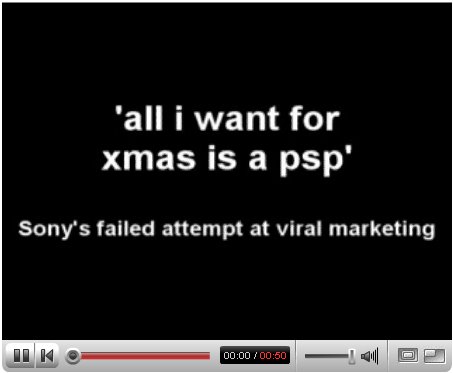
Does anyone know of a central place where people are keeping a list of all the companies who have engaged in stealth marketing (including flogs, or fake blogs)? The latest flog (over a week old now) seems to be Sony for their PSP: alliwantforxmasisapsp.com (see links below for stories covering this development; of course is not the first time for Sony as they messed around with stealth marketing with the Sony Beta 7 as well).

Sony, or at least one part of Sony, is a member of the Word of Mouth Marketing Association (for which I'm an advisory board member), so I would hope that at least some representatives from their company are learning about how social media works and the ethics involved so that no part of their company continues the use of stealth tactics.

The viral marketing firm that created the flog for Sony is Zipatoni (not a WOMMA member). According to a report in a MediaPost article, a person claiming to be a Zipatoni representative contends they advised Sony that there might be this backlash, but their client went ahead with it anyway (this information should be treated with caution, though, because none of this has been confirmed).

Anyway, this story, the Edelman fake blog scandal with Wal-Mart, and many other companies point to the importance of the education work that needs to be done within corporations about social media and ethics. At the latest WOMMA Summit in D.C. Rick Murray from Edelman gave an update on how his company has implemented a mandatory training program for all their employees. Further, they set up a 24/7 hotline where anyone around the world can call in with questions to make sure they are behaving in an ethically approriate way. They also engaged in a review of all their existing programs to ensure that there are no further violations of the WOMMA Ethics Code (at the time of the presentation they were 98% done). Read this post for more details about what Edelman is doing in response.

Other links about the Sony fake blog for PSP:

Sony 'fesses to fake blog. Still gets it wrong. -- Michael O'Connor Clarke

Oh Sony, What Were You Thinking? -- David Binkowski

Sony pays PR firm to lie about wanting a PSP for Christmas -- Videogamesblogger.comSony's holiday marketing campaign sniffed out -- Engadget

Sony Confesses To Creating 'Flog,' Shutters Comments -- Media Post Article

And be sure to check out the following link for a YouTube video created by gamers essentially saying that Sony is stupid for thinking that gamers are stupid and wouldn't figure out the flog.

Thanks to Constantin Basturea for some of the links above.

-->
Tags:

Friday, October 28, 2005

Faked Out By BK?

Seth Stevenson writes a nice piece where he wonders if he's been faked out by an e-mail he received for the Burger King "King" Mask.

Well worth a read, but I'd make a similar comment as I did in an earlier post about use of terminology. Here's a quote from Seth's article:

But let's assume for a moment that Crispin [the agency responsible for the BK "King" account] used "buzz marketing" to fake me out and get my attention (as I'm convinced they did). Is there anything wrong with that?

Should Seth have written "undercover marketing" to imply the practice might be deceptive rather than "buzz marketing"?