Thursday, April 13, 2006

Social Critiques of Peer-to-Peer and WOM Marketing Programs, Take 2: Release of Sales Pitch Society II

In an earlier post I wrote about the various social critiques of peer-to-peer and word-of-mouth marketing efforts. In that post I mentioned a piece written by Kate Kaye called Sales Pitch Society (opens into PDF). In that work Kate was concerned that participants in corporate-sponsored marketing programs were unreflectively becoming "brand vessels" and wondered whether people really believe in the messages they are spreading about brands.

On Monday, Kate released Sales Pitch Society II, an updated version of her analysis. In this latest edition, for which I was interviewed and cited, Kate wants the reader to reflect on how organized word-of-mouth marketing affects our social fabric, relationships, and our own identities as being defined by brands. She argues that people who participate in organized WOMM programs "are condoning the deliberate injection of brands into their conversations. In essence people are facilitating their own exploitation, merely because marketers have asked them to" (p. 38). She cites a number of reasons for this:

empty lives, the desire for belonging, acceptance and insider knowledge, even sheer materialism. (p. 38)
Kate feels that proponets of organized WOMM programs are being seduced by their own rhetoric, drawing a comparison to Orwellian newspeak:
Could it be that WOM marketers have been spewing this Orwellian newspeak for so long, even they’'ve fallen prey to it? This time, the doublethink slogans are not “War Is Peace, Freedom Is Slavery, Ignorance Is Strength.” They'’re more along the lines of: Evangelism is Empowerment, Loyalty is Control, Influence is Altruism
Kate further expands her critique into the world of consumer generated media, arguing that the digital amplification of WOM in the form of CGM may lead us to forsake our human "in-the-flesh" relationships. She writes "Consumer attitudes are shifting, WOM is becoming institutionalized, and CGM is proliferating. At the intersection of these phenomena is digital communication" (p. 38).

Before I continue I should note that Kate adds a disclaimer about her critique:
Please note: This is by no means an anti-capitalist or anti-advertising manifesto. In fact, it comes from the heart and mind of a spirited proponent of free market capitalism. Neither is this an effort to denigrate the individuals who work in the WOM industry. This is merely an attempt to spur further dialogue regarding the ethical and societal implications of engineered WOM marketing campaigns.
I find Kate's work to be thought-provoking on this topic, and I have found her to be very receptive to feedback, though I do disagree with her on a number of points. Here are a few points where we I think we overlap in our views and some points where we diverge (this is not an exhaustive list)...

Areas of Convergence

- I agree that many in our society define our identities too much by the brands we consume. (p. 26)

- I believe we should be reflective about our participation in marketing initiatives, just as we should reflect on and critically interrogate how we spend our time and energy on a range of activities in which we engage. (p. 5)

- I like her interrogation of languaged used by those in the industry (the communication scholar in me!). As an example, I feel similarly that we should interrogate the term "citizen marketer" because it seems to conflate the process of being a citizen in a democratic society (and all the attendant responsibilities of political participation that is required of citizens) with being a consumer in a marketplace. (p. 33)

- I think it's essential that we create a space to discuss the issues that Kate raises in her analysis about the societal and ethical effects of brands and in our lives and the marketing methods used to promote those brands.

Areas of Divergence

- I'm sensitive to, but ultimately resist, the argument that people are "facilitating their own exploitation" by participating in organized WOMM programs. This seems to reproduce a kind of "false consciousness" argument where the critic defines somebody else's reality for them. Kate's suggestion that the motives for participating in organized WOMM programs -- empty lives, desire for belonging, acceptance and insider knowledge, and sheer materialism -- could all be valid. But I wonder if the critique is somewhat reductionist by only, or at least primarily, looking at their participation in the WOMM program; this is likely just one aspect of their multi-faceted lives.

- I wish her critique more evenly incorporated a broader slice of word-of-mouth marketing business models because it may not do justice to the full range and types of perspectives in the field. Although she does spread some of the critique around to more "organic" WOMM programs and even the monitoring of online buzz, a large part of her critique is based on "amplified" programs offered by firms that have a network of members, such as BzzAgent or Tremor, or companies like M80 or Ammo Marketing (companies specifically mentioned). The BzzAgent model receives a good deal of attention and critique (and interestingly there are some in the WOMM industry who have made similar critiques of BzzAgent's business model, just as Kate does). And BzzAgent has always been a "lightning rod" in attracting praise and criticism. Ironically, some of this attention may be because of their level of disclosure and openness about what they do (for example, Kate uses some of the information provided on their blog and website as resources to critique their model). Further they are also a firm that has opened up their model to academic inquiry through their collaborations with universities such as Harvard, Yale, and Northeastern (obvious disclosure here), just to name a few; and since the findings from such studies are part of academic projects whose non-proprietary results are publicly disseminated it can cut both ways.

- I'm not sure what to make of the direction that Kate moves into towards the end of her piece where she implicates the new(er) forms of digital media that faciliate and amplify WOM on a broader scale. She writes that "In some ways, the digital communication we praise for its potential to bring us closer together sometimes actually divides us. It'’s as though some of us have allowed the media we use to transfer our thoughts and enable our discussions to build their own barriers" (pp. 38-39). I agree that technology both enables and constrains, but I think this point could be, and has been, discussed separately from the rest of her argument. That is, there's nothing inherent in the technology that leads us to engage more in brand-related conversations or "communication commodification." And though it's important to consider the role of 'social media' technologies anytime you talk about WOM and CGM I think this is the part of her argument that could be developed the most.

But because her writing style and arguments are often provocative I would encourage people to read Sales Pitch Society II. I plan on having my students read it in my class on WOM, Buzz, and Viral Marketing Communication that I'm teaching this summer, and which she happens to mention in the piece.

I would especially recommend that people who have participated in organized WOMM programs read SPSII and respond with your feedback (to this post or to Kate's site). I'd be fascinated to learn the diversity of responses to it.

-->
Tags:

Tuesday, April 11, 2006

Interview with Paula Courtney about the Methdolology on the Retail Customer Dissatisfaction Study

A couple months ago the Verde Group and the Wharton b-school released a report about how negative word-of-mouth spreads after a dissatisfying shopping experience. I won't summarize the report here since there are already a number of good summaries out there...

Press Release on Study from Verde Group
Church of the Customer Blog Post about study
Customer World Blog Post about study

... but I was especially interested in the study because I'm studying pass-along, or relay, rates among consumers in a variety of contexts, and especially for word-of-mouth marketing programs. So I contacted Paula Courtney, President of the Verde Group, to inquire further about the methodology they used as it relates to my research. Below are the questions I asked her over the phone and my notes from her responses:

1) How was loyalty measured in the study? Was it solely a behavioral measure (such as intent to repurchase? likelihood to tell others, etc.?) or was there also an attidudinal or cognitive measure as well?

Loyalty was solely a behavioral measure based on the following questions: a) willingness to recommend company, b) willingness to recommend product to others, and c) intent to re-purchase over the next year.

2) You were able to assess pass-along rates -- how many people a dissatisfied customer told -- for one generation (dissatisfed customer to their first generation conversational partner). Was there any attempt to determine how many people the first generation conversational partner told?

They didn't look at this in this study (it was only a 9 minute questionnaire) and haven't done multi-generation pass-along studies. But Paula thinks that the number of others told is tiny. She suggests that the reasons people pass-along negative WOM is to get a sense of justification and/or to get a bit of revenge. By sharing the negative story it makes the experience real and factual. Further, it invites sympathy and empathy that was otherwise lacking in the original experience with the company. We're looking for a sense of equilibrium, to close the gap, between our dissatisfied state and our normal state (echoes of cognitive dissonance theory here).

We then discussed the following hypothesis: the less sympathy we get from the first person the more likely we are to tell another one. This would be a fascinating hypothesis to test and suggests that the type of response we get from our friends might moderate how many people we tell about the negative experience. [There's a funny implication of this if it turns out to be true: companies with crappy products and customer service should train the general population to be more empathetic listeners so the negative WOM doesn't spread as far; of course, the company could put that money into making a better product or service but that would just be plain silly!].

3) One finding was that people were 5x more likely to tell their friends rather than the company. Were you able to determine why this was the case (such as too much effort to contact the company? didn't feel like contacting the company would do any good? etc.).

Paula gave five reasons why people don't contact the company: a) not worth their time; b) tried before but had negative experience; c) don't know who or where to contact; d) thought it might negatively affect future service; 5) didn't think it would do any good. She suggested that about 10% of the people who have a negative experience actually contact the retail store (20-30% in consumer sector).

4) Another finding was that friends or colleagues were most likely to hear about a shopper's inability to find an item due to product clutter in stores. I'm interested in the relational types or categories that were included. What were the other categories? Strangers? Acquaintances? Family members? Etc. In my research I use 7 different categories: stranger, acquaintance, friends, best friends, romantic partner/spouse, relative, and co-worker. I'm curious to see how much overlap there might be in our respective category systems.

They didn't measure other relationship types. Their question was worded more generally as how many people outside the company they told and friends and colleagues were just given as examples. We also wondered how significant relationship type was here. For example, do you just tell the first person you come in contact with shortly after experiencing the problem? Or are you more likely to tell a friend versus a spouse versus an acquaintance? I think she felt that a person would just tell the first person they came into contact with, and my feeling is that you would tell someone with whom you have a relational history where talking about such experiences is common.

5) Were there any findings about how many people a customer told who ended up contacting a company and had a satisfying or dissatisfying experience with the company's complaint handling department? I ask because I wanted to see how the findings compared to TARP's study with Coca Cola's consumer affairs department from the early 1980s.

Paula was well aware of the TARP study but the focus of their recent study did not deal with the complaint handling department specifically. Understandably, this would have been a different study to find out that information.
In summary, I think the two most interesting points to come out of our conversation were the social and relationship aspects of sharing dissatisfying experiences.

First, people pass-along negative WOM to get a sense of justification and/or to get a bit of revenge. By sharing the negative story with another it makes the experience real and factual. Further, it invites sympathy and empathy that was otherwise lacking in the original experience with the company.

Second, could it be that our likelihood to pass-along negative WOM to more than one person depends on the level of empathy that we receive from the first person we told?


Thanks for your time Paula!

Tags:

Monday, April 10, 2006

Having A Little Fun: Most Innovative Entries On My Download Registration Page

A couple of months ago I added a registration page to help track who was downloading my academic manuscripts, research reports, and surveys related to word-of-mouth marketing communication.

On the registration page I ask people for their name, institution, and e-mail address. Everytime somebody registers I get an e-mail with this information. Interestingly, my busiest days yet were January 19th and January 20th, 2006, which corresponded with the release of my "To Tell Or Not To Tell?" report on the role of disclosure in organized word-of-mouth marketing programs (over 200 registrations on those two days alone!).

In an attempt to respect people's legitimate concerns for privacy, and realizing that some people might feel "put off" by the idea of having to register, I made it clear that people didn't have to enter their real name and could blatantly make up information (as if they needed my permission!).

A lot of people just started entering "asdf" since that's one of the easier key combinations on a QWERTY keyboard. This was fine, but I got a bit bored by these, so I invited people to surprise me and make up some creative entries. I promised I would post the most innovative ones.

The response has been wonderful and I've pasted in my Top 10 below and even included some "honorable mentions." Feel free to comment and say if you would rank them different.

Ten
Name: fdsa
(ha ha ha, not very clever, but we'll give you the 10 spot.)

Nine
Name: Last minute assignment material
Institution: mental
E-mail: lmam@stressed.com

Eight
Name: Donald Duck
Instutition: Duck and Roll
E-mail: Quacker@quackquack.com

Seven
Name: I love Boston
Institution: Mass Art
E-mail: sorry@cantdoit.com

Six
Institution: University of Nothing
E-mail: idontknow@where.com

Five
Name: Col. Mustard
Institution: Clue Research

Four
Name: WMD
Institution: Liars Inc.
E-mail: denial@iraq.com

Three
Name: MeTalks
Institution: YouListens

Two
Name: Josephina Blow
Institution: Bubble Gum Heiress
E-mail: jo@Blow.com

One
Name: Average
Institution: LikeTheOthers
E-mail: joe@liketheothers.com


Honorable Mentions:

Name: Malcalypse the Elder
Institution: Discordian Society

Name: Buster, Keaton (not Dolly)
Institution: Bound for Trains
E-mail: the@general.nnw

Name: SpamFighter

Name: TBell
Institution: AlwaysLand
E-mail: MagicHappens@work.com

Name: Mickey
Institution: Walt Disney
Obviously I don't know who you are but thanks to everyone for having a little fun! :-)

Saturday, April 01, 2006

Glossing Over Word-of-Mouth Measurement & Metrics?

I recently received an e-mail from Marianne Spain, a student at Franklin University, about my recent presentation on word-of-mouth and consumer-generated media. She felt that my presentation glossed over the measurement piece of word-of-mouth marketing and wanted to know if I could provide her with additional information. Below is her e-mail andmy reply:

Dr. Carl

I found your presentation at www.woomba.com while doing research for a paper at Franklin University. This topic intrigues me and your insights are spot-on. I'm enjoying learning all I can about this topic and you and WOMMA are great sources of information.

If you don't mind, I have a question. You indicate that the key challenges to implementing a CGM/WOM campaign are "Ethics & Societal Effects and Credible Metrics." You thoroughly explain the ethical aspects and fully discuss disclosure, but the presentation glosses over the measurement piece. Other than stating that it's difficult to put the metrics in place, do you have any other data about measures? Most marketers won't support a program that can't prove it's worth and my paper really needs that anchor!

I would appreciate any information you can impart. I eagerly look forward to your reply.

Sincerely,

Marianne Spain
--- --- --- ---
Hi Marianne,

Thanks for your interest in my research. I discussed a little more of the measurement piece in my actual talk but it didn't make it into the slides (and plus I ran out of time towards the end). There are a number of different outcome metrics that companies are using, and many are based on the WOMMA Terminology Framework (disclosure: advisory board member). The metrics used depend a lot on what type of WOM programs you are talking about. For example, if you take an influencer and product seeding program that tries to get a product into the hands of specially screened people there are some commonly used metrics: purchase behavior, inquiry rates (when people go to a website, for example, to learn more information), and pass-along rates (how many people are told). Attitudes towards the brand can also be tracked, brand awareness, and likelihood to recommend are other common ones too. Matchstick describes how they track performance for their influencer and product seeding programs using the Terminology Framework.

The Net Promoter Scale/Score, which is a measure of likelihood to recommend a brand to a friend, is increasingly being used by a number of companies (WOM marketing firms and otherwise). For how WOM marketing firms are using this metric I suggest that you visit BzzAgent's blog to see how they are using the NPS for their campaign tracking in a pre-test, post-test design (what was the likelihood to recommend before the campaign and what was the likelihood to recommend after the campaign). Bazaarvoice is another company using the NPS too. The NPS has been correleated with revenue growth, both in the US and UK (some critiques of this research: 1, 2).

Ways of measuring ROI include control/test groups. BzzAgent has a white paper that tracks different markets in order to determine ROI (for example, City A that has the WOM program and City B that doesn't have it; if sales are higher in City A, and all other things are equal, then this is taken as a sign that the WOM program was effective). However this control/test group design has been critiqued by George Silverman since if it's a really successful WOM program the control group might get "contaminated" by the buzz from the test group.

Brains on Fire helped organize a grassroots marketing program where they were empowering kids in an effort to curb teen smoking, so the ROI outcome metric here was teen smoking rates in South Carolina (Rage Against the Haze program).

You could also monitor online chatter or buzz using various companies' tools (Cymfony, Nielsen BuzzMetrics, etc.) to see if there are increased levels of conversations, the polarity (positive or negative) of the conversations, who is making the comments, etc. The Keller Fay Group is tracking offline and non-publicly available online conversations on a nationwide basis with their Talk Track methodology (disclosure: consulting relationship).

There are more metrics and ways to measure WOM as well but I hope this provides a little more information for you. WOMMA also has put out a book called "Measuring Word-of-Mouth, Volume 1" that has a lot of interesting case studies. The WOMMA Research & Metrics Council will soon be putting out a call for Volume 2 (disclosure: co-chair of this council) and for its next metrics conference.

Walter
-->
Tags:

Friday, March 31, 2006

It's Official! Publication of "What's All the Buzz About?" Study in Management Communication Quarterly

Well, it's finally here!

My manuscript entitled "What's All the Buzz About?: Everyday Communication and the Relational Basis of Word-of-Mouth and Buzz Marketing Practices" has been published in Management Communication Quarterly.

Due to copyright restrictions I am not able to post the official version online. However you can order a reprint from the publisher's website or you can download the unofficial, pre-press version at my download page (which has been available for some time and includes color graphs and additional tables that we couldn't fit in the official version due to page constraints).

Here's the abstract:

Although the influential role of word-of-mouth communication has been known for decades, a more recent phenomenon is the emergence of explicit organizational efforts to stimulate “buzz” (contagious talk about a brand, service, product, or idea). Buzz marketing organizations either pay people, or seek volunteers, to try new brands and then have agents “talk them up” among their social networks. This article contends that the practice of buzz marketing is usefully framed within the study of everyday communication, which has shown considerable growth in the field of communication studies over the past decade. This framework provides a reliable scientific source and basis on which to base further claims about the effectiveness and ethics of buzz marketing.
In case you're interested here's a chronology of significant events regarding the study, press mentions, and its journal publication:
Mid-December 2004: Initial idea for project conceived: to test theories of everyday conversations and relational communication in the context of organized word-of-mouth marketing programs and to compare word-of-mouth communication activities of "everyday people" (those not participating in an organized WOMM program) with WOMM agents/program participants.

Late December 2004: Made phone contact with word-of-mouth marketing company to discuss their interest in collaboration and feasibility of project.

January 2005: Initial meeting with WOMM company to explain research goals. Additional meetings follow.

January 2005: Division of Research Integrity approval process (required for all academic research projects in order to protect the rights of research participants and to treat the data generated appropriately).

February 2005: Agent data collection... recording the number of interactions for a one-week period and the percentage of those interactions that include brand-related talk. Also to learn more detailed information about specific campaign-related and non-campaign related WOM episodes.

February & March 2005: Recruitment for "everyday people" portion of study and data collection. This also involved recording the number of interactions for a one-week period and the percentage of those interactions that include brand-related talk. Also they completed a detailed survey for their "everyday" (organic) WOM episodes.

March 2005: Coding of open-ended responses and data analysis.

April 2005: Writing up results for publication. Submission to journal.

May 2005: Journal begins blind, peer-review process. Manuscript sent to three peer reviewers (in this context blind review means that the reviewers do not know who the author is).

June 2005: Interview with Wall Street Journal reporter William M. Bulkeley. Research finding from study cited in his article "Marketers Scan Blogs for Brand Insights"; Thursday, June 23, 2005. B1.

Mid-July 2005: Presentation of initial results at WOMMA's Measuring Word-of-Mouth conference (PDF file for presentation). Podcast interview with Ben McConnell where I discuss the study's results at WOMMA Metrics conference.

Late-July 2005: Receive notification that manuscript has been accepted for publication on first submission with only minor revisions needed. I learn it will appear in Volume 19, which means it will likely appear in 2006, but not sure which issue number.

Late-July 2005: Minor revisions submitted to journal.

August 2005: Figures (graphs, tables, etc.) submitted. WOMM company releases industry white paper based on results of study. WOMMA includes link to white paper in their WOMNIBUS newsletter. Church of the Customer writes about the industry white paper and the academic study upon which that white paper is based.

September 2005: I learn that no further revisions are required to the manuscript. Post a pre-press version to my download page.

November 2005: I learn that manuscript will appear in Issue 4 of Volume 19.

November 2005: Contacted by journal to determine excerpt that will appear on title page. I suggest the following from the last sentence of the manuscript: "... effective WOM and buzz marketing is not rooted in the marketing of a particular brand, product, or service, but rather is based in the everyday relationships and conversations of people discussing other matters."

February 2006: Jack Morton cites study in their piece on experiential marketing.

March 2006: Received content alert via e-mail that Volume 19, Issue 4 is now available for electronic access online.
In summary, from initial idea to official publication: 15 months.

From initial submission to official publication slightly less than 12 months.

In the world of blind, peer-reviewed academic journal publication this is fairly quick. As a point of comparison I have another manuscript written with a colleague where the data was collected in 2003, submitted to a journal and accepted for publication in 2004, and we are still waiting for it appear in print (going on 3 years now!!!).

Recommend citation for article (APA-style):
Carl, W. J. (2006). What's all the buzz about? Everyday communication and the relational basis of word-of-mouth and buzz marketing practices. Management Communication Quarterly, 19(4), 601-634.

Tags -->

Thursday, March 23, 2006

Slides for Talk: "Consumer-Generated Media: The Birth and Rise of the Word-of-Mouth Industry"

First of all, thanks to those who expressed interest in attending my recent public lecture on the birth and rise of the word-of-mouth industry. I had planned, and tried, to record it for a podcast but there were some technical difficulties :-(

So, I've added in very brief annotations to my slides to give a sense of what some of my points were. (The presentation was about 50 minutes so you might not have wanted to hear the whole thing anyway!). The annotations do make the slides a bit "busy" so I apologize in advance.

I would recommend looking through these if you are new to this emerging industry, though some of you with more familiarity might want to take a peek as well.

I certainly welcome comments and questions.

Download annotated slides here (PDF file; 4MB)

Tags -->

---
Creative Commons License
This work is licensed under a Creative Commons Attribution-NonCommercial-NoDerivs 2.5 License.

Saturday, March 18, 2006

Consumer-Generated Media: The Birth of the Word-of-Mouth Industry

Here's an announcement that just went out on the Northeastern University e-mail system...

Please join Dr. Walter Carl of the Communication Studies Department for a public lecture:

Consumer-Generated Media: The Birth of the Word-of-Mouth Industry


Word-of-mouth and consumer generated media are hot topics now as companies struggle to break through a mediascape cluttered with advertisements, deal with a growing distrust of corporate-affiliated messages, figure out a consumer market that demands greater control and engagement, and try to understand how new communication technologies amplify peer-to-peer communication and influence, both in the online and offline worlds. In his talk Dr. Carl will discuss the resurgence of interest in word-of-mouth and how his research intersects with two of the biggest challenges facing this nascent industry: ethics and measurement standards. To learn more you can visit Dr. Carl's research blog at http://www.wom-study.blogspot.com

Wednesday, March 22, 2006
335 Shillman
Activities Period: 12:00 p.m. - 1:15 p.m.


For More Information Please Contact Meaghan Sinclair at m.sinclair@neu.edu

Tags -->

Wednesday, March 15, 2006

To Tell Or Not To Tell? Poster Presentation at Northeastern University's Research Expo 2006

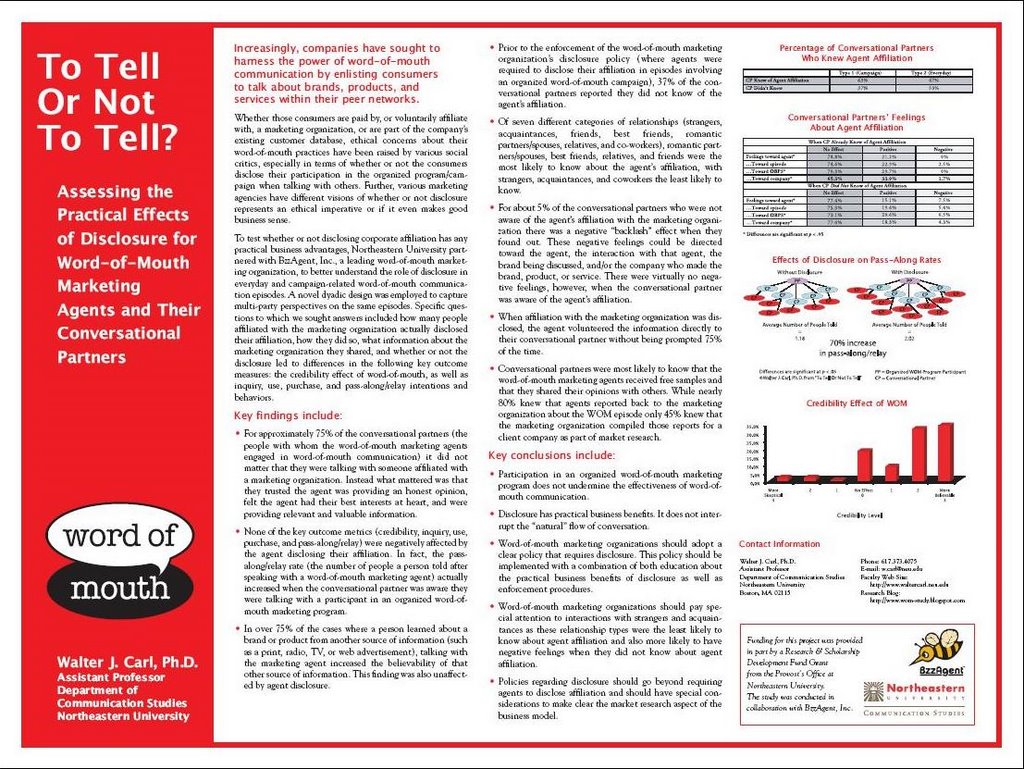
I'll be presenting a poster of my research on the role of disclosure in organized word-of-mouth marketing programs at Northeastern University's Research Expo today. The Research Expo showcases the work of faculty members and students at NU over the past year.

Thursday, March 09, 2006

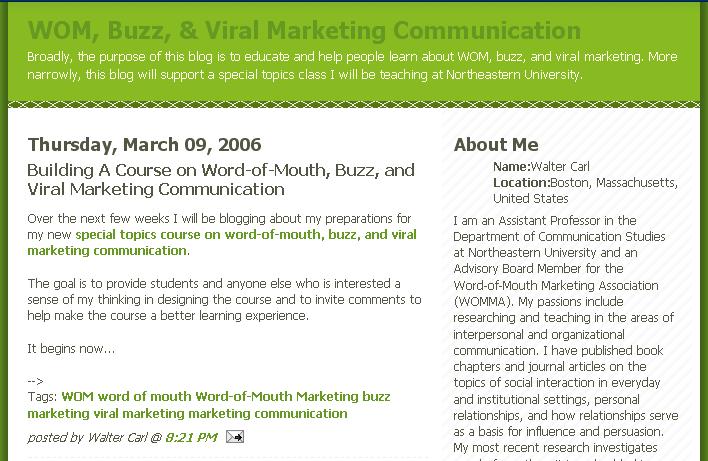
Ever Wonder How You Build A Course On Word-of-Mouth, Buzz, and Viral Marketing Communication?

Well here's your chance to find out.

I'm starting to blog on my "WOM Teach" site as I design my new special topics course in WOM, Buzz, and Viral Marketing Communication.

The goal is to get students interested in the course before it starts and to invite comments from people in the blogosphere so that we can make it the best learning experience for my students.

You can read the course description here. Then you can read my first step in designing the course, the learning objectives.

Don't be shy, go on over and check it out. Here's the link to add it to your reader.

-->
Tags:

Friday, February 17, 2006

Do You Believe? A Social Critique of Organized Peer-to-Peer and WOM Marketing Efforts and Its Practical, Business Implications

In my research on organized word-of-mouth and peer-to-peer marketing efforts I have written about some of the social and ethical concerns that have been raised by the increasing use of organized programs to stimulate brand-related word-of-mouth and "buzz." In my experience the critiques generally revolve around four issues:

1) participation of minors (under 13) as participants or targets of marketing efforts (family protection and consumer watch groups are especially concerned here);

2) disclosure (whether people are aware they're talking with someone who is either being paid or rewarded for their participation in an organized program; this relates to stealth and/or shill marketing);

3) the commercialization of chit-chat (everyday conversations and/or relationships becoming more commercial in nature), and relatedly;

4) "corporate colonization of the life world" (the thesis that corporations and business interests have an ever-expanding presence in our daily discourse and premises for decision-making).
One person who has raised some of these important critiques of organized peer-to-peer, WOM, and buzz marketing programs recently interviewed me about my research. Her name is Kate Kaye, a free-lance writer and author of Sales Pitch Society and the Lowbrow Lowdown website. She and I have had a number of fascinating discussions where we have found areas of common ground as well as points where our perspectives diverge. One issue we talked about concerns whether the social critiques stem from the form of organized WOM marketing efforts (peer-to-peer in the context of everday life), the content of the message that's being shared (corporate brands), or is it a complex interaction of both?

From my reading of Sales Pitch Society she is especially concerned that, among other things, everyday people are unreflectively becoming "brand vessels" by participating in corporate-sponsored marketing programs. In making this critique she compares and contrasts corporate-sponsored peer-to-peer marketing efforts with grass-roots evangelical efforts (whether the goal of the latter is to spread the teachings of Jesus or to protest globalization). She argues that in grass-roots, evangelical efforts people deeply believe in the message they're spreading. But she wonders if the same applies to corporate-sponsored or affiliated WOM marketing program participants. She writes:
What does that say about our society and the mindset of the people living in it if they do feel strongly about the sponsored word they’re spreading? What does it say about them if they don’t? (Sales Pitch Society, p. 31)
This question about belief in, and loyalty to, the message is one that some marketers may not always reflect on. Kate makes a compelling case to consider it on moral grounds, and I'd like to suggest there are practical business reasons for doing so as well (ah, see how easy the corporate colonization sneaks in)...

Companies that want to employ WOM and peer-to-peer marketing initiatives should think about whether the people who are participating in the program really believe in the brand, their membership in a community of others who participate in the organized program, both, or if deep belief in the brand is even desirable.

More concretely it comes down to perceptions of credibility (trustworthiness, sincerity, and competence/expertise). Companies should think through:
- whether the participants are sharing their opinions and recommendations just because they're getting paid or rewarded for it (a possible inference that others might make, especially when there is no existing relational connection to contextualize their involvement in the program);

- if the participants have a stronger belief in the community of participants with which they are affiliated more so than the brand they're talking about (especially if there is a concern that there are competing loyalties or that participants don't possess sufficient category expertise to warrant a knowledgeable recommendation);

- or if the company even wants to work with people who are highly loyal to a particular brand (because they may be seen to be too invested in their recommendation, might come across as too "strong" in their views, or might not interact enough with others outside a well-defined social network).
There is some empirical work that has been done to test out the effectiveness of different philosophies and business models when it comes to belief and loyalty to the message, but much more to do. However in addition to the empirical work we need to create and maintain a space for critical work that explores the moral dimensions and social consequences of the increasing use of WOM and peer-to-peer marketing efforts.

Kate is currently writing a companion, follow-up piece to Sales Pitch Society (for which I was interviewed and look forward to read). Interested readers should also check out her LowbrowLowdown posts on the Word of Mouth Marketing Association's Conference in Chicago (04/08/2005) and Commercial Alert's letter to the FTC (11/04/2005).

---

Creative Commons License

This work is licensed under a Creative Commons License.


Tags:

Friday, February 10, 2006

Industry-Academic Collaborations; Picking Up on Comment by Spike Jones

As part of The Basement's discussion about the "To Tell Or Not To Tell?" report, Spike Jones, from Brains on Fire, made the following comment on Matt Galloway's post regarding the the validity of the report to the broader world of word-of-mouth marketing (WOMM):

Hey Matt,

Good post. And, as you probably know by now, I'm not a BzzAgent fan, but I am - on the other hand - a Dr. Carl fan.

Here's my question about the study: Do you think the results would have been different if they didn't use BzzAgents? Something triggers my radar here. The BzzAgent model is a unique one, that much I agree on, but I can't help but think that this study was funded to validate that model instead of looking at the world of WOMM outside of BzzAgent.
I wanted to respond to Spike's comments about the purpose of the study, its funding, and the broader generalizablity or applicability to other business models because these are all important issues in any research project, but especially with academic-industry collaborations. But first I want to thank Spike for being a "fan" and say how excited I am to use the Brains on Fire case study for Rage Against the Haze in my WOM class this summer (to learn about their case study go to the Brain's On Fire website, click "Work" then "WOM" then the first case study in the lower-left-hand corner) :-)

Purposes of the Study. There were three purposes for my most recent collaboration with BzzAgent: 1) To test a new set of outcome metrics that are more consistent with the WOMMA Terminology Framework (credibility effect related to other information sources, inquiry, purchase, use, and pass-along; by "new" I mean that my first study didn't include these); 2) knowledge of institutional identity (meaning were the conversational partners aware that they were talking with a person affiliated with a marketing company and did this make a difference in the outcome metrics?); and 3) differences between the everyday WOM behavior of agents/program participants and their institutional (or campaign-related) behavior. (Additional articles or research reports will discuss findings from the other areas beyond disclosure of institutional identity).

I mention these multiple goals because they are informed by a theory I'm developing about organized WOM (more generally), the testing of a specific business model, as well as a test of the WOMMA Terminology Framework (to my knowledge this is the first academic-industry study to explicitly situate the study in the Framework's terms; disclosure: I was on the drafting committee for this Framework). So two things here: 1) yes, one purpose of the study was to test aspects of the BzzAgent business model, but it would be incomplete to just say that; and 2) the sword cuts both ways in terms of validation as part of an academic research project. That is, findings might invalidate the business model as well as validate it. Results get reported whether they are favorable or unfavorable to that model (and the TTONTT report has both).

Funding. Initial funding came from an internal grant I received from Northeastern's Research & Scholarship Development Fund (thanks to the Provost's office), and this covered the cost for the conversational partners' portion of the study. BzzAgent covered all the costs on their end related to the Agent participation. Of course, even if the company funded the full study as part of an academic research project then the same principles of reporting results that would validate or invalidate a particular business model would still apply. Exceptions sometime apply to any proprietary information but this factor gets disclosed as it becomes relevant and doesn't compromise the integrity of the results for this study.

Speaking of funding, I have another parallel study ready to go that seeks to investigate the same outcome metrics and WOM communication dynamics for "everyday people" without any organized WOMM program involved. So far I have only had funding for university students so if any company or foundation out there wants to further our understanding of everyday WOM through a nationally representative sample, just let me know! :-)

Generalizability or Applicability to WOMM. Any study has limitations and the unique business model investigated here is no exception (I discuss some of the more relevant limitations on p. 20 of the report). To validate the findings they need to be replicated with the same business model at a different time, and with different business models (and I'll be the first to acknowledge the value of doing so). Further, the results need to be peer-reviewed as is standard practice with academic work, which is why TTONTT is called a "summary report" and Footnote 1 states that academic journal publication constitutes official reporting of the results. And in specific response to one of Spike's questions: I do think we should expect to see differences in some of the outcome metrics and how program participants are viewed (for example, as existing customers, as category experts, etc.) depending on the business model, so this is another reason why additional models need to be studied.

But here are some ways I think the study does have applicability beyond the specific BzzAgent business model:

- I think the importance of disclosure applies to WOMM firms that have their own ongoing community of participants (like BzzAgent or Tremor or Vocalpoint) as well as those who work with different sets of category influencers for each campaign (like Matchstick or M80 or Brains On Fire) [Addendum, 02/11/2006: Please see Spike Jones' comment to this post about my grouping of these companies]. Further, I would suggest that companies who work with their own existing customers as part of organized programs (without an outside company to help them) would still benefit from campaign disclosure. (I mention some of this in point #10 on p. 18 of the report.) I think disclosure issues may be slightly different based on different models, but this will be the subject of a later post.

- I think the report points to the importance of the existing relationship as a factor in source credibility and perceptions of an ulterior motive. I'll be developing this in an academic article to tie in with research on the Persuasion Knowledge Model and the Social Consequences of Interpersonal Influence Model (opens into 3MB PDF file).

- It also points to the fundamental principles of all WOM, whether it is organic or organized: relevancy, trustworthiness, and goodwill.

- It provides a test of the WOMMA Terminology Framework and contributes new terminology to refer to "Participants." Specifically I think the Terminology Framework needs generic terms to distinguish between those who participate in organized WOMM programs or have an affiliation with a marketing company and those who do not. I propose we use "everyday people" and "program participants" (I used "agents" as a generic term in the TTONTT report but think "program participants" is even more inclusive).

- I think there are some other issues as well but stay tuned for more research on those!

Thanks to Matt and Spike for the opportunity to contribute additional thoughts!

-->
Tags:

Thursday, February 09, 2006

Response to Matt Galloway: "Should WOMM Agents Talk To Strangers?"

Matt Galloway over at The Basement posted about the "To Tell Or Not To Tell?" report on disclosure and organized word-of-mouth marketing (WOMM) programs. He wondered whether or not an implication of the report's findings was that WOMM agents shouldn't talk to strangers. He writes:

So while Dr. Carl's recommendation is to encourage disclosure, it seems to me that equally good advice is for agents not to talk with strangers.
Matt bases this conclusion on the findings that 1) trust is already lower in stranger relationships and 2) because there isn't a relationship history to contextualize the affiliation with a marketing company, it might be best to just avoid interactions with strangers.

I would like to agree and disagree. That is, I think interactions with strangers can be appropriate, but under certain conditions. First, I think stranger interactions should be avoided in terms of randomly going up to strangers and striking up a conversation specifically in order to generate WOM and without consideration of the other person's needs. This seems strikingly similar to invasive advertising models that WOM-friendly folks are working against.

Second, I think engaging in interactions with strangers that emerge coincidentally are more acceptable, as long as there is a) relevancy gleaned from category knowledge and/or experience, b) taking the other person's needs into consideration, and 3) disclosure of program participation. For example, suppose a participant in an organized program is at a store and somebody comes up to that person to ask them a question about something. I don't see any reason why a program participant wouldn't talk with that person as long as they say they are part of a program (assuming the program they are part of is relevant to the question being asked). Or in a situation where a program participant happens to overhear people talking about a product and helps them out. The trick here is that strategically positioning oneself as a "plant" or lurking around certain areas to wait for such "coincidental" conversations to happen seems suspect to me.

To illustrate this point consider situations where people are just genuinely motivated by altruism, even in interactions with strangers. For example, Steve Hershberger from ComBlu sent me a really interesting behavioral study on "Evangelist/Customer Impact in the Liquor & Wine Industry" (Steve said I could make it available for download; opens into PDF file). In the study they described one customer of a local wine shop who loved to be in the store and help others pick out wines. While he was shopping himself he would look around and if he saw someone struggling or looking lost he would go up to help them out. After trying to figure out what their needs and interests were he would make a relevant recommendation. (It was through some of these questions related to the use of the product, in this case, wine, where a level of trust was built). In a situation where the stranger was still skeptical he might even go so far as to buy a single bottle of the wine for a person out of his own pocket, just so the fellow consumer could benefit from the wine. The ComBlu case study goes on to report interesting findings about the business implications of such evangelist behavior (apparently the small store had four or five patrons who did similar things), but there are interesting points to learn here for organized WOMM campaigns.

This wine shop situation seemed appropriate because the person was sincerely passionate and knowledgeable about the product category (and not just about a single product that's part of the campaign), had the other person's best interests at heart, and provided relevant recommendations to a stranger who would clearly benefit from information. Now, if this person was also a participant in an organized WOMM campaign and discloses their participation right from the start, then why not talk to strangers? Everything here is consistent with the bedrock principles of WOM which are trustworthiness, goodwill, and relevancy (based on prior knowledge and experience).

So, to sum up, stranger interaction for organized WOMM programs seems acceptable under the following conditions:

1) the participant is sincerely passionate and knowledgeable about the product category;
2) provides relevant information and recommendations to people who would clearly benefit from the information; and
3) discloses their participation to the stranger right from the start.

I'm not naive to think that every WOM program participant will go through all of this, but I think some would. And if they don't fulfill these criteria, then Matt may just be right and program participants shouldn't talk with strangers.

-->
Tags:

Tuesday, January 31, 2006

Word-of-Mouth & Avoiding the Silo Mentality

Jonah Bloom, the executive editor of Advertising Age, writes a compelling piece that appeared yesterday on AdAge.com (free subscription required; also available here). After praising the Word of Mouth Marketing Association (WOMMA) for making "smart moves" -- 1) engaging bloggers by inviting them to blog about the recent WOMMA Basic Training conference and to participate in the ongoing discussions about the role of word-of-mouth, 2) taking a firm stand on ethics by standing against shill and stealth marketing, and 3) anticipating concerns raised by the FTC -- he also challenges WOMMA to avoid a marketing "silo mentality." He writes:

The once concern with all of this is that with the emergence of such a strong association and what seemed from the conference to be something of a new-members club of executives, we could be yet again witnessing the cultivation of a marketing silo rather than the full integration of a new philosophy and skill set.
Bloom's essay is important for at least two reasons. First, it helps us understand that WOM is not just a sexy campaign but rather a larger philosophy of monitoring existing consumer-to-consumer conversations, creating spaces for consumer conversations and listening to them, early and ongoing engagement, relationship-building, shared control with consumers and other stakeholders, creating products and experiences that are worth talking about, etc.. (Of course, the sexy and creative campaigns can be an activity that grows out of the larger philosophy). Second, Bloom's essays recognizes the need to adopt a systems approach to how organizations communicate both internally and externally (that is, a way of seeing how all the parts and processes are interdependent and need to work together in order to be effective). Bloom argues, and I agree, that without integrating WOM principles into the whole of an organization, WOM will be seen simply as a boutique activity.

At the WOMMA conference Bloom facilitated a panel discussion on the challenges and opportunities when companies seek to integrate WOM into their corporate philosophies. Panelists included representatives from Intuit, BzzAgent, and Conference Calls Unlimited.

Disclosure: I am a member of WOMMA's Advisory Board.

-->
Tags:

Wednesday, January 25, 2006

To Tell Or Not To Tell?: Question About If Inundation and Repetitive Experiences With WOM Agents Decreases Credibility

Over the past few days I've had the chance to talk with bloggers, journalists, and authors about findings in the "To Tell Or Not To Tell?" report. One issue that has surfaced in a couple of the interviews relates to what happens if, and/or when, people start to become inundated with agents who participate in organized WOM marketing programs; will non-agents become less accepting of the message? [Note that "agent" is being used here generically to refer to any participant in an organized WOM marketing program].

I wanted to reproduce a specific exchange I had over e-mail about this issue (it's actually a follow-up to my last post with Isaac from Chapell Associates). What follows is the question and then my response.

In the Ad Age article covering the release of your study, you're quoted as saying:
“There’s a sense if there’s an organized word-of-mouth marketing program there must be something interesting about it...There’s a sense that a company wouldn’t do this unless there was something interesting or new about the product.”
Correct me if I'm wrong, but part of this seems to be that consumers aren't used to being approached as part of a WOM program - so it seems important and exciting. This makes sense to me, but it makes me wonder: if WOM became more prevalent, and consumers got many a "recomendation" via WOM agent, would they be less accepting of the messages?

This is, to some degree, a question of inundation - how much WOM are consumers willing to accept? Are repeated experiences with WOM likely to increase or decrease their trust of the recommendations provided by WOM agents?
Here's my response:
Thanks for your question and you raise a valid point. First, let me respond with some background to the quotation that appeared on AdAge.com. I was asked to explain why I thought the number of pass-alongs (how many people a person told after talking with a WOM agent) was higher when there was disclosure. I think there may be three reasons: 1) conversational quality scores were also higher when there was disclosure (that is, those conversations were rated as more informal, personal, relaxed, and in-depth); 2) credibility scores were higher, specifically that there were higher ratings of trustworthiness (being genuine and ethical) and goodwill (feeling like the other person had their own interests at heart); and 3) there's a sense of being "in the know" when you receive information that's part of an organized WOMM program (because it might be a new product or something especially interesting about an existing one in order to warrant being part of an organized program). The AdAge quotation came from my explanation of this third point.

I provide this background because I think organized WOMM programs will only be effective when they incorporate the three bedrock principles of all WOM: trustworthiness, goodwill, and relevance. That is, WOM works because we feel the other person has our best interests at heart and we view them as a reliable, trustworthy source of relevant information.

In terms of your question about how much WOM are people willing to accept, I think we need to reflect on how WOM is being used here. WOM can be seen as part of a larger philosophy of engagement, listenting, responsiveness, involvement, etc. as well as a specific set of activities or tactics (such as a campaign). I think you're talking about the latter in your question and I don't know what the threshold is for exposure to organized WOMM campaigns. But again, I think it all goes back to if people perceive the program is facilitating the exchange of relevant, credible information within the context of a trusted relationship.

I also don't know if repeated experiences with a WOMM program lead to more or less credibility in a message or towards a specific person. But I think this one is easier to answer because it would probably be like any other experience and depend on the quality of the recommendation and the relevance of that recommendation to our lives. If people's experience with organized WOMM programs help them to make better decisions, feel more in the know, feel like they can help others better, etc., then I think repeated experiences will lead to higher credibility. If the converse is true then I think people will begin to lose any belief in the value of the organized WOMM programs.

One final comment, you write about people not accustomed to being approached by WOM agents, but I don't know if this is really how it works, at least based on my research. That is, it's not like agents are going around like a salesperson might, door-to-door, and trying to make contact with a certain number of people (granted, some participants might do this or some companies might encourage their participants to do this, but if they are, I think this is a very unwise approach). Rather, the brand-related talk is more likely to come up in relevant points of existing conversations. For example, based on some recent findings, only 24% of campaign-related WOM episodes were planned in advance by the agent, suggesting that 76% came up spontaneously, or at least without an existing idea that they were going to talk about it. And then we'd need to look at the 24% that were planned because an agent might be looking forward to telling someone about the brand, either because of a positive or negative experience with it (that is, as opposed to "plotting" a time to enter it into a conversation). So in sum, to the extent that agents are going up to people and talking about the brand when it's not relevant to the other person, or not a relevant point in the conversation, then I think there is a problem, and people will not accept this type of model and will have a strong desire to "tune out."
Thanks, and again, let's keep the discussion going!

---

Creative Commons License

This work is licensed under a Creative Commons License.


Tags:

Saturday, January 21, 2006

Explanation for Counter-Intuitive Findings in "To Tell Or Not To Tell?"

I've had a great response from the blogosphere to my research report on disclosure and organized word-of-mouth marketing programs (see also the AdAge.com article). Some people are surprised by what seem to be counter-intuitive findings in the study, especially in terms of why consumers might not be more skeptical after learning of a person's commercial affiliation through their participation in an organized WOM marketing program. For example, Isaac from the Chapell Associates blog posted this:

I must to say I'm surprised by the report's findings. Intuitively, we like to think of recommendations as just someone liking a product and then telling others about it - "here, try this brand of coffee, I really like it," not "here, try this brand of coffee, the company that makes it tells me it's really good." To be totally honest: I can't see why consumers, having been told that someone has a commercial relationship with an advertiser, wouldn't be more skeptical of that person's recommendation.
Here's three reasons why I think credibility may be the same or higher when there is disclosure in an organized word-of-mouth marketing program (I presented some of these points in my talk at the WOMMA Basic Training conference on Thursday):

1) In a clear majority of the cases there was an existing personal relationship between the agent (a person participating in the organized WOM marketing program/campaign) and their conversational partner (the person with whom they were talking). In fact, the median length of time the two knew each other was about 6 years. That existing relationship implies a history of conversations about brand-related and non-brand-related topics. In those conversations that aren't related to the organized program the conversational partner builds up trust and credibility in the other person (the agent). Thus, the fact that the person/agent is participating in the program is contextualized by all the other conversations and history of their relationship. That is, in many cases, the conversational partner is likely to feel like it doesn't matter that the person is in the campaign because s/he has my best interests at heart, I know I can trust her/him becasuse of our other interactions, and I know s/he is providing information that would be valuable and relevant to me.

2) A second reason credibility is unaffected, or may even be higher, when disclosure takes place has to do with the fact that the act of disclosing affiliation might be interpreted as a marker of honesty and credibility. That is, the conversational partner hears the disclosure and realizes the person isn't trying to be deceptive or pulling something over on them.

3) Additionally, I don't think many of the conversations play out as the hypothetical scenario you created might indicate. You wrote:
"here, try this brand of coffee, I really like it," versus "here, try this brand of coffee, the company that makes it tells me it's really good."
I don't have actual recordings of the interactions but I do have narrative accounts. A more likely scenario might be:

"hey I got some new coffee from company x as part of this campaign I'm in. It's a bit strong for my taste but I think you'd like it."

Part of the point with my admittedly hypothetical scenario (I didn't use an actual excerpt because I wanted to keep it as close as possible to your example for illustration purposes) is that, while people do receive information about the product from the company, they also try it out for themselves and then tell others what they think about it. Thus, the participants are spreading WOM based on their own experience with the brand, product, or service not (just) what the company said.

Thanks for the comment Isaac!

Disclosure is a crucial topic in the word-of-mouth marketing industry so please pass-along the link to download the study to anyone who might be interested in reading the report. Let's keep the discussion going!

---

Creative Commons License

This work is licensed under a Creative Commons License.


Tags:

Wednesday, January 18, 2006

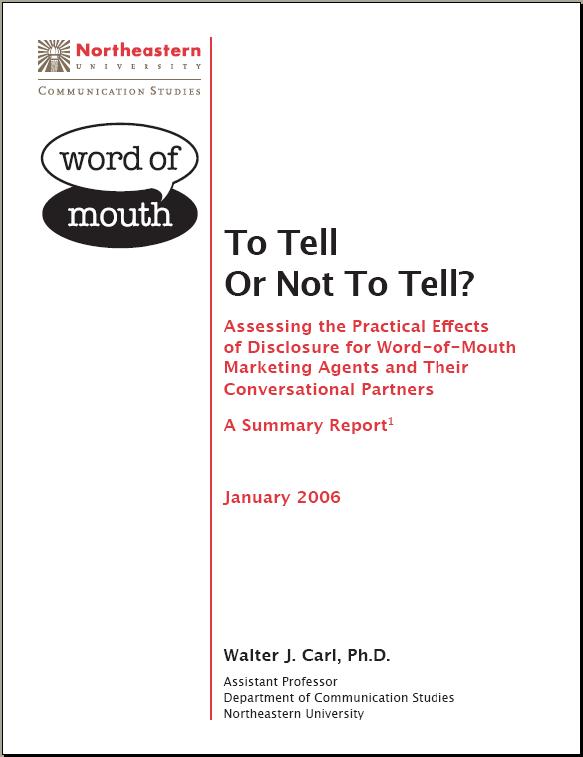
To Tell Or Not To Tell? -- Research Report on Disclosure & Organized Word-of-Mouth Marketing Programs Now Available!

I am excited to announce that my research report on disclosure and organized word-of-mouth marketing programs is now available free of charge at my download page. The report is a result of a major industry-academic collaboration between BzzAgent, Inc. and Northeastern University.

My hope is that the report will stimulate discussion about the role of disclosure in organized word-of-mouth marketing initiatives and I invite thoughful commentary and criticism. If you are so inclined to blog about the report, please provide a trackback and a link to my download page -- http://www.waltercarl.neu.edu/downloads/ -- rather than uploading the file to your server. Also, please feel free to write comments to this post.

Below is a summary of the main findings...

• For approximately 75% of the conversational partners (the people with whom the word-of-mouth marketing agents engaged in word-of-mouth communication) it did not matter that they were talking with someone affiliated with a marketing organization. Instead what mattered was that they trusted the agent was providing an honest opinion, felt the agent had their best interests at heart, and were providing relevant and valuable information.

• None of the key outcome metrics (credibility, inquiry, use, purchase, and pass-along/relay) were negatively affected by the agent disclosing their affiliation. In fact, the pass-along/relay rate (the number of people a person told after speaking with a word-of-mouth marketing agent) actually increased when the conversational partner was aware they were talking with a participant in an organized word-of-mouth marketing program.

• In over 75% of the cases where a person learned about a brand or product from another source of information (such as a print, radio, TV, or web advertisement), talking with the marketing agent increased the believability of that other source of information. This finding was also unaffected by agent disclosure.

• Prior to the enforcement of the word-of-mouth marketing organization’s disclosure policy (where agents were required to disclose their affiliation in episodes involving an organized word-of mouth campaign), 37% of the conversational partners reported they did not know of the agent’s affiliation.

• For about 5% of the conversational partners who were not aware of the agent’s affiliation with the marketing organization there was a negative “backlash” effect when they found out. These negative feelings could be directed toward the agent, the interaction with that agent, the brand being discussed, and/or the company who made the brand, product, or service. There were virtually no negative feelings, however, when the conversational partner was aware of the agent’s affiliation.
... and key conclusions:
• Participation in an organized word-of-mouth marketing program does not undermine the effectiveness of word-of-mouth communication.

• Disclosure has practical business benefits. It does not interrupt the “natural” flow of conversation.

• Word-of-mouth marketing organizations should adopt a clear policy that requires disclosure. This policy should be implemented with a combination of both education about the practical business benefits of disclosure as well as enforcement procedures.

• Word-of-mouth marketing organizations should pay special attention to interactions with strangers and acquaintances as these relationship types were the least likely to know about agent affiliation and also more likely to have negative feelings when they did not know about agent affiliation.

• Policies regarding disclosure should go beyond requiring agents to disclose affiliation and should have special considerations to make clear the market research aspect of the business model.

Many thanks to all the agents and conversational partners who participated in this study!

Click on the links below for other posts on this blog regarding disclosure and word-of-mouth marketing:

- Clarification in ClickZ's Story "BzzAgent to Agents: Spill the Beans, Or Else"

- The Practical Value of Disclosure in Word-of-Mouth Marketing Campaigns

- How Much Can You Trust Buzz?

- Do You Know of Video Clips about WOM, Buzz, and/or Undercover/Stealth Marketing?

- Faked Out By BK?

- Campus Ambassador Programs, Buzz Marketing, and Disclosure

- On Affiliation with a Buzz Marketing Agency, Disclosure, and Shopping in a Supermarket -- Part 2

- On Affiliation with a Buzz Marketing Agency, Disclosure, and Shopping in a Supermarket -- Part 1

---

Creative Commons License

This work is licensed under a Creative Commons License.


Tags:

Monday, January 16, 2006

Sneak Peek at "To Tell Or Not To Tell?"


To coincide with WOMMA's Basic Training conference I'll be releasing a major report on disclosure and organized word-of-mouth marketing programs.

Starting January 18th copies of the report can be downloaded free of charge at my download page. A special page will be set up on my blog for comments and discussion of the findings.

My talk at the conference is entitled "To Tell Or Not To Tell?: Managing Effective Word-of-Mouth Marketing Programs Based On Why People Talk (and Listen!)"

Tags:

Tuesday, January 10, 2006

Free Pass to WOMMA Basic Training Conference for a Worthy University/College Student

It turns out I had a winning bid for the charity auction to the Word of Mouth Marketing Association conference. I'd like to donate it to a student who otherwise wouldn't be able to attend the conference. Ideally this could be any interested student in a university or college, but given travel and hotel costs, it might be a student in the Orlando area. If you fit the bill send me an e-mail! If no one eligible contacts me in the next few days I'll donate the pass to WOMMA to use at their discretion.

Disclosure: I am a member of the WOMMA advisory board.

Thursday, January 05, 2006

Put Your Money Where Your WOMMouth Is!


Anyone interested in attending the Word of Mouth Marketing Association "Basic Training" conference in Orlando? It costs $795 if you're already a member or $1,095 if you're not a member. Or, you can bid your way in with all the proceeds going to a number of great charities (American Red Cross, The Prostate Net, Habitat for Humanity, Electronic Frontier Foundation, etc.). WOMMA is auctioning 20 passes on eBay and right now the bids are well below the prices quoted above. To learn more about the charity auction visit this page on the WOMMA website.

I just put in a bid for the Leukemia & Lymphoma Society. As a WOMMA Advisory Board member I won't need the pass if I win it so I'm happy to give it to someone who wouldn't otherwise be able to go. I'll know in a couple days and will provide an update on my blog.

Also, I'll be releasing a summary report from my latest research project on the practical benefits of disclosure in organized word-of-mouth marketing programs. The title of my report will be "To Tell Or Not To Tell? Assessing the Practical Benefits of Disclosure for Word-of-Mouth Marketing Agents and Their Conversational Partners." More details in the days to come...

Tags: