 I've noticed the Ford commercials where everyday car drivers were able to swap their non-Ford cars with a Ford vehicle for one week so that they could experience what the Ford vehicle was like. In the commercial, and on the Swap Your Ride's website, Ford was very up front that they didn't tell the people whose cars were swapped that the camera crews were from Ford and instead told them they were doing "market research" (if you watch the "Behind the Scenes" video at the website they justify doing this because Ford wanted the drivers' honest opinions). Ford videotaped each person's experience and promoted these stories in the commercial and on the website, again without telling the people the film crews were from Ford.
In order to actually make the commercial or put these people's stories on the website I'm sure Ford had to secure the people's permissions and at that time they must have found out Ford was behind this. So it seems like we have an example of "delayed disclosure" going on here.
This makes a great case study for one of my classes. Here's a question I would pose to my students: Is the Ford "Swap Your Ride" program an example of stealth, or undercover, marketing? And if so, is this unethical? First, a definition. The Word of Mouth Marketing Association (WOMMA) defines stealth marketing as: "Any practice designed to deceive people about the involvement of marketers in a communication."
Second, we need a set of criteria to work with. Let's use WOMMA's Honesty ROI guidelines to briefly work through this case. Why is this an appropriate set of guidelines? Is this a WOM marketing program, and if so, how? I would contend it is because the marketer is using stories or testimonials from everyday people about their product-related experiences in order to engage an audience and promote their brand.
Of the honesty of relationship, opinion, and identity, it seems that this program initially fails on the first but is OK on the second and third. Specifically, Ford didn't have its crew disclose the fact that they were working for Ford and instead said they were market researchers (violates honesty of relationship). The people in the video seemed to be real people (that is, not actors or employees of the company, or otherwise paid or compensated beyond getting the chance to drive a new car around for a week; so honesty of identity seems OK here). And these real people seem to be providing their own unscripted, honest assessments (honesty of opinion; though it's clear the comments were edited and we have no access to any negative comments anyone might have said). Interestingly the video on the website uses the language of "Real people. Real opinions." which supports the analysis so far.
So, according to WOMMA's Honesty ROI ethical framework, this really comes down to an issue of disclosure of the marketer's relationship. There was an intent to deceive but it was justified on the grounds of soliciting people's honest opinion. And Ford came clean about it to the larger audience in their commercial and in the video. (Interestingly, this deceit is also carried out in academic research, as long as the benefits of doing so outweigh the costs, that the disclosure eventually occurs, and that no one gets hurt in the process.)
So, let's think about if anyone got hurt here. The drivers are getting to drive around in a new car for a week and show it off to their friends which juices their sense of being special. There could be a feeling of being "duped" and there may have been some backlash. And this may have had the effect of undermining credibility in marketing activities or making it that much more difficult for real market researchers to do their work (see the Market Research Society's Code of Conduct for interesting thoughts on this; of course the people doing the commercial aren't actually market researchers so they wouldn't be bound by such guidelines).
Ford must have done all their legal due diligence about the deception. It's probably legal since the larger audience in the commercial or video was informed that Ford was deceiving people for the purposes of filming the videos. It seems that it comes down to the following: in what situations is "delayed disclosure" (un)ethical*? Is disclosure a black or white issue or are there shades of gray? And does the WOMMA Honesty ROI or The Ethics 20 Questions give us the tools to make this decision?
What do you think?
* The issue of delayed disclosure is addressed by Justin Foxton in the book Connected Marketing (chapter titled "Live buzz marketing") so interested readers can also turn there.
-->
Tags: WOM word of mouth Word-of-Mouth Marketing buzz marketing viral marketing marketing communication stealth marketing Swap Your Ride
Sunday, September 30, 2007
Is Ford's "Swap Your Ride" Program an Example of Stealth Marketing?


Monday, February 12, 2007
Predicting the Future of Connected Marketing
 Along with a number of other folks, I've been contacted by Justin Kirby, co-editor with Dr. Paul Marsden of Connected Marketing: The Viral, Buzz, and Word of Mouth Revolution, to comment on whether or not the predictions for the future of connected marketing he made at the end of that book were right or wrong or have come true or not. He made the following 10 predictions in 2005 (my thoughts on each below):
1. Connected marketing will become more strategic, with the focus shifting from promotion (creating remarkable campaigns) to innovation (creating remarkable products).
I believe that CM will become more strategic. Some early companies seemed to experiment with WOM initiatives, especially more on the promotion end, because they may have had some extra money around from a media buy that wasn't spent. Other companies had a very intuitive sense of the role of WOM and factored this in to their strategic decision-making but weren't necessarily very formal or explicit about it. Now, however, I see much more thought going into how WOM initiatives are part of an integrated program. I would say that since companies may have experimented with promotional strategies early on that more money will be shifting into the insight and innovation aspects, but I think that smart companies will figure out that insight, innovation, and promotional goals are all important, at various times and to various degrees. Of course, my empirical base of information on this is anecdotal because there isn't yet continuously-tracked industry data about this. I'd love to see the Word of Mouth Marketing Association track the resource allocation of this, perhaps in concert with other industry associations.
2. ROI metrics will be mandatory for viral, buzz and word of mouth campaigns. ‘Advocacy rates’ and ‘sales uplift’ will become important parts of ROI metrics, displacing traditional measures such as campaign reach.
Indeed, that's definitely a take-away message from the second volume of Measuring Word of Mouth (published by WOMMA; disclosure: I edited the volume). There is increasingly more demand for accountability and ROI metrics. I still think campaign reach will be a factor, though, because companies will want ways to compare their WOM initiatives (especially more of the "promotional" variety) with other media and marketing channels and initiatives (and old habits are well ingrained). I think what you'll see is a metric that provides a sense of the relative value of a conversation versus another kind of media impression. I do agree with you that sales uplift will definitely be important and I think increasingly we'll see agent-based models used to help assess the role of WOM relative to other media and marketing channels to assess that. Further, we'll see greater refinement of advocacy metrics, especially those related to intention to recommend and actual recommendation behaviors.
3. Word of mouth tracking will become a key metric in brand tracking market research.
Yep, absolutely. And yep, we're seeing this as companies like Nielsen BuzzMetrics, Cymfony, BrandIntel, Keller Fay, etc. see their client lists grow. See Nathan Gilliat's blog for more details.
4. Buzz, viral and word of mouth marketing will be merged into the wider marketing mix, with online viral marketing adopted and integrated within advertising, word of mouth within promotions and buzz within PR.
Yes and no. I think buzz, viral, and WOM will be merged into the ongoing operations of the firm, across many different areas. Yes, online viral marekting will be integrated within advertising, but I think even more traditional advertising messages will need to take into account the pass-along effects of WOM in order to calculate their true value (there's a great article by Hogan, Lemon, and Libai on quantifying the ripple effect of advertisements and tying it to a customer lifetime value approach). But I wouldn't limit "word of mouth" to just promotions (I guess it depends on definitions here as you use "connected marketing" as the umbrella term and I use "WOM" as an umbrella term). For example, I consider WOM to also be a source of innovation and customer insight. I think PR will take up buzz strategies but equally important is figuring out ways to engage their stakeholders in a variety of environments, such as discussion groups, blogs, online and offline communities, etc.
5. Managing and avoiding negative word of mouth, online and offline, will be an increasingly important area in connected marketing.
Yep, absolutely. And not enough attention has been paid to managing NWOM. A good bit of this can be done in managing the service recovery process but also in tracking and learning from existing WOM, especially regarding innovation.
6. Online branded entertainment (advertainment, advergaming, alternate reality games) will be used more as key brand touch-points for entertainment brands.
I think so, but we're seeing it used beyond entertainment brands as well. Check out some of the case studies on the websites of PodDesign and M80 for example.
7. Techniques developed in connected marketing initiatives will be adopted for change management and internal communication.
Yes, indeed. Internal blogs can be a great knowledge management tool. Enabling and empowering employees (principles of WOM) is important so that they have the tools and skills to create effective relationships with customers and other stakeholders (though see Chapter 6 of the book Loyalty Myths [pp. 153-168] for some important cautions about the relationship between employee performance and customer loyalty and profitability).
8. Techniques developed in viral, buzz and word of mouth will be increasingly adopted in CRM programs as both retention and acquisition (turning buyers into advocates) tools.
It would be great to use CRM programs in this way. It's especially important to think about segmenting customers appropriately and designing CM initiatives that are tailored for them.
9. Cell phones will develop rapidly as an important medium for spreading connected marketing promotions, such as mobile invitations, SMS barcode discounts, etc.
Yes, I think we are starting to see this. I think it will be important to distinguish. though, how much of cell phones, as a medium, are being used in "push" versus "pull" programs.
10. Marketers will eventually be able to locate influencers by zip/post code, by which point they will be all chasing the same chosen few… Prepare for another paradigm shift in marketing?
Of course, influencers differ by product category, not just by zip/post code, but I think your point is that as methods to identify influencers become more "efficient" (from the firm's perspective) they may be overloaded with programs. I think what continues to remain important is providing programs that are strategically in line with the company's goals, relevant to the participants involved, and that leverage motivations for why people spread positive WOM (for example, altruism, status, personal and social expression after a delightful experience, reducing risk and uncertainty, etc.).
Interestingly I noticed that there were no predictions about any of the ethical concerns regarding disclosure, commercialization of chit-chat, and working with minors. These were hugely important issues for the industry, and will continue to be, so I'd add that in as well. I know you have a lot of thoughts on this so I'd encourage you to add it is as part of your assessment.
Good luck with your article. I'm anxious to see what others say and what your own reflections are!
UPDATE (2/13/2007): If readers of this blog would like to contribute their own thoughts on Justin's predictions then feel free to do so at the Connected Marketing site by contributing to this survey.
UPDATE (2/19/2007): My comment about the lack of predictions regarding ethics doesn't imply that Justin doesn't have a position on this important topic. Interested readers should read his final chapter in the Connected Marketing text where he addresses the topic of ethics and connected marketing programs. My comment was only pointing out that ethics wasn't mentioned specifically in the 10 predictions, not that Justin didn't cover the topic of ethics in his chapter.
-->
Tags: WOM word of mouth Word-of-Mouth Marketing buzz marketing viral marketing marketing communication connected marketing
Wednesday, December 20, 2006
Flog Alert Repository?; Company Training About Ethics Violations
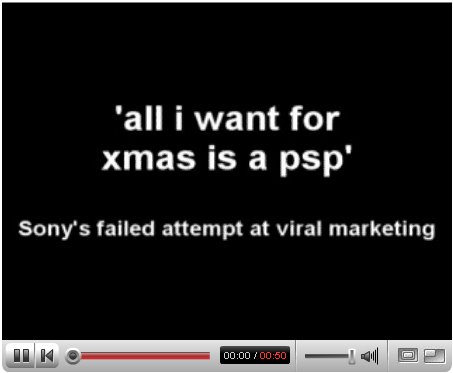 Does anyone know of a central place where people are keeping a list of all the companies who have engaged in stealth marketing (including flogs, or fake blogs)? The latest flog (over a week old now) seems to be Sony for their PSP: alliwantforxmasisapsp.com (see links below for stories covering this development; of course is not the first time for Sony as they messed around with stealth marketing with the Sony Beta 7 as well).
Sony, or at least one part of Sony, is a member of the Word of Mouth Marketing Association (for which I'm an advisory board member), so I would hope that at least some representatives from their company are learning about how social media works and the ethics involved so that no part of their company continues the use of stealth tactics.
The viral marketing firm that created the flog for Sony is Zipatoni (not a WOMMA member). According to a report in a MediaPost article, a person claiming to be a Zipatoni representative contends they advised Sony that there might be this backlash, but their client went ahead with it anyway (this information should be treated with caution, though, because none of this has been confirmed).
Anyway, this story, the Edelman fake blog scandal with Wal-Mart, and many other companies point to the importance of the education work that needs to be done within corporations about social media and ethics. At the latest WOMMA Summit in D.C. Rick Murray from Edelman gave an update on how his company has implemented a mandatory training program for all their employees. Further, they set up a 24/7 hotline where anyone around the world can call in with questions to make sure they are behaving in an ethically approriate way. They also engaged in a review of all their existing programs to ensure that there are no further violations of the WOMMA Ethics Code (at the time of the presentation they were 98% done). Read this post for more details about what Edelman is doing in response.
Other links about the Sony fake blog for PSP:
Sony 'fesses to fake blog. Still gets it wrong. -- Michael O'Connor Clarke
Oh Sony, What Were You Thinking? -- David Binkowski
Sony pays PR firm to lie about wanting a PSP for Christmas -- Videogamesblogger.comSony's holiday marketing campaign sniffed out -- Engadget
Sony Confesses To Creating 'Flog,' Shutters Comments -- Media Post Article
And be sure to check out the following link for a YouTube video created by gamers essentially saying that Sony is stupid for thinking that gamers are stupid and wouldn't figure out the flog.
Thanks to Constantin Basturea for some of the links above.
-->
Tags: WOM word of mouth Word-of-Mouth Marketing buzz marketing viral marketing marketing communication stealth marketing flogs fake blog
Tuesday, December 12, 2006
FTC Response on Word of Mouth Marketing Regarding Disclosure
 I'm blogging today from the Word of Mouth Marketing Association Summit in Washington, D.C. We just heard a presentation from Mary Engle, Associate Director for Advertising Practices at the Federal Trade Commission. She discussed the FTC's response to a complaint received from Commercial Alert (see background on the complaint and FTC consideration here). She summarized their complaint as follows:
Commercial Alert states that it is deceptive for marketers to pay consumers to engage in buzz without disclosure of the monetary exchange. They sought investigation of "buzz marketing" practices and asked the FTC to issue guidelines and bring cases. (NOTE: Commercial Alert should be calling this "shilling" or "stealth marketing" rather than calling this buzz marketing).
Here's the quick summary, with more details below:
- when payment is made to a consumer, that payment, by law, needs to be disclosed;Here are the details:
- marketers do not need to get parental permission for teens 13-18, but do need permission if the kid is under 13 (consistent with COPPA);
- non-monetary compensation (such as free samples, reward points, swag, etc.) do not need to be disclosed by law, but the FTC referenced that the WOMMA ethics code requires disclosure regardless of payment.
The FTC declined the request to issue specific guidelines for WOM marketing, arguing that they feel a case-by-case investigation and enforcement is adequate. However, they did issue an official response later stating the the FTC's Endorsement & Testimonial Guides are applicable to WOM marketing. The FTC states that paid WOM advocacy fits the following definition of endorsement:
"An endorsement is any advertising message that consumers believe represents the opinions, beliefs, experience, etc. of a person other than the sponsoring advertiser" (Slide 8)The Endorsement Guides require disclosure of the relationship between a seller and endorser "that might materially affect the weight or credibility of the endorsement" (Slide 9). They define a material connection as "one that isn't reasonably expected by the audience" (Slide 9). They also provide the following examples of these relationships: 1) seller is paying endorser, 2) endorser is related to seller, and 3) endorser is business associate of seller.
Their reasoning is that consumers wouldn't normally expect that someone has been paid to talk to them about a product. Further they suggest that consumers may give more weight to Person A's views rather than Person B's views if they know that Person A is independent from a seller while Person B is getting paid. Therfore, the reasoning goes, "Under the FTC Endorsement Guides, financial tie between the seller and paid agent should be disclosed."
Ms. Engle's presentation also addressed if the WOM program participant isn't paid, is disclosure still required? The FTC argues that it depends on whether consumers would give more weight to an endorsement if payment was or wasn't involved. It also notes that WOMMA's ethical guidelines call for disclosure even when there isn't payment. (For a research study about the potential business benefits of disclosure and guidelines for companies, please read my "To Tell Or Not To Tell?" report).
The Commercial Alert complaint also expressed concern about children's involvement in WOM marketing programs. The same disclosure applies in these cases. But what about parental consent? If a marketer solicits participation of kids under 13, then marketers need to comply with COPPA (Children's Online Privacy Protection Act), which means parental consent is required. But outside the scope of COPPA, the FTC doesn't enforce any other law that requires parental approval.
Download Mary Engle's Presentation from the FTC (opens into PDF file)
Commerical Alert's Reaction (Dec 11, Dec 12)
WOMMA's Reaction
Download To Tell Or Not To Tell? Research Report (link to download page)
Disclosure: Advisory Board Member of WOMMA
-->
Tags: WOM word of mouth Word-of-Mouth Marketing buzz marketing disclosure
Friday, October 27, 2006
Weighing in On The Edelman & Wal-Mart Flogging Scandal: Insights from Organizational Communication
 Like many others, I was very disappointed to learn of Edelman's role in the Wal-Mart fake blogging (flogging) scandal, especially since Edelman is a governing member of the Word of Mouth Marketing Association. This issue is especially salient to me, not only because I am a member of the WOMMA Advisory Board and Co-Chair of the Research & Metrics Council, but because I also conduct research in the WOM marketing space, consult orgnizations about how they should ethically and effectively manage WOM, and am an educator who teaches classes on the same topics.
There has been a great deal of discussion about what WOMMA's response should be. Broadly speaking, should it take more of an educational role or an enforcement role, or some combination of the two? Clearly WOMMA has an educational role to play and I struggle with what role an industry association should play in terms of enforcement. I'll speak briefly to this below, but for the time being, I would actually like to bracket (just for a few paragraphs) what WOMMA's role should be so that I can discuss what I would like to see from Edelman, or any company in this situation, but especially a company who is as well-known and respected as Edelman is in this space.
In one of the classes I teach at Northeastern -- Advanced Organizational Communication -- we study certain communication imperatives that any organization must follow in order to be ethical and effective. There are a number of imperatives, but two seem highly relevant to me: the notion of automatic responsibility and the institutionalization of dissent.
Automatic responsibility is the idea that each organizational member has the responsibility to solve a problem as they become aware of it (whether that problem be a difficulty a customer is having, or whether there is an ethical violation within the organization). If they don't have the technical knowledge or skill set to solve the problem, then it is their responsibility to make sure they find somebody in the organization who can address it.
The institutionalization of dissent is the obligation of an organization to build communication systems such that organizational members are encouraged to dissent, have that dissent be listened and responded to, and to be rewarded (rather than punished) for their dissent.
Upon learning of Edelman's complicity with this obvious and unfortunate violation of the WOMMA Ethics Code (for example, dishonesty about the bloggers' identities) I was left to wonder how this could have happened.
How could an organization who contributed to the creation of the ethics code and who has demonstrated leadership in the social media space commit such a transgression? What was the organizational decision-making process that led to this? Did anyone ever dissent and say this (fake) blogging program wasn't a good idea (it should have been the moral obligation of each employee to exercise their automatic responsibility and do so)? If there was dissent, what happened to this dissent? Was it ever encouraged in the first place? Was it ever listened to? Further, was it (or will it be) rewarded or was it punished?
I read that Edelman wants to make this situation right (see Rick Murray's comment on the WOMMA discussion list) and I sincerely believe that they do. A lot is at stake, as it represents a crisis of confidence for the reputation of their company, for WOMMA and the WOM marketing industry, and for the consumer/citizen.
So what should Edelman do now? A tough question and here's a start (see the WOMMA-faciliated discussion for other ideas): If I were advising them on what to do I would counsel them to conduct a comprehensive, independent investigation whose purpose would be to uncover the organizational communication and decision-making before, during, and after this scandal. Specifically, the goal would be to find answers to the questions above about where were the voices of dissent and if there were voices, why weren't they heeded? Fundamentally interrogating this issue of dissent is paramount in a media and organizational landscape where the dominant values are discursive engagement, openness, and transparency.
The board would include representatives from the following groups: consumer protection group(s), the FTC, academic expert(s) in corporate blogging and/or corporate ethics, member(s) of the WOMMA Ethics Council (and possibly other associations to which Edelman belongs), and of course, blogosphere netizen(s) or other consumers/citizens. The board would make the results of their investigation publicly available through a written report (electronically faciliated and with a public discussion board). Individual actors and the organizational system must then be held accountable in accordance with the findings of the report. The appropriate actions of holding individuals and the organizational system responsible cannot be further debated until after the investigation and the report is made public -- well the actions can be debated, but there's still too much we don't know at this time.
I feel this would be an appropriate course of action because it would be conducted in the spirit of openness and transparency that is highly valued and desired by not only the blogging community but by the principles of a democratic citizenry, it would allow Edelman to continue in the leadership position they have taken great strides to establish by showing they should be held to the same principles of openness and transparency they espouse, and it is a proactive move that would allow other practitioners and students to learn from this crisis.
I think the decision to initiate this investigation should be Edelman's while WOMMA (and again, other relevant industry associations) should continue to facilitate this process by continuing to host discussions on the matter, to contribute a representative of the Ethics Council to the investigation board, and to help with the educational effort based on the results of the independent investigation.
I would love to hear others' views on this matter through comment, but I would encourage that we make trackbacks and/or comments to WOMMA's discussion board as well.
Many of the principles discussed in this blog post were dervied from Phil Tompkins' book: Apollo, Challenger, and Columbia: The Decline of the Space Program (A Study in Organizational Communication) which I use as a textbook in my class.
Addendum: I should add that part of the investigative or auditing process I describe above needs to include Wal-Mart and what role they played in this. Working out the practicalities of involving Wal-Mart makes this more complex but it would be important to understand the systemic dimensions.
Update (11/1/2006): WOMMA has officially placed Edelman's membership under a 90-day administrative review. Edelman needs to take the following 6 steps (some of which appear to already be underway) in order to re-instate its full membership:
1. Provide assurances that all inappropriate programs have been stopped.
2. Provide a briefing to the WOMMA Executive Committee to fully explain the details of the incident.
3. Implement a training program to educate all employees on ethical practices and disclosure requirements.
4. Institute systems to prevent violations from happening in the future, and to correct them if they do.
5. Formally participate in upcoming WOMMA ethics programs and comply with all new ethics requirements for members.
6. Please provide detailed documentation of your compliance with the above requests.
-->
Tags: WOM word of mouth Word-of-Mouth Marketing marketing communication ethics disclosure edelman wal-mart
Playing 20 Questions With Ethics -- It's Not Just A Game
 WOMMA is at it again on the ethics front. Building from their Ethics Code and Honesty ROI framework (Relationship, Opinion, and Identity), the Ethics Council has created a tool to help organizations evaluate whether or not their next WOM marketing program falls within what could be considered ethical boundaries. WOMMA has submitted their "20 Questions Ethics Assessment Tool" in draft form and is inviting public comment.
This document is very timely given recent revelations by Edelman about its role in the Wal-Mart flogging (fake blogging) scandal and other violations of the Ethics Code such as LonelyGirl15
Disclosure: WOMMA Advisory Board member
-->
Tags: WOM word of mouth Word-of-Mouth Marketing buzz marketing viral marketing marketing communication
Wednesday, April 19, 2006
DuPont's Endorsement of WOMMA's Ethics Code
 I just finished the WOMMA-sponsored teleconference on word-of-mouth ethics (recap). I don't know the actual count of how many people participated but there were a lot of *beeps* as people joined the call. The podcast should be available on the WOMMA website in the coming weeks (disclosure: WOMMA Advisory Board member).
I enjoyed hearing my co-panelist, Gary Spangler from DuPont, speak about the latest news in WOM marketing ethics. DuPont is the first Fortune 100 company to fully endorse the WOMMA Ethics Code in all of their marketing and communication practices. Gary talked about his involvement in helping DuPont integrate the Code into his company's policy: he acted as an "internal champion," he helped to create knowledge and educate others about what WOM marketing is and what forms of WOM marketing are unethical, and talked about the importance of getting the key decision-makers involved. Apparently DuPont's existing corporate values were already consistent with the spirit of the Code so there was nothing to prevent them from officially endorsing it. Gary feels that the governance issue regarding ethics rests on the "client side of the equation," meaning that it is incumbent on clients not to work with firms that engage in deceptive deceptive marketing practices.
Andy Sernovitz actually began the call with an overview of ethical issues facing the WOM marketing industry (PDF), followed by Gary, and then me talking about my "To Tell Or Not To Tell?" study on the role of disclosure in organized word-of-mouth marketing programs. One ethical issue that wasn't addressed in the call was the societal effects of word-of-mouth marketing and peer-to-peer influence programs (I only mentioned it as one other ethical concern that has been expressed, in addition to the role of disclosure, and the role of minors).
We all fielded questions from the audience which included: best practices for companies to ensure the agencies they are working with are engaging in ethical practices, whether or not to run a WOM marketing campaign if you know you have an inferior product, and how, if at all, a company should participate in online consumer-to-consumer discussions about its own brand.
Finally, stay tuned for some ethics initiatives coming out from WOMMA in the near future that will help companies ensure their involvement with word-of-mouth marketing programs is consistent with the WOMMA Ethics Code.
-->
Tags: WOM word of mouth Word-of-Mouth Marketing buzz marketing disclosure ethics
Thursday, April 13, 2006
Social Critiques of Peer-to-Peer and WOM Marketing Programs, Take 2: Release of Sales Pitch Society II
 In an earlier post I wrote about the various social critiques of peer-to-peer and word-of-mouth marketing efforts. In that post I mentioned a piece written by Kate Kaye called Sales Pitch Society (opens into PDF). In that work Kate was concerned that participants in corporate-sponsored marketing programs were unreflectively becoming "brand vessels" and wondered whether people really believe in the messages they are spreading about brands.
On Monday, Kate released Sales Pitch Society II, an updated version of her analysis. In this latest edition, for which I was interviewed and cited, Kate wants the reader to reflect on how organized word-of-mouth marketing affects our social fabric, relationships, and our own identities as being defined by brands. She argues that people who participate in organized WOMM programs "are condoning the deliberate injection of brands into their conversations. In essence people are facilitating their own exploitation, merely because marketers have asked them to" (p. 38). She cites a number of reasons for this:
empty lives, the desire for belonging, acceptance and insider knowledge, even sheer materialism. (p. 38)Kate feels that proponets of organized WOMM programs are being seduced by their own rhetoric, drawing a comparison to Orwellian newspeak:
Could it be that WOM marketers have been spewing this Orwellian newspeak for so long, even they’'ve fallen prey to it? This time, the doublethink slogans are not “War Is Peace, Freedom Is Slavery, Ignorance Is Strength.” They'’re more along the lines of: Evangelism is Empowerment, Loyalty is Control, Influence is AltruismKate further expands her critique into the world of consumer generated media, arguing that the digital amplification of WOM in the form of CGM may lead us to forsake our human "in-the-flesh" relationships. She writes "Consumer attitudes are shifting, WOM is becoming institutionalized, and CGM is proliferating. At the intersection of these phenomena is digital communication" (p. 38).
Before I continue I should note that Kate adds a disclaimer about her critique:
Please note: This is by no means an anti-capitalist or anti-advertising manifesto. In fact, it comes from the heart and mind of a spirited proponent of free market capitalism. Neither is this an effort to denigrate the individuals who work in the WOM industry. This is merely an attempt to spur further dialogue regarding the ethical and societal implications of engineered WOM marketing campaigns.I find Kate's work to be thought-provoking on this topic, and I have found her to be very receptive to feedback, though I do disagree with her on a number of points. Here are a few points where we I think we overlap in our views and some points where we diverge (this is not an exhaustive list)...
Areas of Convergence
- I agree that many in our society define our identities too much by the brands we consume. (p. 26)
- I believe we should be reflective about our participation in marketing initiatives, just as we should reflect on and critically interrogate how we spend our time and energy on a range of activities in which we engage. (p. 5)
- I like her interrogation of languaged used by those in the industry (the communication scholar in me!). As an example, I feel similarly that we should interrogate the term "citizen marketer" because it seems to conflate the process of being a citizen in a democratic society (and all the attendant responsibilities of political participation that is required of citizens) with being a consumer in a marketplace. (p. 33)
- I think it's essential that we create a space to discuss the issues that Kate raises in her analysis about the societal and ethical effects of brands and in our lives and the marketing methods used to promote those brands.
Areas of Divergence
- I'm sensitive to, but ultimately resist, the argument that people are "facilitating their own exploitation" by participating in organized WOMM programs. This seems to reproduce a kind of "false consciousness" argument where the critic defines somebody else's reality for them. Kate's suggestion that the motives for participating in organized WOMM programs -- empty lives, desire for belonging, acceptance and insider knowledge, and sheer materialism -- could all be valid. But I wonder if the critique is somewhat reductionist by only, or at least primarily, looking at their participation in the WOMM program; this is likely just one aspect of their multi-faceted lives.
- I wish her critique more evenly incorporated a broader slice of word-of-mouth marketing business models because it may not do justice to the full range and types of perspectives in the field. Although she does spread some of the critique around to more "organic" WOMM programs and even the monitoring of online buzz, a large part of her critique is based on "amplified" programs offered by firms that have a network of members, such as BzzAgent or Tremor, or companies like M80 or Ammo Marketing (companies specifically mentioned). The BzzAgent model receives a good deal of attention and critique (and interestingly there are some in the WOMM industry who have made similar critiques of BzzAgent's business model, just as Kate does). And BzzAgent has always been a "lightning rod" in attracting praise and criticism. Ironically, some of this attention may be because of their level of disclosure and openness about what they do (for example, Kate uses some of the information provided on their blog and website as resources to critique their model). Further they are also a firm that has opened up their model to academic inquiry through their collaborations with universities such as Harvard, Yale, and Northeastern (obvious disclosure here), just to name a few; and since the findings from such studies are part of academic projects whose non-proprietary results are publicly disseminated it can cut both ways.
- I'm not sure what to make of the direction that Kate moves into towards the end of her piece where she implicates the new(er) forms of digital media that faciliate and amplify WOM on a broader scale. She writes that "In some ways, the digital communication we praise for its potential to bring us closer together sometimes actually divides us. It'’s as though some of us have allowed the media we use to transfer our thoughts and enable our discussions to build their own barriers" (pp. 38-39). I agree that technology both enables and constrains, but I think this point could be, and has been, discussed separately from the rest of her argument. That is, there's nothing inherent in the technology that leads us to engage more in brand-related conversations or "communication commodification." And though it's important to consider the role of 'social media' technologies anytime you talk about WOM and CGM I think this is the part of her argument that could be developed the most.
But because her writing style and arguments are often provocative I would encourage people to read Sales Pitch Society II. I plan on having my students read it in my class on WOM, Buzz, and Viral Marketing Communication that I'm teaching this summer, and which she happens to mention in the piece.
I would especially recommend that people who have participated in organized WOMM programs read SPSII and respond with your feedback (to this post or to Kate's site). I'd be fascinated to learn the diversity of responses to it.
-->
Tags: WOM word of mouth Word-of-Mouth Marketing buzz marketing disclosure ethics
Friday, February 17, 2006
Do You Believe? A Social Critique of Organized Peer-to-Peer and WOM Marketing Efforts and Its Practical, Business Implications
In my research on organized word-of-mouth and peer-to-peer marketing efforts I have written about some of the social and ethical concerns that have been raised by the increasing use of organized programs to stimulate brand-related word-of-mouth and "buzz." In my experience the critiques generally revolve around four issues:
1) participation of minors (under 13) as participants or targets of marketing efforts (family protection and consumer watch groups are especially concerned here);One person who has raised some of these important critiques of organized peer-to-peer, WOM, and buzz marketing programs recently interviewed me about my research. Her name is Kate Kaye, a free-lance writer and author of Sales Pitch Society and the Lowbrow Lowdown website. She and I have had a number of fascinating discussions where we have found areas of common ground as well as points where our perspectives diverge. One issue we talked about concerns whether the social critiques stem from the form of organized WOM marketing efforts (peer-to-peer in the context of everday life), the content of the message that's being shared (corporate brands), or is it a complex interaction of both?
2) disclosure (whether people are aware they're talking with someone who is either being paid or rewarded for their participation in an organized program; this relates to stealth and/or shill marketing);
3) the commercialization of chit-chat (everyday conversations and/or relationships becoming more commercial in nature), and relatedly;
4) "corporate colonization of the life world" (the thesis that corporations and business interests have an ever-expanding presence in our daily discourse and premises for decision-making).
From my reading of Sales Pitch Society she is especially concerned that, among other things, everyday people are unreflectively becoming "brand vessels" by participating in corporate-sponsored marketing programs. In making this critique she compares and contrasts corporate-sponsored peer-to-peer marketing efforts with grass-roots evangelical efforts (whether the goal of the latter is to spread the teachings of Jesus or to protest globalization). She argues that in grass-roots, evangelical efforts people deeply believe in the message they're spreading. But she wonders if the same applies to corporate-sponsored or affiliated WOM marketing program participants. She writes:
What does that say about our society and the mindset of the people living in it if they do feel strongly about the sponsored word they’re spreading? What does it say about them if they don’t? (Sales Pitch Society, p. 31)This question about belief in, and loyalty to, the message is one that some marketers may not always reflect on. Kate makes a compelling case to consider it on moral grounds, and I'd like to suggest there are practical business reasons for doing so as well (ah, see how easy the corporate colonization sneaks in)...
Companies that want to employ WOM and peer-to-peer marketing initiatives should think about whether the people who are participating in the program really believe in the brand, their membership in a community of others who participate in the organized program, both, or if deep belief in the brand is even desirable.
More concretely it comes down to perceptions of credibility (trustworthiness, sincerity, and competence/expertise). Companies should think through:
- whether the participants are sharing their opinions and recommendations just because they're getting paid or rewarded for it (a possible inference that others might make, especially when there is no existing relational connection to contextualize their involvement in the program);There is some empirical work that has been done to test out the effectiveness of different philosophies and business models when it comes to belief and loyalty to the message, but much more to do. However in addition to the empirical work we need to create and maintain a space for critical work that explores the moral dimensions and social consequences of the increasing use of WOM and peer-to-peer marketing efforts.
- if the participants have a stronger belief in the community of participants with which they are affiliated more so than the brand they're talking about (especially if there is a concern that there are competing loyalties or that participants don't possess sufficient category expertise to warrant a knowledgeable recommendation);
- or if the company even wants to work with people who are highly loyal to a particular brand (because they may be seen to be too invested in their recommendation, might come across as too "strong" in their views, or might not interact enough with others outside a well-defined social network).
Kate is currently writing a companion, follow-up piece to Sales Pitch Society (for which I was interviewed and look forward to read). Interested readers should also check out her LowbrowLowdown posts on the Word of Mouth Marketing Association's Conference in Chicago (04/08/2005) and Commercial Alert's letter to the FTC (11/04/2005).
---

This work is licensed under a Creative Commons License.
Tags: WOM word of mouth Word-of-Mouth Marketing buzz marketing disclosure ethics
Friday, October 28, 2005
Faked Out By BK?
Seth Stevenson writes a nice piece where he wonders if he's been faked out by an e-mail he received for the Burger King "King" Mask.
Well worth a read, but I'd make a similar comment as I did in an earlier post about use of terminology. Here's a quote from Seth's article:
But let's assume for a moment that Crispin [the agency responsible for the BK "King" account] used "buzz marketing" to fake me out and get my attention (as I'm convinced they did). Is there anything wrong with that?
Should Seth have written "undercover marketing" to imply the practice might be deceptive rather than "buzz marketing"?


