Friday, October 13, 2006

Top Ten Sources for PR and Marketing Communication and Higher Education Blogs

I recently learned that the Word-of-Mouth Communication Study blog was included as one of the Top 10 blogs for PR, Marcom, and HigherEd. The list was compiled by Robert French from Auburn University. His blog and associated resources at Auburn Media are excellent and should be included in the Top 10 as well, but he modestly put himself at number 11.

Here's the introduction that Robert put together for the list:

Public relations from the academic point of view. These links represent some of the people teaching the future PR practitioners of our world and those practicing PR for their universities. What do they have in common? They are blogging. Their views are important to the wider public relations conversation occurring online. To the PR practitioners of the world, your concerns are important to these bloggers. Without active involvement from practitioners, how else may future PR practitioners be prepared for post-graduate life? To recent adopters, or those just exploring social media for their classes, may this list serve as a jumping off point for your efforts. Please engage these educators in conversations.
Given this description interested reasders may want to check out my class blogs: Advanced Organizational Communication and WOM, Buzz, and Viral Marketing Communication.

I encourage folks to check out the other great blogs and wikis on the list.

-->
Tags:

Wednesday, October 04, 2006

WOM Marketing Activity For Your Next Class, Presentation, or Training Session

I recently received an e-mail inquiry about exercises or activities that can be used when presenting about WOM marketing with PR and marketing professionals.

One activity I’ve found really useful when talking with groups is about the different approaches to WOM marketing. The goals of the activity are:

1. for people to see the broad range of strategies and techniques that fall under the umbrella of WOM marketing,
2. to understand the advantages and disadvantages of each, and
3. to understand when to use each technique.
The activity is based on my own observations and interviews with industry practitioners, as well as on the work of authors and consultants Ben McConnell and Jackie Huba at Church of the Customer, and consultant John Moore from Brand Autopsy.

First, I explain that the range of WOM marketing initiatives can be broken down along three continua (there are more but three is a good start):
1. Degree of control over messages: consumer control versus company control
2. Outlook for future: longer-term versus shorter-term
3. End-goal: generating advocacy by developing a better brand, product, or service experience versus generating awareness though an attention-grabbing WOM activity
Second, I present case studies of actual WOM marketing initiatives and ask the participants to place the case along each of the continua above. In selecting cases I make sure that the case serves as a good representation of certain WOM marketing techniques. You can find a list of these techniques at the Word of Mouth Marketing Association’s website. Placing each case along these continua often generates some very good discussion.

For example, I have presented the case of the Chevy Tahoe Campaign where Chevy hosted a contest on their site to determine who could create the best consumer-generated ad. Chevy provided folks with the tools they needed: images, audio tracks, an easy editing interface to create the ad, and then a way to easily spread the message to other consumers. Many of the user-generated submissions were posted on their own site while others found their way to YouTube. Additionally, many of the ads were not very flattering from Chevy’s perspective, often serving as political statements about the negative effects of SUVs on the environment.

So after I explain the program I ask the audience to place it along the first continuum: consumer-company control. Some audience members think it should go all the way on the consumer end arguing that consumers could create their own ad without any input from the company. Further, Chevy didn’t filter or exclude submissions they didn’t agree with. Others argued that it shouldn’t be all the way on the consumer-control end because Chevy still did provide the raw materials and hosted many of the videos on their own site. Plus the ads on their site were taken down after the campaign, thus suggesting more company control over the process).

The next continuum is whether or not the initiative represented a longer-term strategy or a shorter-term campaign. Most of the audience says this is a shorter-term campaign (but maybe some initial stages of a longer-term strategy of figuring out consumer-generated media).

In terms of the third continuum, the end-goal, most audience members feel like the focus was to capture attention and generate awareness of Chevy Tahoe through an innovative activity designed to spread WOM (of course, Chevy wasn’t the first to do this; other examples include Converse, MasterCard, etc.). To support this classification, I usually chime in here to show that the WOM activity wasn’t really designed to elicit consumer feedback about how the Chevy Tahoe could be built better or how it wasn't designed to build more loyalty to Chevy and ultimately WOM advoacy.

The contrasts among the different types of programs become clearer when you discuss a few different examples. Here are some examples of other ones I’ve used:
1. Monitoring & Engaging in Online Conversations (Kryptonite U-locks)
2. Creating Consumer Communities & Cultivating Advocacy (Discovery Educator Network’s program for their unitedstreaming product; Church of the Customer)
3. Providing Tools for Viral Spread of Messages (Family Guy DVD program; M80)
4. Engaging Influencers (Wine Council of Ontario’s VQA program; Matchstick)
5. Stimulating WOM via Agent-Based Networks (Hershey’s Take 5 candy bar program; BzzAgent and Arnold Worldwide)
Finally, after going over the continua and presenting each case and discussing where each falls, I then facilitate a discussion about the relative advantages and disadvantages of each type of program and when a company might want to use each one. In the facilitation I think it’s important to emphasize that each technique can be useful depending on the specific company goals, and may in fact be complementary (here’s a link to one of my students’ post about combining the goals of generating both awareness and advocacy).

Feel free to contribute other activities, exercises, or discussion points you might use, or want to see, in a presentation on WOM marketing.

For more information on this post:

Watch John Moore's presentation on WOM Creationists versus Evolutionists.

Read Ben & Jackie's post on the buzz versus WOM divide

Read posts on the Chevy Tahoe campaign from Church of the Customer and Pete Blackshaw's CGM blog and ClizkZ column on consumer control and what counts as (in)authentic consumer-generated media:


Why Chevy Tahoe campaign was doomed before it launched

Chevy Tahoe campaign: Not CGM

GM Steps into the Chevy Tahoe Debate

Can Marketers Control CGM? Should They?


-->
Tags:

Wednesday, September 06, 2006

Pursuing a Ph.D. in Word-of-Mouth Marketing?

I recently received an e-mail from a person interested in planning an interdisciplinary Ph.D. in word-of-mouth marketing. Specifically, I was asked if I was aware of folks doing doctoral studies or research in this area.

Here's my response:

(I invite others to add to this list by posting a comment to this post)

***
... In terms of resources to aid your planning:

1) You can check out the class I taught on WOM, Buzz, and Viral Marketing Communication. This was designed for undergraduates but I included optional readings for graduate students. So the level would be too basic for a Ph.D., but the topics of study might be relevant.

2) I would also check out Kerimcan Ozcan's site. He recently completed a dissertation related to WOM at the U of Michigan and has a helpful website.

3) I would visit Andrea Wojnicki's website. She is now at University of Toronto but recently finished her Ph.D. in the WOM arena at Harvard Business School. Andrea is also on the advisory board at the Word of Mouth Marketing Association (WOMMA).

4) Relatedly, you might want to check out the following faculty members who also serve as advisory board members to the Word of Mouth Marketing Association, esp. Dina Mayzlin at Yale, Dave Godes at Harvard, Robert Kozinets at York, Chris Dellarocas at Maryland, etc. You can find links to all of their websites at http://www.womma.org/advisors.htm

5) Visit Peter Verlegh's website at Erasmus University Rotterdam as there are a number of people there who do work in the area of WOM.

6) Finally, you might want to poke around the Association for Consumer
Research
website and listserv and post your query there, as there are
people there who study WOM.

There are others but this should get you started! Let me know if you have additional questions.

Walter
***

Also, you can learn about Robert East at Kingston University in England. Here's a post I did about some of his work.

You might also want to learn more about the work of Alain Samson and Paul Marsden at the London School of Economics.

Added 9/26/2006: Check out the Ph.D. program at Touro University International as well.

-->
Tags:

Wednesday, August 23, 2006

WOM in Higher Education and the HigherEdBlogCon

I recently presented at an innovative institution of higher education. I spoke to the division of enrollment mangagement and college relations as part of their day-long retreat. This division includes such departments as admissions, alumni relations, financial aid, athletics, the career center, etc.

The first part of the presentation was an introduction to WOM marketing. In this opening presentation I discussed reasons for the resurgence of WOM, motivations for spreading WOM, WOMM ethics, and then layed out a number of different case studies, both from the corporate world, as well as higher education, to illustrate some basic WOM principles. Then the next session was an activity where participants applied those principles of WOM in the first session to developing their own WOM marketing programs.

I also prepared a resource packet for the participants and one of the resources was a web-based conference called HigherEdBlogCon. Of immediate relevance to this audience was the section of the conference devoted to Admissions, Alumni Relations, and Communications & Marketing: Below is a sampling of the topics discussed:

How Can I Learn More About New Media
The Teeming Web (This includes a very helpful primer on social networking sites relevant to a higher education audience (PDF).
Blogging & Podcasting for Student Recruitment
Freshman Reveal Their Secrets: The Mansfield University Podcast
Alumni E-Networks: Using Technology to Engage Alumni and Constituents
Online Networks: A New Tool for Alumni Relations
Social Networking: What Is It and Where Does It Fit In the Alumni World?
Using Wikis to Facilitate Communication, Collaboration, and Knowledge Sharing Among Admissions and Administrative Personnel

I also suggested a few blogs that are relevant to higher education:

Karine Joly
An excellent source for what to do as a university looking into new media


Dan Karleen’s blog

Director of New Media, Thomson Peterson’s, Organizer of Higher Ed Blog Con


The Future of PR

All about blogging and wikis in higher education.

-->
Tags:

Thursday, August 03, 2006

Need The Latest Stats on Word-of-Mouth For Your Presentation Tomorrow?

I receive a call or e-mail at least once a week from a reporter, a company, a student, etc. where a question is asked about the latest stats on WOM. Well my life just got a lot easier because I can refer them to a resource provided by the Word of Mouth Marketing Association called "Stats, and Data, and Numbers, Oh My!" (PDF).

It's billed as "all the facts and figures about word of mouth that you can eat" and it's a good thing because there's a lot of hungry people out there looking for this information.

The stats are organized according to four areas: 1) why WOM is important, 2) who is creating and relying on WOM, 3) where WOM is happening, and 4) what is being said.

The numbers were compiled by Ann Green of Millward Brown, Ed Keller of the Keller Fay Group, and Greg Wester of VoodooVox for WOMMA's recent WOMBAT 2 conference in San Francisco.

Bon appétit!

Hat tip to the WOMMA Research Blog

Disclosure: WOMMA Advisory Board Member


-->
Tags:

Friday, July 07, 2006

Advertising Age Article on Net Promoter Score Becoming an Industry Standard

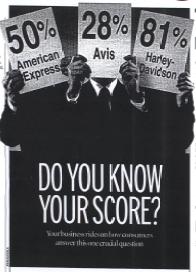
Some folks may have missed this due to the 4th of July holiday here in the States, but Matt Creamer over at Advertising Age wrote an article entitled "Do You Know Your Score?" [print edition, cover story and p. 24 for July 3rd, 2006].

The article does a nice job of talking about how the use of the Net Promoter Score (NPS; the likelihood that a person will recommend an organization, brand, product or service [OBPS] to a friend or colleague) is becoming a standard across many different industries but especially among the word-of-mouth marketing community. The NPS score is calculated by subtracting the number of people who would not recommend the OBPS, or detractors, from the number of people who definitely would recommend the OBPS, or the promoters.

There are several advantages to using the NPS to track performance (whether it be product or service quality, customer service interactions, or the effectiveness of a word-of-mouth marketing campaign) including that it's easy to understand, it's straightforward to calculate, simple to administer, many companies are using it, and it has been tied to revenue growth (tested in both US and UK companies).

Fortunately the article also mentioned some of the drawbacks or cautions about using the score as the "only" or "ultimate" question. When I discuss the NPS during presentations I discuss its wonderful utility as well as four critiques:

1) Is revenue growth the only financial indicator that matters?
2) Is the number of promoters, versus likelihood to promote, a better indicator of revenue growth?
3) Does NPS tell you what’s working and what’s not working?
4) How precise is NPS?
First, besides revenue growth, other indicators are also important such as operating cash flow (the “lifeblood of the firm”), cash flow volatility (indicator of financial risk), Tobin’s Q (the relative value of such intangible assets as knowledge, human capital, brands, and relationships), and the price-to-book ratio (the ability to generate cash from assets). These other indicators are discussed in Neil Morgan and Lopo Rego’s letter-to-the-editor in the April 2004 Harvard Business Review (they are marketing professors at the business schools of UNC-Chapel Hill and University of Iowa, respectively). They conclude that revenue growth doesn’t necessarily equal success in these other metrics and thus companies shouldn't use NPS as the "only" thing to focus on in increasing shareholder value. They and others have also argued that customer satisfaction scores are also correlated with important indicators in certain industries.

Second, Morgan and Rego argue that there is evidence that the number of people promoting may actually be a better indicator of revenue growth. However this is not consistently supported as Paul Marsden and colleagues, who have studied NPS among UK companies, did not found this in their research (learned via e-mail correspondence).

Third, an important concern is that NPS doesn't tell you what's working and what's not working. It's important to know why one has a high or low NPS so that an organization can make appropriate changes, or build on their strengths. Some people worry that organizations will stop at just measuring NPS and won't do enough follow-up research to understand why they're getting that score.

Finally, some people question how precise the NPS metric is. Pissed-off detractors who give an organization a "0" on the 0-to-10-point scale (0 - extremely unlikely to recommend, while 10 is extremely likely to recommend) are weighted the same as "passive" folks who give the organization a 5 or a 6 (this critique is discussed in a Business Week article). To be fair here, though, Fred does talk about how to address each of the three categories -- promoters, passives, and detractors -- differently when trying to improve one's performance and thus NPS score.

In their critique of the NPS in their HBR letter-to-the-editor, Morgan and Rego write that before an organization adopts the NPS, they should ask two questions:
1) What customer feedback measures best predict business performance in my industry?, and

2) What dimensions of my business performance am I trying to maximize?

According to them, an organization should only adopt the NPS if the answer to #1 is the number of net promoters, and to #2, revenue growth and nothing else. They also emphasize the importance of tracking what’s driving the recommendation as well as the number of customers making the WOM recommendations.

However, another way of thinking about whether a company should adopt the NPS is offered by Dr. Laura Brooks from Satmetrix. She argues in a blog post that a company should adopt the NPS if it actually motivates employees (and the organization as a whole) to change their behaviors.

And for a response to why some people hate the NPS, be sure to check out this blog post from Fred Reichheld.

Stay tuned for WOMMA's Measuring Word-of-Mouth, Volume 2 where we'll see how different WOMM companies are using the NPS in their businesses [disclosure: work group editor for this research book].

Other posts of interest:

My blog post about the London School of Economics study entitled "Advocacy Drives Growth"

My blog post about metrics used by WOM marketing companies to determine ROI

- Image above copyright by Advertising Age and Crain Communication. It is being used without their permission and knowledge but hopefully they won't mind.

-->
Tags:

Sunday, June 25, 2006

If You Don't Know These Things Before You Leave This Class on WOM, Buzz, and Viral Marketing Communication ... :-(

I am meeting with my WOM, Buzz, and Viral Marketing Communication class for the last time tomorrow morning at 8 am EST. We'll be discussing what worked well in the class and what didn't, what they learned about WOM marketing, the future of WOMM and their careers, as well as a review for the final exam (which will be a take-home final).

As part of this final class we will be discussing what we think the most essential points are to take away from the class (and this is actually what they'll have to do on the take-home final). I've come up with my own list by looking over everything we covered in the class, points made by leading industry figures through their guest lectures, reflecting on my own and others' academic research, my experiences consulting with companies, and finally questions I am asked by reporters, audience members, and companies when they are trying to get their head around WOM.

It turns out I came up with 13 points, or what I'll call my "Baker's Dozen of Essential Points about WOM Marketing". Please feel free to add or otherwise modify this list through your comments.

Baker's Dozen of Essential Points about WOM Marketing

1. What is word-of-mouth (WOM) and consumer generated media (CGM)?
2. What are motivations for positive WOM (PWOM) and negative WOM (NWOM)?
3. Why is WOM hot now?
4. How far back is there academic research on WOM?
5. How does online WOM compare to offline WOM?
6. How do I find my influencers, or should I even bother?
7. How do you track the ROI of WOM?
8. How do you compute the Net Promoter Score and why would I want to?
9. Why should I care about WOM in relational networks?
10. (How) Should I get involved in "the conversation"? And what is "the conversation" anyway?
11. What are two competing philosophies of WOM? And is there any way to reconcile these?
12. What are the most common ethical critiques about WOMM?
13. What are three ways to FUBAR the future of WOM Marketing?

-->
Tags:

Sunday, June 18, 2006

How Oblivious Is Your Company? Developing A Six Phase Model to Characterize A Company’s Level of Involvement and Engagement in the WOM/CGM Space

I recently developed a model to characterize where a company was in terms of their level of involvement and engagement with understanding stakeholder word-of-mouth and consumer generated media. I can’t say this is an entirely original model since I have attended a number of presentations where people have talked about how to get involved in the “conversation” that takes place among consumers. So if I’ve inadvertently plagiarized this from anyone just let me know.

And I should also say that it’s not my original model since I initially presented it to my students a couple weeks ago in class and they provided incredible feedback, and in fact proposed some new levels.

All that aside, I believe all companies can be placed along a continuum for each of these six phases. They might not go through these in a linear fashion and it’s not necessarily the case that the final phases are more evolved than the earlier stages (though you’ll probably detect a bias in the model for companies to strive towards the later phases). Different companies need to pick a level of involvement that’s suitable for their culture and their industry. However it is generally the case that early phases are more “passive” while later phases are more “active.”

Phase I – Oblivious

This label sounds a bit harsh but it amazes me how many companies don’t realize that people talk about them. They don’t think to pay attention to what consumers have to say and don’t benefit at all from any of their insights or ideas. Companies are in this phase because they might not know any better or have been trained to focus too much on a “control” mentality where they “push” the message out to a target audience. Ignorance, however, is not bliss.

Phase II – Indifference or Neglect


Phase II is not necessary to pass through, but it is an option that some companies take. In this phase the company is aware that consumers are talking about them but are indifferent and don’t care about what they have to say, or simply neglect to pay attention to it. This too is probably the result of the control-push dynamic.

Phase III – Monitoring


In Phase III, a company is aware that people are talking about them and consider it important enough to pay attention to. A lot of monitoring right now is taking place online and the reason some people first monitor the online space is because they realize there is the potential for widespread distribution of the message and impact. A few other interesting things to note about this phase: a) some companies only monitor the online space because they could care less if just a few people are saying in offline or private conversations because they don’t think that WOM has an impact (this can be a dangerous strategy since it represents a form of indifference); b) some companies are monitoring the space because they see it as a form of “competitive intelligence” with no motivation to engage in the dialogue (again, probably more of the control-push mindset); and c) other companies may be at the monitoring phase because they are cautiously dipping their toe in the WOM/CGM space to try and figure out what’s going on.

Phase IV – Listening

In this phase a company is not only monitoring the WOM/CGM but doing so with an intent to move towards more engagement. It’s a subtle but important distinction, and represents a key difference between “monitoring” and “listening”. Thus, in Phase IV, a company is listening for insight but also for understanding as a move towards dialogue (contrast this with some companies in Phase III who are just monitoring the space to make sure nothing bad gets said about them). Laurent Flores has talked a great deal about this (and later phases) on his blog. My colleague Lois Kelly has written an excellent book called Beyond Buzz about this topic as well. Listening involves a more active (even proactive) and attentive orientation and represents a crucial preliminary step to the final two phases: responding and joining in.

Phase V – Responding


In this phase a company takes the next step and responds to consumer WOM/CGM. Responding is a crucial element of acting on feedback provided to the company from consumers. This can also take the form of outreach to their stakeholders, and increasingly in the online world this takes the form of blogger outreach. This can be a delicate matter since the company doesn’t want to appear as being invasive or “interrupting” the conversations already going on. Jim Nail from Cymfony recently gave an excellent talk to my class about if and how to respond to negative WOM. In some ways, though, responding might be a little reactive because a company might be waiting for something to happen before they respond, but if a company is thoroughly committed to the fourth phase of listening, then responding becomes an extension of that proactive strategy.

Phase VI – Joining In


This represents the most active, committed, and dialogic phase. Here the company is an active, perhaps even passionate, contributor to the dialogue about their brand, products, and services, as well as general issues that face their category and industry, and even more broadly, the company demonstrates concern about topics that are of interest to their consumers. A company at this phase acts in accordance with the dialogic principles of co-creation of meaning making. You can identify companies in this phase by some of the following indicators: the company is seen as a well-respected thought leader in a topic of concern to its stakeholders; the company hosts and sponsors events of importance to its customer community; it supports or hosts forums on those important topics in online or offline venues such as blogs, message boards, events, and mini-conferences; it has a strong reputation of listening and being responsive to customer suggestions and complaints; it proactively seeks out feedback and critical scrutiny of its actions; it has a high Net Promoter Score (more people who actively promote and recommend it than detract from the company); and/or it has a reputation for being clear and transparent in its communication practices.

In summary, all companies can be placed on this continuum of passive to active involvement and engagement with their stakeholders. Companies can use this tool to identify where they are on the continuum and reflect on whether or not this is the best place to be for their corporate culture and industry.

As I mentioned above I don’t think this model is completely original, and there are probably others out there with their own existing models, but I’d love to hear feedback on this one and/or for you to share your own models that you’ve come up with. Thanks again to my students for co-creating this model with me!

* Image Copyright

-->
Tags:

Thursday, June 15, 2006

WOM Among Youth

I was recently asked via e-mail about the connection between WOM and the youth demographic and if I had any insights from my academic research in this area. The specific questions were as follows: does WOM travel differently among youth? Does technology acceptance impact connections? Are there more conversations happening online vs. live for youth? Are their networks wider, deeper or have no difference to the average 40 year old? Are there different categories of discussions?

I posted my response to this inquiry on WOMMA's new research blog, so check it out! [[Added 05/25/2007: New link for WOMMA research blog post]].

By the way, WOMBAT 2 (WOM Basic Training conference) is coming up quickly. The meeting will be out in San Francisco.

-->
Tags:

Wednesday, June 07, 2006

SPIDERs! Social Psychology of Information Diffusion Educational Resources

Light blogging lately because of all the activity on my teaching blog. But this one will make up for it.

Here's a great website for all things relating to "the spread of culture, information, and even diseases": the Social Pyschology of Information Diffusion -- Educational Resources page.

No arachnophobia here! This is an incredible resource for such topics as social networks, memes, contagion, persuasion, word-of-mouth, rumors and gossip, etc. There are also some very helpful bibliographies on these topics as well as primers for key conepts on information diffusion, communication, and social influence.

The site is maintained by Dr. Alan Reifman, a faculty member at Texas Tech University in the Department of Human Development and Family Studies.

Definitely check it out!

-->
Tags:

Friday, May 26, 2006

Pete Blackshaw's Comment Reponding to "Is Negative WOM More Frequent Online than Offline?"

Pete made some excellent comments in response to my last post "Is Negative WOM More Frequent Online than Offline?". In the interests of promoting dialogue and involving as many others as possible I wanted to "elevate" his comment into a post so that more people might have access to it. Please find his post below (edited only for typos and paragraph spacing to make it easier to read):

Great post, and it truly is an important topic and question. To lend further perspective on my opinion, I do believe consumers are as inclined to provide positive feedback as negative feedback, but as the barriers to providing that feedback increase, the ratio of negative to positive feedback (or recommendation) increases.

This was very clear to me in the early days of developing a consumer feedback portal after leaving P&G. We carefully studied why consumer feedback to companies (and the ensuing "recommendations to others") tended [to be] so negative. The vast majority of consumers (24 or 25) who have a so-called "feedback moment" would fail to provide that feedback because of (1) contact barriers, (2) cyncism that no one would listen or bother to respond, (3) didn't know who to find, etc. Consequently, only the really negative would push through the pipe, and that in turn would cascade (in a highly cathartic manner) to CGM venues like message boards. In so far as it takes time to invest into the feedback process, the emotion behind the negative tends to dominate the exercise.

That said, as CGM venues have become easier and more effortless, we're seeing a growing percentage of neutral to positive commentary, especially in blogs, which are becoming highly transparent mirrors into everyday behavior. Often the "word of mouth" or "recommendation" is incidental or implied, not delibrate.

If what Keller and others suggest is true, I'm even more convinced that companies and brands must be more aggressive in actively inviting -- nay, encouraging -- feedback, and lowering the barriers at all cost to that expression. If a friction-free feedback experience ups the odds of Pampers capturing an evangelist who speaks generously of the brand both offline and via high-impact CGM venues, that's a great payout. I'll think more about this.
Thanks for this Pete! Two comments on your comment:

Your points about customers not able or motivated to tell the company is definitely consistent with other research on this topic. For example, the Customer Dissatisfaction Study released by the Verde Group found that people were 5x more likely to tell friends about a negative experience rather than a company for the following reasons: a) it's not worth customers' time to contact the company; b) customers tried before but had a negative experience in contacting the company; c) customers don't know who or where to contact; d) customers thought it might negatively affect future service; 5) customers didn't think it would do any good. In an interview with Paula Courtney from the Verde Group I learned that about 10% of the people who have a negative experience actually contact the retail store (20-30% in consumer sector).

The other comment is that there is a great research opportunity for a study to be done that demonstrates the hypothesis that 1) there is a growing percentage of neutral and positive commentary in CGM venues, especially blogs, and that 2) this increase is due to CGM venues becoming easier and more effortless to use. Is there some graduate student out there who wants to do a thesis or dissertation on this? ;-)

-->
Tags:

Thursday, May 25, 2006

Is Negative WOM More Frequent Online than Offline?

I'm trying to make sense of two seemingly contradictory positions about the prevalance of positive and negative WOM (PWOM, NWOM). Let's start first with some recent findings reported by Keller Fay from their TalkTrack methodology (opens into PDF).

Their data show that brand-related interactions are more likely to be "mostly positive" (62%) than "mostly negative" (9%) in terms of valence (aka, polarity or sentiment). And the majority of the WOM episodes represented were offline (92% to be exact, including F2F and telephone).

My own research with college-students (obviously not a representative sample) also supports the finding that PWOM is more frequent than NWOM (and a similar percentage of these interactions were in offline settings too).

Further, Robert East from Kingston Business School, has found that PWOM is 3x more likely than NWOM (largely because people have more opportunities to spread positive WOM). Robert's research also suggests the counter-intuitive finding that PWOM and NWOM are not all that different from each other in terms of impacting brand decisions, though this varies by category. Read his study for more details (opens into PDF).

A contrasting picture, however, emerges from Pete Blackshaw in a recent blog post and ClickZ article on defensive branding. Pete contends that in online CGM venues negative experiences are far more prevalent than positive ones. This is especially the case in search, where people are seeking out information online and considering a purchase. It seems that for certain product categories, such as automotive and electronics (two categories mentioned in Pete's post), the search results are often dominated by negative comments. Further, if it's indeed the case that many people use search for researching brands before they buy, then these negative comments can have a great deal of reach with, and potentially impact on, other consumers. So, regardless of whether or not all online CGM is more positive or more negative (anyone know of comprehensive research on this matter?), the important point according to Pete is that search results, at least for certain categories, often include more negative comments than positive comments (and these are the comments more likely to be seen by inquiring consumers).

OK, so let's assume the following for the sake of argument: PWOM is more prevalent in offline venues and online CGM-related search results are frequently more negative. What explains this difference? Is there something about people's communication patterns via online and offline media? Is it somehow easier to share PWOM offline? Is it somehow more gratifying to complain online?

Existing academic research by Sundaram et al. (1998) in Advances in Consumer Research shows that there are four primary motivations for spreading negative WOM: 1) altruism (to help ensure others don't get burned); 2) anxiety-reduction (telling someone else about the negative experience allows the other person to validate the person's reaction as reasonable and appropriate and gets the issue off our chest); 3) advice-seeking (where one person has a negative experience and seeks the aid of another to help them decide how to respond); and 4) vengeance (wanting to get back at the company).

All of these motivations could also apply to CGM/online WOM. And research by Bailey (2004) in the Journal of Marketing Communications certainly suggests that the internet does contribute to negative consumer-to-consumer articulations because it provides a forum where angry customers can make complaints and have a receptive and global audience to validate their negative experience. These articulations invite "that-happened-to-me-too" responses from others and these "me-too" comments may in turn raise the rankings of such posts in search engine rankings (this is speculation on my part but it seems plausible). Coincidentally, see an exchange between my students about bad cell phone service on our class blog and others responding with "me-too" comments (this example includes trashing one service provider while praising another.)

Plus don't forget that WOM articulations communicate more than just information about the product, but also about our own identities (this is what I like and don't like and this is the type of person I am and am not). The internet is a huge forum for this kind of identity-expression (or perhaps more accurately, identity-construction) -- just think MySpace and other social networking and community forums -- and on a societal level we seem to increasingly identify ourselves by our consumption and brand-related experiences.

And further, if you add in the fact that most companies don't do a good job of providing responsive and engaging outlets for people to complain it makes sense that consumers will take things into their own hands and perhaps express themselves where they'll get the largest and most receptive audience (which leads Pete to argue, and I agree wholehearedly, that effective WOM/CGM programs need to include the consumer affairs folks as well as the marketing folks).

But then if you grant the difference between online and offline WOM regarding an issue like positive versus negative sentiment wouldn't it then follow that online WOM isn't necessarily representative of offline WOM and vice versa? Or maybe it's that online search results aren't representative of offline WOM? I'm anxious to see research that looks at CGM across a range of different categories to determine the relative prevalence of comments with positive versus negative sentiment. Is anyone aware of research that does this?

And if it turns out that online WOM does skew more negative than offline WOM then it seems that online isn't representative of offline WOM as many claim. An implication of this, then, is that if companies are only paying attention to monitoring online WOM (which seems extremely important to do and we'd be foolish not to pay serious attention to it), and if consumers are primarily coming across negative articulations in search results, then nobody is getting a full picture of consumer-to-consumer WOM about brands just by looking online.

-->
Tags:

Tuesday, May 16, 2006

TalkTrack and the Conversational Geography of WOM Project

Advertising Age reports yesterday on some exciting findings from The Keller Fay Group's TalkTrack methodology (disclosure: consulting relationship).

Actually before I go on, does anyone notice how there's almost always a WOM-related story in AdAge on Mondays when the print version comes out? It's like WOMMA's version of WOM Wednesdays except it's Advertising Age's "WOM Mondays" (doesn't have quite the same alliteration value though [er, actually consonance since alliteration only technically refers to the use of a vowel at the beginning of a word]). It's great to see a WOM-related story almost every week nowadays in this publication.

Back to TalkTrack... one of the reasons I'm very excited by this is because of the parallels with my academic work that falls under the heading of the conversational geography of WOM project. Briefly the argument that I have made is that effective WOM communication is based less in the marketing of a particular brand and more in the everyday conversations in relational networks, since it is those everyday conversations and relationships that form the basis for the influence characteristic of WOM episodes. Thus, in order to understand WOM successfully, you have to take into account A) a mapping of the everyday conversations, and B) the relational histories of the people talking.

Methodologically speaking, you can accomplish A and B through a combination of different methods. To track the conversations you can use 1) a diary-based method, which I've done with the Word-of-Mouth Episode Survey (and what TalkTrack is doing for brand-related interactions on an ongoing basis with a nationally-representative sample), as well as 2) recording actual conversations and WOM episodes in order to transcribe them and analyze them for how WOM episodes emerge on a sequential and inferential basis (using insights from conversation and discourse analysis).

But you also have to account for another kind of history beyond the conversational history that plays out turn-by-turn in a specific episode, and that's the relational history of the people talking. For this, you can use 3) a "relational ethnography" approach (see Carl & Duck, in press; contact me for a pre-press version). What you do here is ask people to record their everyday conversations, which will include WOM episodes, transcribe these interactions, and then interview the participants about what they see going on from their "insider/participant" perspective (this insider perspective will supplement the "outsider/analyst" perspective). Specifically you want to ask the participants in the WOM episodes about how they make sense of their own interaction and to provide insights that an outside analyst wouldn't have access to since s/he is not an "insider" to the relationship. Here, then, you're gaining insights into how the relational connection and history serves as a basis of influence in the WOM episode.

Now, from my perspective, TalkTrack is extremely valuable because it will give insight into the first of the two points I mentioned: the mapping of everyday conversations. And there are many practical applications of this, some of the most important from a commercial perspective, arguably, are the ability to see trends in the conversations, to get a sense of what percentage of the conversations in a particular industry or category a particular brand occupies, insights into polarity, who's making recommendations, where these are taking place, what people are saying, etc. (see my presentation in Hamburg Germany about how this information can be used).

Another benefit is that TalkTrack, or a longitudinal, diary-based approach more generally, can be used as an industry benchmark for how everyday, organic WOM episodes play out. Companies can then compare their outcomes from organized programs to this more general data. Even more specifically, companies that specialize in designing organized WOM marketing programs can then compare data they gather from participants in organized WOM marketing programs to what non-participants (or "everyday people"; the type TalkTrack is tracking) are doing.

I will actually be writing about this for my contribution to WOMMA's Measuring Word-of-Mouth Volume 2 research book (disclosure: WOMMA Advisory Board and work group leader for this book). Specifically I'll be comparing findings gleaned from TalkTrack to findings of WOM marketing agents from my research collaboration with BzzAgent.

The next phase of my academic research agenda will be to utilize the relational ethnography approach for the analysis of WOM episodes.

Stay tuned for the details!

-->
Tags:

Monday, May 15, 2006

The WOMBAT Strikes Back -- WOMBAT 2 in San Francisco

WOMMA's Word-of-Mouth Basic Training Conference is coming back for more. WOMBAT 2 will be in San Francisco June 20-21, 2006.

I won't be able to make this one unfortunately as I'm teaching my summer class on WOM, buzz, and viral marketing communication (and missing two class periods in a row during the summer term is like missing a full week in a regular semester). I'm bummed that I'll have to miss the keynote speech by Shel Israel and Robert Scoble, authors of Naked Conversations :-(

But hopefully there will be some good blog coverage of the event that we can all follow!

Disclosure: Advisory Board Member of WOMMA

Friday, May 05, 2006

Inviting My Research Blog Readers To Participate In My Class on Word-of-Mouth, Buzz, and Viral Marketing Communication

I would love to extend an invitation to readers of my research blog to also check out my teaching blog. I am gearing up for my new special topics course on Word-of-Mouth, Buzz, and Viral Marketing Communication and want you to participate via the blog.

I have been building this course from scratch over the past few weeks and am very excited about it. We will be learning about the academic research on word-of-mouth marketing and communication and also learn from some of the industry leaders who are building this field. We have a number of wonderful guest speakers joining us and we will be collaborating with some great companies in the space as part of a class project (visit the class blog to learn more!)

Students will also be blogging about the concepts and their experiences in the course and I hope to do a few podcasts of lectures as well.

So, if you're one of the 74 people out there that Feedburner tells me are subscribing to this feed (thanks so much by the way!) or if you're one of the 450 unique visitors per month that MapStats tells me about, then please add my teaching blog feed to your readers today!

-->
Tags:

Thursday, May 04, 2006

Mapping the Conversational Geography of Word-of-Mouth in China

The conversational geography of word-of-mouth project is traveling to China!

A few months ago I was contacted by Paul Clark, an Assistant Professor at Okanagan College in British Columbia. In addition to his work in Canada, Paul teaches classes in Shanghai, China and is the Director for Shanghai Direct, a consulting firm that helps companies wanting to enter the Chinese market. He has followed my research on the mapping of everyday word-of-mouth conversations and asked if I was interested in collaborating on a small study with his students at Shanghai University.

After discussions about the best way to integrate the study into his Advertising and Promotions course we decided to have the students (n=70) use the Total Interactions and Word-of-Mouth Episode (TIWOME) worksheet to track the percentage of total conversations that include brand-related talk for a 7-day period. It will be fascinating to compare the results with the students from the U.S. population.

His students begin tracking their conversations next week and we hope to have it collected and analyzed within a couple weeks after that. Stay tuned for details!

My goal is to track the conversations all around the world using the diary-based TIWOME and Word-of-Mouth Episode Survey methodologies so if there are other professors who want to collaborate on similar projects please let me know.

-->
Tags:

Wednesday, April 19, 2006

DuPont's Endorsement of WOMMA's Ethics Code

I just finished the WOMMA-sponsored teleconference on word-of-mouth ethics (recap). I don't know the actual count of how many people participated but there were a lot of *beeps* as people joined the call. The podcast should be available on the WOMMA website in the coming weeks (disclosure: WOMMA Advisory Board member).

I enjoyed hearing my co-panelist, Gary Spangler from DuPont, speak about the latest news in WOM marketing ethics. DuPont is the first Fortune 100 company to fully endorse the WOMMA Ethics Code in all of their marketing and communication practices. Gary talked about his involvement in helping DuPont integrate the Code into his company's policy: he acted as an "internal champion," he helped to create knowledge and educate others about what WOM marketing is and what forms of WOM marketing are unethical, and talked about the importance of getting the key decision-makers involved. Apparently DuPont's existing corporate values were already consistent with the spirit of the Code so there was nothing to prevent them from officially endorsing it. Gary feels that the governance issue regarding ethics rests on the "client side of the equation," meaning that it is incumbent on clients not to work with firms that engage in deceptive deceptive marketing practices.

Andy Sernovitz actually began the call with an overview of ethical issues facing the WOM marketing industry (PDF), followed by Gary, and then me talking about my "To Tell Or Not To Tell?" study on the role of disclosure in organized word-of-mouth marketing programs. One ethical issue that wasn't addressed in the call was the societal effects of word-of-mouth marketing and peer-to-peer influence programs (I only mentioned it as one other ethical concern that has been expressed, in addition to the role of disclosure, and the role of minors).

We all fielded questions from the audience which included: best practices for companies to ensure the agencies they are working with are engaging in ethical practices, whether or not to run a WOM marketing campaign if you know you have an inferior product, and how, if at all, a company should participate in online consumer-to-consumer discussions about its own brand.

Finally, stay tuned for some ethics initiatives coming out from WOMMA in the near future that will help companies ensure their involvement with word-of-mouth marketing programs is consistent with the WOMMA Ethics Code.

-->
Tags:

Tuesday, April 18, 2006

Free Lunch Teleconference on Word-of-Mouth Marketing Ethics

Who ever said there's no such thing as a free lunch?

On Wednesday, April 19th, at 12 noon, the Word of Mouth Marketing Association will be offering a free seminar on word-of-mouth ethics.

The title of the seminar is "WOM Ethics: A Practical Guide to Doing it Right."

The seminar is free so that as many people as possible can benefit from this important issue. Simply dial 512-225-3050 and then enter passcode 772541#

Andy Sernovitz from WOMMA will be talking about the WOMMA ethics code and principles of ethical WOM. Gary Spangler from DuPont will be talking about the practical, company-wide implementation of the ethics principles behind the code. And then I will be speaking about my research on the role of disclosure in organized word-of-mouth marketing programs. You can learn more at http://womma.org/telecon.htm

In the interests of full disclosure, only the teleconference is free. You have to bring your own lunch :-) (and I'm an advisory board member of WOMMA)

-->
Tags:

Thursday, April 13, 2006

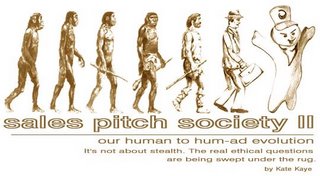
Social Critiques of Peer-to-Peer and WOM Marketing Programs, Take 2: Release of Sales Pitch Society II

In an earlier post I wrote about the various social critiques of peer-to-peer and word-of-mouth marketing efforts. In that post I mentioned a piece written by Kate Kaye called Sales Pitch Society (opens into PDF). In that work Kate was concerned that participants in corporate-sponsored marketing programs were unreflectively becoming "brand vessels" and wondered whether people really believe in the messages they are spreading about brands.

On Monday, Kate released Sales Pitch Society II, an updated version of her analysis. In this latest edition, for which I was interviewed and cited, Kate wants the reader to reflect on how organized word-of-mouth marketing affects our social fabric, relationships, and our own identities as being defined by brands. She argues that people who participate in organized WOMM programs "are condoning the deliberate injection of brands into their conversations. In essence people are facilitating their own exploitation, merely because marketers have asked them to" (p. 38). She cites a number of reasons for this:

empty lives, the desire for belonging, acceptance and insider knowledge, even sheer materialism. (p. 38)
Kate feels that proponets of organized WOMM programs are being seduced by their own rhetoric, drawing a comparison to Orwellian newspeak:
Could it be that WOM marketers have been spewing this Orwellian newspeak for so long, even they’'ve fallen prey to it? This time, the doublethink slogans are not “War Is Peace, Freedom Is Slavery, Ignorance Is Strength.” They'’re more along the lines of: Evangelism is Empowerment, Loyalty is Control, Influence is Altruism
Kate further expands her critique into the world of consumer generated media, arguing that the digital amplification of WOM in the form of CGM may lead us to forsake our human "in-the-flesh" relationships. She writes "Consumer attitudes are shifting, WOM is becoming institutionalized, and CGM is proliferating. At the intersection of these phenomena is digital communication" (p. 38).

Before I continue I should note that Kate adds a disclaimer about her critique:
Please note: This is by no means an anti-capitalist or anti-advertising manifesto. In fact, it comes from the heart and mind of a spirited proponent of free market capitalism. Neither is this an effort to denigrate the individuals who work in the WOM industry. This is merely an attempt to spur further dialogue regarding the ethical and societal implications of engineered WOM marketing campaigns.
I find Kate's work to be thought-provoking on this topic, and I have found her to be very receptive to feedback, though I do disagree with her on a number of points. Here are a few points where we I think we overlap in our views and some points where we diverge (this is not an exhaustive list)...

Areas of Convergence

- I agree that many in our society define our identities too much by the brands we consume. (p. 26)

- I believe we should be reflective about our participation in marketing initiatives, just as we should reflect on and critically interrogate how we spend our time and energy on a range of activities in which we engage. (p. 5)

- I like her interrogation of languaged used by those in the industry (the communication scholar in me!). As an example, I feel similarly that we should interrogate the term "citizen marketer" because it seems to conflate the process of being a citizen in a democratic society (and all the attendant responsibilities of political participation that is required of citizens) with being a consumer in a marketplace. (p. 33)

- I think it's essential that we create a space to discuss the issues that Kate raises in her analysis about the societal and ethical effects of brands and in our lives and the marketing methods used to promote those brands.

Areas of Divergence

- I'm sensitive to, but ultimately resist, the argument that people are "facilitating their own exploitation" by participating in organized WOMM programs. This seems to reproduce a kind of "false consciousness" argument where the critic defines somebody else's reality for them. Kate's suggestion that the motives for participating in organized WOMM programs -- empty lives, desire for belonging, acceptance and insider knowledge, and sheer materialism -- could all be valid. But I wonder if the critique is somewhat reductionist by only, or at least primarily, looking at their participation in the WOMM program; this is likely just one aspect of their multi-faceted lives.

- I wish her critique more evenly incorporated a broader slice of word-of-mouth marketing business models because it may not do justice to the full range and types of perspectives in the field. Although she does spread some of the critique around to more "organic" WOMM programs and even the monitoring of online buzz, a large part of her critique is based on "amplified" programs offered by firms that have a network of members, such as BzzAgent or Tremor, or companies like M80 or Ammo Marketing (companies specifically mentioned). The BzzAgent model receives a good deal of attention and critique (and interestingly there are some in the WOMM industry who have made similar critiques of BzzAgent's business model, just as Kate does). And BzzAgent has always been a "lightning rod" in attracting praise and criticism. Ironically, some of this attention may be because of their level of disclosure and openness about what they do (for example, Kate uses some of the information provided on their blog and website as resources to critique their model). Further they are also a firm that has opened up their model to academic inquiry through their collaborations with universities such as Harvard, Yale, and Northeastern (obvious disclosure here), just to name a few; and since the findings from such studies are part of academic projects whose non-proprietary results are publicly disseminated it can cut both ways.

- I'm not sure what to make of the direction that Kate moves into towards the end of her piece where she implicates the new(er) forms of digital media that faciliate and amplify WOM on a broader scale. She writes that "In some ways, the digital communication we praise for its potential to bring us closer together sometimes actually divides us. It'’s as though some of us have allowed the media we use to transfer our thoughts and enable our discussions to build their own barriers" (pp. 38-39). I agree that technology both enables and constrains, but I think this point could be, and has been, discussed separately from the rest of her argument. That is, there's nothing inherent in the technology that leads us to engage more in brand-related conversations or "communication commodification." And though it's important to consider the role of 'social media' technologies anytime you talk about WOM and CGM I think this is the part of her argument that could be developed the most.

But because her writing style and arguments are often provocative I would encourage people to read Sales Pitch Society II. I plan on having my students read it in my class on WOM, Buzz, and Viral Marketing Communication that I'm teaching this summer, and which she happens to mention in the piece.

I would especially recommend that people who have participated in organized WOMM programs read SPSII and respond with your feedback (to this post or to Kate's site). I'd be fascinated to learn the diversity of responses to it.

-->
Tags:

Tuesday, April 11, 2006

Interview with Paula Courtney about the Methdolology on the Retail Customer Dissatisfaction Study

A couple months ago the Verde Group and the Wharton b-school released a report about how negative word-of-mouth spreads after a dissatisfying shopping experience. I won't summarize the report here since there are already a number of good summaries out there...

Press Release on Study from Verde Group
Church of the Customer Blog Post about study
Customer World Blog Post about study

... but I was especially interested in the study because I'm studying pass-along, or relay, rates among consumers in a variety of contexts, and especially for word-of-mouth marketing programs. So I contacted Paula Courtney, President of the Verde Group, to inquire further about the methodology they used as it relates to my research. Below are the questions I asked her over the phone and my notes from her responses:

1) How was loyalty measured in the study? Was it solely a behavioral measure (such as intent to repurchase? likelihood to tell others, etc.?) or was there also an attidudinal or cognitive measure as well?

Loyalty was solely a behavioral measure based on the following questions: a) willingness to recommend company, b) willingness to recommend product to others, and c) intent to re-purchase over the next year.

2) You were able to assess pass-along rates -- how many people a dissatisfied customer told -- for one generation (dissatisfed customer to their first generation conversational partner). Was there any attempt to determine how many people the first generation conversational partner told?

They didn't look at this in this study (it was only a 9 minute questionnaire) and haven't done multi-generation pass-along studies. But Paula thinks that the number of others told is tiny. She suggests that the reasons people pass-along negative WOM is to get a sense of justification and/or to get a bit of revenge. By sharing the negative story it makes the experience real and factual. Further, it invites sympathy and empathy that was otherwise lacking in the original experience with the company. We're looking for a sense of equilibrium, to close the gap, between our dissatisfied state and our normal state (echoes of cognitive dissonance theory here).

We then discussed the following hypothesis: the less sympathy we get from the first person the more likely we are to tell another one. This would be a fascinating hypothesis to test and suggests that the type of response we get from our friends might moderate how many people we tell about the negative experience. [There's a funny implication of this if it turns out to be true: companies with crappy products and customer service should train the general population to be more empathetic listeners so the negative WOM doesn't spread as far; of course, the company could put that money into making a better product or service but that would just be plain silly!].

3) One finding was that people were 5x more likely to tell their friends rather than the company. Were you able to determine why this was the case (such as too much effort to contact the company? didn't feel like contacting the company would do any good? etc.).

Paula gave five reasons why people don't contact the company: a) not worth their time; b) tried before but had negative experience; c) don't know who or where to contact; d) thought it might negatively affect future service; 5) didn't think it would do any good. She suggested that about 10% of the people who have a negative experience actually contact the retail store (20-30% in consumer sector).

4) Another finding was that friends or colleagues were most likely to hear about a shopper's inability to find an item due to product clutter in stores. I'm interested in the relational types or categories that were included. What were the other categories? Strangers? Acquaintances? Family members? Etc. In my research I use 7 different categories: stranger, acquaintance, friends, best friends, romantic partner/spouse, relative, and co-worker. I'm curious to see how much overlap there might be in our respective category systems.

They didn't measure other relationship types. Their question was worded more generally as how many people outside the company they told and friends and colleagues were just given as examples. We also wondered how significant relationship type was here. For example, do you just tell the first person you come in contact with shortly after experiencing the problem? Or are you more likely to tell a friend versus a spouse versus an acquaintance? I think she felt that a person would just tell the first person they came into contact with, and my feeling is that you would tell someone with whom you have a relational history where talking about such experiences is common.

5) Were there any findings about how many people a customer told who ended up contacting a company and had a satisfying or dissatisfying experience with the company's complaint handling department? I ask because I wanted to see how the findings compared to TARP's study with Coca Cola's consumer affairs department from the early 1980s.

Paula was well aware of the TARP study but the focus of their recent study did not deal with the complaint handling department specifically. Understandably, this would have been a different study to find out that information.
In summary, I think the two most interesting points to come out of our conversation were the social and relationship aspects of sharing dissatisfying experiences.

First, people pass-along negative WOM to get a sense of justification and/or to get a bit of revenge. By sharing the negative story with another it makes the experience real and factual. Further, it invites sympathy and empathy that was otherwise lacking in the original experience with the company.

Second, could it be that our likelihood to pass-along negative WOM to more than one person depends on the level of empathy that we receive from the first person we told?


Thanks for your time Paula!

Tags:

Monday, April 10, 2006

Having A Little Fun: Most Innovative Entries On My Download Registration Page

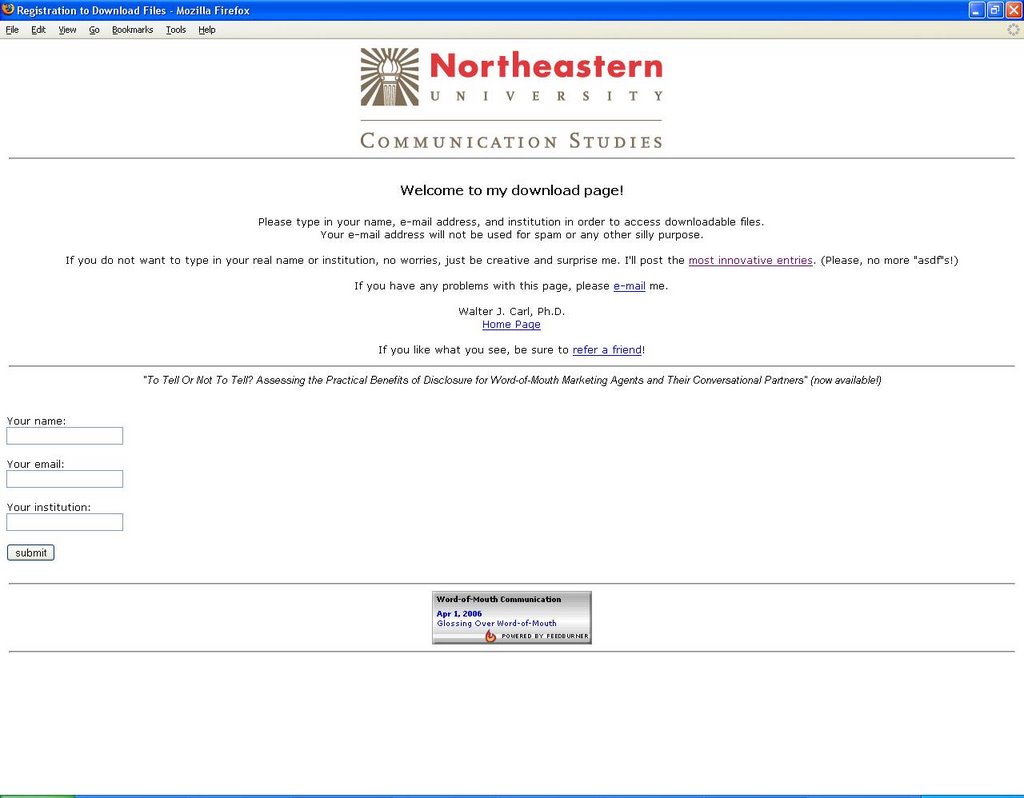
A couple of months ago I added a registration page to help track who was downloading my academic manuscripts, research reports, and surveys related to word-of-mouth marketing communication.

On the registration page I ask people for their name, institution, and e-mail address. Everytime somebody registers I get an e-mail with this information. Interestingly, my busiest days yet were January 19th and January 20th, 2006, which corresponded with the release of my "To Tell Or Not To Tell?" report on the role of disclosure in organized word-of-mouth marketing programs (over 200 registrations on those two days alone!).

In an attempt to respect people's legitimate concerns for privacy, and realizing that some people might feel "put off" by the idea of having to register, I made it clear that people didn't have to enter their real name and could blatantly make up information (as if they needed my permission!).

A lot of people just started entering "asdf" since that's one of the easier key combinations on a QWERTY keyboard. This was fine, but I got a bit bored by these, so I invited people to surprise me and make up some creative entries. I promised I would post the most innovative ones.

The response has been wonderful and I've pasted in my Top 10 below and even included some "honorable mentions." Feel free to comment and say if you would rank them different.

Ten
Name: fdsa
(ha ha ha, not very clever, but we'll give you the 10 spot.)

Nine
Name: Last minute assignment material
Institution: mental
E-mail: lmam@stressed.com

Eight
Name: Donald Duck
Instutition: Duck and Roll
E-mail: Quacker@quackquack.com

Seven
Name: I love Boston
Institution: Mass Art
E-mail: sorry@cantdoit.com

Six
Institution: University of Nothing
E-mail: idontknow@where.com

Five
Name: Col. Mustard
Institution: Clue Research

Four
Name: WMD
Institution: Liars Inc.
E-mail: denial@iraq.com

Three
Name: MeTalks
Institution: YouListens

Two
Name: Josephina Blow
Institution: Bubble Gum Heiress
E-mail: jo@Blow.com

One
Name: Average
Institution: LikeTheOthers
E-mail: joe@liketheothers.com


Honorable Mentions:

Name: Malcalypse the Elder
Institution: Discordian Society

Name: Buster, Keaton (not Dolly)
Institution: Bound for Trains
E-mail: the@general.nnw

Name: SpamFighter

Name: TBell
Institution: AlwaysLand
E-mail: MagicHappens@work.com

Name: Mickey
Institution: Walt Disney
Obviously I don't know who you are but thanks to everyone for having a little fun! :-)

Saturday, April 01, 2006

Glossing Over Word-of-Mouth Measurement & Metrics?

I recently received an e-mail from Marianne Spain, a student at Franklin University, about my recent presentation on word-of-mouth and consumer-generated media. She felt that my presentation glossed over the measurement piece of word-of-mouth marketing and wanted to know if I could provide her with additional information. Below is her e-mail andmy reply:

Dr. Carl

I found your presentation at www.woomba.com while doing research for a paper at Franklin University. This topic intrigues me and your insights are spot-on. I'm enjoying learning all I can about this topic and you and WOMMA are great sources of information.

If you don't mind, I have a question. You indicate that the key challenges to implementing a CGM/WOM campaign are "Ethics & Societal Effects and Credible Metrics." You thoroughly explain the ethical aspects and fully discuss disclosure, but the presentation glosses over the measurement piece. Other than stating that it's difficult to put the metrics in place, do you have any other data about measures? Most marketers won't support a program that can't prove it's worth and my paper really needs that anchor!

I would appreciate any information you can impart. I eagerly look forward to your reply.

Sincerely,

Marianne Spain
--- --- --- ---
Hi Marianne,

Thanks for your interest in my research. I discussed a little more of the measurement piece in my actual talk but it didn't make it into the slides (and plus I ran out of time towards the end). There are a number of different outcome metrics that companies are using, and many are based on the WOMMA Terminology Framework (disclosure: advisory board member). The metrics used depend a lot on what type of WOM programs you are talking about. For example, if you take an influencer and product seeding program that tries to get a product into the hands of specially screened people there are some commonly used metrics: purchase behavior, inquiry rates (when people go to a website, for example, to learn more information), and pass-along rates (how many people are told). Attitudes towards the brand can also be tracked, brand awareness, and likelihood to recommend are other common ones too. Matchstick describes how they track performance for their influencer and product seeding programs using the Terminology Framework.

The Net Promoter Scale/Score, which is a measure of likelihood to recommend a brand to a friend, is increasingly being used by a number of companies (WOM marketing firms and otherwise). For how WOM marketing firms are using this metric I suggest that you visit BzzAgent's blog to see how they are using the NPS for their campaign tracking in a pre-test, post-test design (what was the likelihood to recommend before the campaign and what was the likelihood to recommend after the campaign). Bazaarvoice is another company using the NPS too. The NPS has been correleated with revenue growth, both in the US and UK (some critiques of this research: 1, 2).

Ways of measuring ROI include control/test groups. BzzAgent has a white paper that tracks different markets in order to determine ROI (for example, City A that has the WOM program and City B that doesn't have it; if sales are higher in City A, and all other things are equal, then this is taken as a sign that the WOM program was effective). However this control/test group design has been critiqued by George Silverman since if it's a really successful WOM program the control group might get "contaminated" by the buzz from the test group.

Brains on Fire helped organize a grassroots marketing program where they were empowering kids in an effort to curb teen smoking, so the ROI outcome metric here was teen smoking rates in South Carolina (Rage Against the Haze program).

You could also monitor online chatter or buzz using various companies' tools (Cymfony, Nielsen BuzzMetrics, etc.) to see if there are increased levels of conversations, the polarity (positive or negative) of the conversations, who is making the comments, etc. The Keller Fay Group is tracking offline and non-publicly available online conversations on a nationwide basis with their Talk Track methodology (disclosure: consulting relationship).

There are more metrics and ways to measure WOM as well but I hope this provides a little more information for you. WOMMA also has put out a book called "Measuring Word-of-Mouth, Volume 1" that has a lot of interesting case studies. The WOMMA Research & Metrics Council will soon be putting out a call for Volume 2 (disclosure: co-chair of this council) and for its next metrics conference.

Walter
-->
Tags: