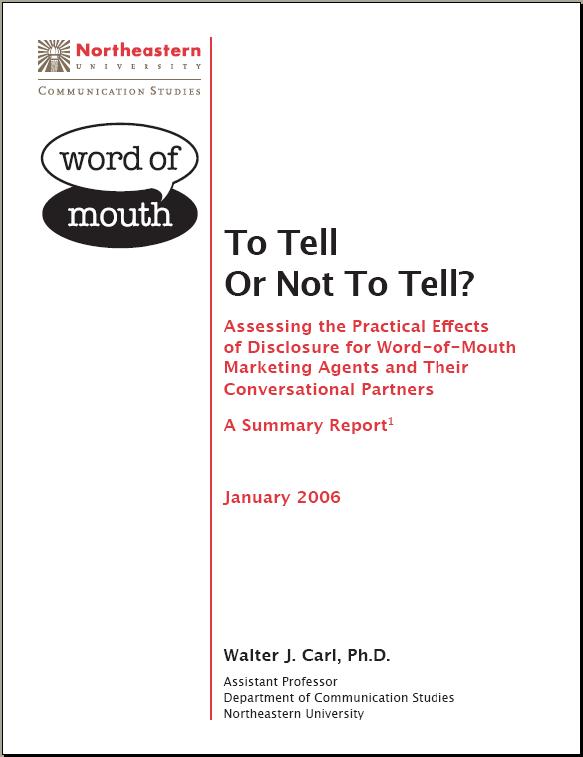
To coincide with WOMMA's Basic Training conference I'll be releasing a major report on disclosure and organized word-of-mouth marketing programs.
Starting January 18th copies of the report can be downloaded free of charge at my download page. A special page will be set up on my blog for comments and discussion of the findings.
My talk at the conference is entitled "To Tell Or Not To Tell?: Managing Effective Word-of-Mouth Marketing Programs Based On Why People Talk (and Listen!)"
Tags: WOM word of mouth Word-of-Mouth Marketing disclosure
Monday, January 16, 2006
Sneak Peek at "To Tell Or Not To Tell?"


Tuesday, January 10, 2006
Free Pass to WOMMA Basic Training Conference for a Worthy University/College Student
It turns out I had a winning bid for the charity auction to the Word of Mouth Marketing Association conference. I'd like to donate it to a student who otherwise wouldn't be able to attend the conference. Ideally this could be any interested student in a university or college, but given travel and hotel costs, it might be a student in the Orlando area. If you fit the bill send me an e-mail! If no one eligible contacts me in the next few days I'll donate the pass to WOMMA to use at their discretion.
Disclosure: I am a member of the WOMMA advisory board.
Thursday, January 05, 2006
Put Your Money Where Your WOMMouth Is!

Anyone interested in attending the Word of Mouth Marketing Association "Basic Training" conference in Orlando? It costs $795 if you're already a member or $1,095 if you're not a member. Or, you can bid your way in with all the proceeds going to a number of great charities (American Red Cross, The Prostate Net, Habitat for Humanity, Electronic Frontier Foundation, etc.). WOMMA is auctioning 20 passes on eBay and right now the bids are well below the prices quoted above. To learn more about the charity auction visit this page on the WOMMA website.
I just put in a bid for the Leukemia & Lymphoma Society. As a WOMMA Advisory Board member I won't need the pass if I win it so I'm happy to give it to someone who wouldn't otherwise be able to go. I'll know in a couple days and will provide an update on my blog.
Also, I'll be releasing a summary report from my latest research project on the practical benefits of disclosure in organized word-of-mouth marketing programs. The title of my report will be "To Tell Or Not To Tell? Assessing the Practical Benefits of Disclosure for Word-of-Mouth Marketing Agents and Their Conversational Partners." More details in the days to come...
Tags: WOM word of mouth Word-of-Mouth Marketing charity disclosure
Sunday, December 11, 2005
How Much We Do Word-of-Mouth Marketing As Part of Our Everyday Interactions

What percentage of all our conversations include talk about an organization, brand, product, or service?
Based on my research with college students (18-29 years of age) the answer is about 17.5%, on average. This is a little higher than the 13.5% I found in an earlier study (see "March 2005" results in the chart and below for details).
I arrived at these numbers by asking people to record all of the interactions they have over a 7-day period with people of different relationship types (strangers, acquaintances, friends, best friends, family members, romantic partners or spouses, or co-workers) as well as those interactions that include brand-related talk (what I call a "word-of-mouth episode"). The percentage of all interactions that include a WOM episode is called the E/I ratio. Learn more about the Total Interactions & WOM Episodes Woksheet and definitions of interactions and episodes (link opens PDF file in new window).
The chart above shows the results. "E" stands for WOM episodes, "I" for interactions, "E/I" for Episode to Interaction ratio (see NOTE 1 below), and "N" for the number of participants in each sub-set.
It's not clear why the "March 2005" numbers (collected during weeks in February and March 2005) are lower than the other months, which may suggest seasonal variation. The winter months may explain lower numbers of interactions but it wouldn't explain why there would be a lower percentage of those interactions involving a WOM episode. Another explanation could be the small sample sizes. Although outliers have been removed, a few individuals in each sub-set could skew the results.
If you want to see how your numbers stack up, I encourage you to count the number of your interactions and WOM episodes. Start with a day and see how it goes. If you want to try for the full 7-days feel free to download the TIWOME worksheet. To learn how these numbers compare to those people affiliated with a buzz marketing agency, see my Management Communication Quarterly article (link opens to my download page where you can access a pre-press version of the article).
Thank you to all of the students who have agreed to participate in this research!
NOTE 1: The E/I ratio is the average of all the relationship type x day of week calculations rather than simply the result of dividing the total Es by the total Is. Taking the average of the reltype x dayweek calculations is a more precise metric because it takes into account the variations across different relationship types and days of the week. See my Management Communication Quarterly article for more details.
NOTE 2: Please note that "WOM" is defined here as talk about an organization, brand, product, or service, but WOM can also be understood as a medium of informal, peer-to-peer communication which could be about a range of topics. For example, gossip about other people or work could also be considered WOM, but is not counted in the "WOM Episode" numbers (interactions involving gossip would be included as part of total interactions however).
---
This work is licensed under a Creative Commons License.
Tags: WOM word of mouth Word-of-Mouth Marketing
Thursday, December 08, 2005
Clarification in ClickZ's Story "BzzAgent to Agents: Spill the Beans, Or Else"
Pamela Parker covered BzzAgent's latest change in disclosure policy in a ClickZ article entitled "BzzAgent to Agents: Spill the Beans, Or Else."
I just want to clarify a statement she made in the article:
BzzAgent says its new stance stems from a study conducted by Walter Carl, a professor at Northeastern University. The report found that disclosure created trust, combated a stigma about "stealth" marketing, and increased the depth of product-related discussions. Carl came to his conclusions by examining 270,000 word-of-mouth reports submitted by BzzAgent volunteers.
While BzzAgent's white paper did reference findings from a collaborative study we conducted (details forthcoming in the weeks ahead as I write up the findings for academic publication), it was BzzAgent who conducted their own internal analysis of the 270,000 word-of-mouth reports.
Reference to preliminary findings from our collaborative study are specifically called-out in the white paper. Otherwise, the results stem from BzzAgent's internal research or other third-party sources.
Thanks to Pete Blackshaw's post for raising my awareness of the ClickZ story.
Tags: WOM word of mouth buzz marketing disclosure
Tuesday, December 06, 2005
Special Topics Course On Word-of-Mouth, Buzz, and Viral Marketing Communication

I am excited to announce that I will be teaching a special topics course entitled "Word-of-Mouth, Buzz, and Viral Marketing Communication" at Northeastern University in the Department of Communication Studies, first summer session (May and June 2006).
To support the teaching of this course, and learning about WOM, buzz, and viral marketing more generally, I have created a new blog. The "Word-of-Mouth Communication Study" blog will still be my primary blog on WOM, but posts related to that class specifically, and educational efforts regarding WOM, more broadly, will be on the new blog.
Here is the course description:
CMNU914 -- Special Topics in Organizational Communication: Word-of-Mouth, Buzz, and Viral Marketing Communication
Have you ever loved a company, product, or idea so much that you couldn’t wait to tell others about it? Seen a horrible movie lately and told your friends not to go? Tried a new type of food because a friend suggested it? Heard a story about a town that named themselves after a start-up internet company? Passed along an e-mail about a funky chicken you can command at your will? Posted or read an online review to a consumer website? If you answered yes to any of these questions you engaged in word-of-mouth communication and may have also wittingly or unwittingly participated in an organized word-of-mouth, buzz, or viral marketing campaign.
Word-of-mouth, buzz, and viral marketing is a hot topic now as organizations of all kinds – for-profits, not-for-profits, academic institutions, you name it – struggle to break through a mediascape cluttered with advertisements, deal with a growing distrust of corporate-affiliated messages, figure out a consumer market that demands greater control and engagement, and try to understand how new communication technologies amplify peer-to-peer communication and influence, both in the online and offline worlds.
The purpose of this course is to introduce advanced undergraduate students to the word-of-mouth, buzz, and viral marketing industry. Students will learn about the theories and practices that inform this industry through readings of popular press books and academic journal articles, guest lectures from leading industry figures, analysis of existing word-of-mouth, buzz, and viral marketing campaigns, analysis of key companies operating in the word-of-mouth space, and learning industry best practices in designing, executing, and measuring organizationally-facilitated attempts to manage word-of-mouth and consumer generated media.
Specific topics include:
· Terminology issues: distinguishing word-of-mouth, buzz, and viral from other marketing and advertising practices
· Similarities and differences between organic (everyday) and amplified (institutionally-facilitated or sponsored) word-of-mouth.
· Historical overview of academic research on word-of-mouth
· How peer influence works. Are there really a small, select group of people who lead the rest of the population’s opinions? What is the role of relationship networks?
· Tracking online and offline word-of-mouth
· Metrics used to measure word-of-mouth and determine ROI
· How to build principles of effective word-of-mouth into business practices
· Emergence of the word-of-mouth industry associations
· Ethical controversies surrounding the industry: commercialization of chit-chat, undercover and stealth marketing, shilling
Pre-Requisites: Middler-year and above
Tags: WOM word of mouth buzz marketing
Monday, December 05, 2005
The Practical Value of Disclosure in Word-of-Mouth Marketing Campaigns
Today BzzAgent has released a white paper (link opens PDF in new window) arguing for the practical value of disclosure in word-of-mouth marketing campaigns.
Their report is based on analysis of more than 270,000 reports filed by their WOM volunteers (BzzAgents) over three years, preliminary findings from our collaborative research project investigating dyadic (two person) or multi-party perspectives on the same WOM episode, and other third-party sources.
In short, BzzAgent concluded that "disclosure increases the validity of WOM interactions without reducing the breadth of campaign reach" (p. 2). More specifically they found that:
- Disclosure does not reduce WOM activity.
- Disclosure creates peer trust.
- Disclosure combats “stealth” stigma.
- Disclosure supports perceived product value.
- Disclosure increases depth and reach of product-related discussions.
I am currently in the process of writing up the results of our collaborative study for academic publication and will be releasing additional findings over the coming weeks and months. I will also be sharing some of these findings in my presentation at WOMMA's WOM Basic Training conference in January 2006.
It should also be noted that the findings from their white paper also led to changes in their disclosure policy. Here's a comment from BzzAgent's PR person that elaborates on their new policy:
BzzAgent also issued a press release today announcing the impact the conclusions in the whitepaper had on the company's business.
Specifically, the positive relationship between agent transparency and campaign performance has inspired us to strengthen our disclosure policy. Here are the changes BzzAgent volunteers can expect to see:
1.) New volunteers will be required to accept a Terms of Service prior to completing their registration.
2.) Agents that complete a report will be given the option of clicking a "disclosure check box" prior to submitting their WOM report. This box verifies that the conversational partner was aware of the agent's participation in the WOM campaign.
Please be sure to disclose. It's the right think to do from an ethical standpoint ... and now we know that it's also vital from a performance standpoint. Agents that do not disclose their affiliation will be required to participate in an online disclosure training -- similar to the BzzAgent "boot camps" -- prior to being offered access to future campaigns.
Keep in mind that the primary benefit to transparency is agent credibility. Revealing you are part of a BzzCampaign contributes to the legitimacy of everything you say and it underscores the validity of your opinions.
Tags: WOM word of mouth buzz marketing
Monday, November 28, 2005
WOMMA Basic Training Conference in Orlando

The Word-of-Mouth Marketing Association (WOMMA) will host their next conference -- Word of Mouth Basic Training -- in Orlando, FL, January 19-20, 2006.
I'll be speaking on Day 1. Here's the title and blurb for the panel, along with my fellow panelists:
Measurement 2: Why People Talk: Consumer Behavior and Word of Mouth
Walter Carl, Professor, Northeastern University
Kerry Stranman, Partner, Chief Strategist, MotiveQuest
David Fletcher, MD MediaLab, Mediaedge:cia UK
Learn how consumers interact in a word of mouth world. Discover what gets them talking, why they get active in discussions -- and why they don’t. Learn how to understand their motivations and how to measure them.
You can get a $100 discount by using the following code when you register: "speakerdeal"
Disclosure: I am an Advisory Board member for WOMMA and received an e-mail asking me to mention the conference on my blog, which I am happy to do :-)
Wednesday, November 23, 2005
Rumor, Gossip, and WOM: Response to Jeremy Depauw's Query
Jeremy Depauw posted the following query as a comment on my blog:
Am I correct if I think that WoM could also be risky as a rumors creator?
I'm really interrested in the ways organisations are able to make WoM a force instead of a weakness. I have to admit that during my Communication studies, most of the teachers used to focus on the negative way rumors and legends may interact with an organisation réputation and image.
It's really surprising to see that few information sources about Information Management (my resaerch fiel actually), as KM for example, don't consider WoM as you do. Maybe I'm wrong, but as far as I know (not so far by the way)it does not seem to be a major interest as a positive field of improvement in organisation IM.
I would be glad to have your opinion about that.
Thanks anymway.
Here's my response:
Hi Jeremy,
It might be helpful to differentiate rumour, gossip, and WOM.
I define a rumour as unverified information that is spread within and across informal, or emergent, networks. By emergent I mean those networks that are not prescribed by the organization chart but emerge organically. It sometimes takes a formal network or a formal source to authorize the information as legitimate. However, the grapevine communication is often faster, richer, and accurate, more often than not.
Gossip refers to evaluative, moral talk about an absent other. It tends to categorize others as a certain type of person, belonging to social categories such as jerks, studs, saints, etc.
In my research on WOM marketing, I define WOM as informal, evaluative communication about an organization, brand, product, or service, which may or may not include a recommendation. I further differentiate this between institutional (consciously managed by an organization) and everyday WOM. This obviously shows a bias towards "marketing" or "brand"-related content.
All three can be "risky" to the organization depending on how each is managed.
To the rest of your question, I think there IS a lot of interest for WOM and internal information management.
One of the foundational articles on informal, emergent networks is Keith Davis' article in Harvard Business Review from the 1950s ("Management Communication and the Grapevine"). But there are much more recent examples, such as the work of David Krackhardt (see his co-authored article in HBR from 1993 entitled "Informal Networks: The Company"). You may also be interested in the work of Rob Cross for his 2003 book entitled The Hidden Power of Social Networks: Understanding How Work Really Gets Done in Organizations. You may also want to read the work of Noshir Contractor who also is very active in this space.
Hope that helps!
Walter
Monday, November 14, 2005
How Much Can You Trust Buzz?
Scott Kirsner wrote an article that appeared in today's Boston Globe entitled "How much can you trust buzz?"
The article contributes to the ongoing discussion about social and ethical concerns surrounding buzz marketing and issues of disclosure. (See my previous posts on this: 10/24/2005 Part 1, 10/24/2005 Part 2, 10/25/2005, 10/28/2005, and 11/4/2005).
This article focuses on BzzAgent, and a book ("Grapevine: The New Art of Word-of-Mouth Marketing") recently authored by its founder and president, Dave Balter.
Apparently a number of volunteers affiliated with the agency, or BzzAgents, posted reviews on Amazon's website about the book, most identifying their affiliation with BzzAgent, but a small few who did not. According to the article, BzzAgent was able to determine that 3 of 4 people who didn't identify their affiliations were indeed part of the BzzAgent network. The article states that BzzAgent considers the activity of these agents "unacceptable" and that these Agents will face some type of disciplinary action.
Kirsner, the article's author, contends that since BzzAgent's business model is built on a word-of-mouth network, "it needs to get more serious about disclosure. It's one thing to ask agents to be honest and open, but BzzAgent would avoid more bad publicity, and do well by its clients, if it gave its disclosure policy some teeth -- kicking agents out of the network when they fail to disclose their connection."
It will be interesting to hear BzzAgent's response to this article. Their policies have developed over the years towards increasing disclosure to the point now that disclosure is required of BzzAgents. They also have a disciplinary program in place, which they call Pest Control.
Kirsner's point goes beyond just BzzAgent, however, because it is calling for something that is not layed out explicitly in WOMMA's Code of Ethics. That code requires disclosure of relationship, opinion, and identity, but does not currently provide guidelines for its member companies on disciplinary behaviors.
Stay tuned to see how these issues develop in the coming weeks and months.
By the way, you can read my review of Grapevine that I sent to Dave Balter, and which he posted on the BzzAgent blog back in September. In the interests of disclosure, I am not a BzzAgent, I have collaborated, and am currently collaborating, with BzzAgent on research projects regarding managed word-of-mouth marketing programs (some of the findings from an earlier project are cited in Grapevine), and I am an Advisory Board member of WOMMA.
Tags: word of mouth buzz marketing
Friday, November 11, 2005
What WOM Tells Us About Organizational Decision Making
A reader of my blog recently posted the following comment:
Good morning,
I am a (young)resaercher in the field of Information Management and Mass Media Studies. I have discovered (few days ago)the field of WOM.
My question is: In what way this field could be invovolved in the comprehension of the organisation decision-making process ?
Thank you in advance for your answer.
Regards
Jeremy
Jeremy Depauw | Homepage | 11.10.05 - 2:58 am | #
Here's my response (and I invite others to post how they would respond):
Hi Jeremy,
This is an excellent question. I'll just start a response here and invite others to contribute. You ask about how WOM can help us better understand how organizations make decisions (if I captured what you are asking correctly).
I think one way to answer that question is to think of word-of-mouth as a process of consumer-to-consumer communication (or substitute any appropriate term other than consumer, such as user, stakeholder, citizen, constituent, etc.; I'll use stakeholders). Many stakeholders want to be more involved in the decision-making process of organizations, or at the very least, feel "heard" or "listened to" by the organization. Organizations of all flavors should sieze on the opportunity to be responsive to this desire and involve their stakeholders in decisions that affect the stakeholders (such as product design, policies, etc.) and figure out ways to become partners in these conversations among their stakeholders (blogging could be one example, being responsive to any feedback is another, creating educational resources that stakeholders will find relevant to their lives, etc.).
Thus, the organizational decision-making process would potentially become more open and clear to those outside of the organization (what many call transparency), or even to those internal stakeholders as well (such as employees). In this process I think many organizations are realizing the line between internal and external needs to be blurred to facilitate this communication. For example, employees of an organization can often be the organization's best ambassadors.
This is certainly not a comprehensive answer, but just a starting point.
Thanks for your question and I invite you and others to contribute their thoughts!
Walter
Monday, November 07, 2005
Measuring WOM: Advocacy Drives Growth in UK Companies
Be sure to check out a study conducted by Paul Marsden and colleagues at the London School of Economics (LSE) on how advocacy drives growth in UK companies (PDF download of report). In their study, they replicated the use of the net promoter score for UK companies as a way of predicting revenue growth (the net promoter score is a measure that indicates how likely people are to recommend to others a brand, product, or service in comparison to those who are neutral or would recommend against the brand; a higher score indicates that more people are spreading positive recommendations than negative recommendations).
Here are some points I found interesting (I've also included some additional comments gleaned from an e-mail conversation with Paul about the findings):
1) The research was able to correlate the net promoter score with revenue growth in the UK companies. This represents an important contribution because it increases confidence in the link between WOM and revenue growth, and the utility of the net promoter score to predict growth in a culture outside of the U.S.
2) The average net promoter score for UK companies was much lower than US companies (3% versus 11%). The study didn't go into details to explain the difference, but speculating, the difference might be explained due to cultural differences in terms of WOM communication practices. For example, Paul brought up the example in US political campaigns where those in the US might be more likely to advocate while those in the UK might be more reserved or express more cynicism or criticism.
3) Negative WOM recommendations (e.g., "Don't buy X"; NWOM), on its own, predicted growth but positive WOM recommendations (PWOM) didn't. These findings are consistent with existing research on social influence that would suggest NWOM has more of an impact than PWOM. Though see some contrary evidence regarding positive and negative WOM from Robert East's work (Kingston University).
4) The study contends that WOM drives growth rather than vice versa. This is a little trickier since the study uses correlational data to infer causation, but the article does provide compelling evidence to support its claim. For example, the net promoter score correlated with growth figures in the same year, but growth from the prior year (2002-2003) didn't correlate with the net promoter score for the following year (from 2003-2004). It seems an even stronger case could be made if we had the growth figures from 2004-2005; the goal would be to see if these numbers are correlated with the net promoter score from the prior year (2003-2004).
5) The LSE researchers hope to extend their research into WOM advocacy as predictors of productivty (the "likelihood that employees would recommend working for their company to friends or colleagues") and share growth (the "likelihood that investors would recommend investing in a company to friends or colleagues"). I'm looking forward to learning more!
By the way, Paul is also an Advisory Board member of WOMMA.
Friday, November 04, 2005
Do You Know of Video Clips about WOM, Buzz, and/or Undercover/Stealth Marketing?
I am compiling a list of video clips about WOM, buzz, and/or undercover/stealth marketing to be used for teaching and illustration purposes. Here are two to get the list started:
1. 60 Minutes segment on "Undercover Marketing" (October 2003)
2. "Triumph of the Shill" segment in The Corporation (2003)
3. "The Merchants of Cool" "Under-the-Radar Marketing", Chapter 2 of Frontline video (2002)
NOTE: These three clips obviously focus on the ethically suspect practices of undercover and stealth marketing, but I'm interested in video clips of all different forms of word-of-mouth marketing.
Please add in ones you know of through a comment. Thanks!
Tuesday, November 01, 2005
Psst! How Do You Measure Buzz?
Catharine Taylor of Adweek has written an interesting article on the issue of how to measure word-of-mouth. A subscription is required to read the article though a PDF version can be downloaded at John Moore's Brand Autopsy blog. While you're there be sure to read John's commentary on the article. A key issue he raises is whether we should think of WOM as a marketing method (just another tool in the toolbox) or as part of a larger business practice (by which he means a whole culture that supports engagement with stakeholders, openness and transparency, etc.
A related issue I would have liked to have seen in the Adweek article is not only about measurement but about how to more fully understand WOM. That is, when we hear "measurement" we tend to think of quantitative measures and methods; but equally important is the rich understanding that can be gained from more qualitative approaches such as conversational geography focus groups and relational ethnography (a blend of participant-observation, interviewing, and conversation analysis).
Friday, October 28, 2005
Faked Out By BK?
Seth Stevenson writes a nice piece where he wonders if he's been faked out by an e-mail he received for the Burger King "King" Mask.
Well worth a read, but I'd make a similar comment as I did in an earlier post about use of terminology. Here's a quote from Seth's article:
But let's assume for a moment that Crispin [the agency responsible for the BK "King" account] used "buzz marketing" to fake me out and get my attention (as I'm convinced they did). Is there anything wrong with that?
Should Seth have written "undercover marketing" to imply the practice might be deceptive rather than "buzz marketing"?
Tuesday, October 25, 2005
Campus Ambassador Programs, Buzz Marketing, and Disclosure
I was recently interviewed for an article that appeared in the Boston Globe yesterday about the use of campus ambassador programs on university campuses. The author, Sarah Schweitzer, writes about how major companies like Microsoft, JetBlue Airways, The Cartoon Network, and Victoria's Secret are attemtpting to reach the "elusive" college market through such word-of-mouth and peer-to-peer programs.
With such programs, Schweitzer writes, niche firms recruit students from a particular university so that they can market products and services on behalf of the company (and sometimes companies may directly recuit and train students themselves). An example she mentions in the article concerns Microsoft's OneNote software program.
The issue of disclosure of affiliation came up again (see my two prior posts, Part 1 and Part 2). The students Schweitzer mentioned said they didn't disclose their identities, but they were wearing "logo-bearing t-shirts," in the case of Microsoft. She also writes that...
"Campus ambassadors generally are not required to state their corporate affiliation, but most companies instruct them not to try to obscure it."
The article went on to say...
"Students they approached said, in interviews after listening to the pitch, they did not understand the students' relationship with Microsoft, but that it mattered little."
In my own class discussions I find that a lot of students view this type of P2P and WOM marketing as acceptable and just "the way things are done now." Some argue the way things "have to be done now." A much smaller number criticize the practice or see it as invasive.
It's an interesting article that's worth checking out. One critique I have is that Schweitzer writes that buzz marketing is when "people talk up a product to friends and family without necessarily revealing corporate affiliation." Should people who write and talk about buzz marketing be encouraged to use the term "undercover marketing" instead when the corporate affiliation isn't disclosed? Or "shill" marketing when they received monetary compensation for their activities?
---

This work is licensed under a Creative Commons License.
Monday, October 24, 2005
On Affiliation with a Buzz Marketing Agency, Disclosure, and Shopping in a Supermarket -- Part 2
This post picks up with the second part of Matt Galloway's comment to my earlier post regarding what policies buzz marketing agencies should have regarding the issue of disclosure:
What we can (and should) expect is for Tremors NOT to discourage disclosure - either directly or indirectly. Since everyone working in the area of WOMM says you can't control the message, I think it is an unrealistic for us to expect agecies to be able to when it comes to disclosure.
So, "You never tell a panelist what to say." is not a cop out AS LONG AS "You ALSO never tell a panelist what NOT to say."
Well said, and I wonder if we're also focusing too much on the actions of the panelist in our discussion.
That is, what if the guiding principle was less on what the panelist does or does not do, and more on the sense-making of the "conversational partner"? The key criterion would be to make sure that the people with whom the panelist is talking do not feel misled, deceived, or manipulated, at the moment of the WOM episode or afterwards. I add the last part "at the moment of the WOM episode or afterwards" because conversational partners might not feel misled if they don't know about the institutional affiliation, but may feel "tricked" after learning about it (see the 60 Minutes episode on "Undercover Marketing" for examples of some people feeling deceived after being "shilled").
Of course, the conversational participant would have to be aware that the person is participating in a buzz marketing campaign; explicit, verbal disclosure is just one way of doing this.
But one might counter: "If you can't control what a panelist will or won't say, how can an agency control what a conversational partner will think or feel?" Yep, that's right, but since you can't control either one (you can seek to influence both), you might as well aim for which is the most important, and I would argue it's how the conversational partner walks away from the WOM episode. The agency's responsibility in all this might be, for example, to host discussions among its panelists/agents/etc. and allow them to come up with ways to ensure that the conversational participants walk away from the episode engaged but without being misled. I think any principled buzz marketing agency would want to adopt the same criterion.
---
This work is licensed under a Creative Commons License.
On Affiliation with a Buzz Marketing Agency, Disclosure, and Shopping in a Supermarket -- Part 1
John Cass and Matt Galloway made two very interesting comments to my blog post about the issue of buzz marketing and disclosure, especially in light of the Commercial Alert letter to the FTC seeking disclosure requirements for WOM marketing firms like P&G's Tremor. John made the following comment:
I was thinking the P & G example is a little bit like going to a supermarket where someone asks you to test a product, say a dip or a new type of microwave sandwich. If I ate the product, liked it, bought it and went home and told all my friends. Commercial alert is suggesting the company would ask me to inform everyone I spoke with about the new product that I received a free product at the supermarket. Somehow I don't think that type of product testing and promotion is against the FTC rules. What do you think?
Thanks for the comment John! I agree with you that I don't think the the supermarket situation would violate FTC rules about deceptive advertising. Why? The identities and affiliations of all the parties are clear and transparent, and thus the potential for being misled about the affiliation is low. The customer in the store knows that the person giving you the sample is employed by the store (or, in some cases, is from the company making the product) and the purpose of the interaction is to provide the customer with a product sample.
But what you're writing about is whether the person who tries the product at the supermarket through a free sample marketing campaign needs to tell the other person how they learned about it. This is different. In the supermarket example the person talking about the product DOESN'T HAVE an institutional affiliation with the store or with the company making the product. With buzz marketing, the person telling others about the product DOES HAVE an institutional affiliation.
And not only is there an institutional affiliation in buzz marketing, but this affiliation is not marked by the context cues (meaning no one is in uniform, one may not be in a "commercial" setting, etc.). In fact, the context cues often suggest an "everyday" conversation (the scare quotes are used to mark the fact that I'm using the term "everyday" as a contrast term to "institutional" talk where either the product/service/brand being discussed is part of an organized WOM marketing campaign, and/or the person doing the talking is affiliated with a buzz marketing agency). The/an explicit purpose of a buzz marketing campaign is to stimulate discussion about the brand/product/service and the person talking about the product has made a conscious alignment and affiliation with that process. The context cues of everyday interactions would not usually suggest participation in such a process. So with buzz marketing campaigns there is greater opportunity for people to feel like they are being misled (even though there may be no intention to mislead).
Thus, I don't think the free-sample-in-the-supermarket example matches the situation for buzz marketing and disclosure of identity.
Now to the first part of Matt's posting (thank you for your comment as well!). Matt writes:
I've been thinking a lot about disclosure in the BzzAgent/Tremors WOMM model. I'm currently reading Grapevine and I've heard Dave Balter speak on this and I've read some of you stuff from previous WOMMA events. Dave says (usuallu citing some study conducted by you) that the effectiveness of a BzzAgent isn't effect by the disclosure of their association with a WOMM program . This makes sense to me as I think it is more about the trust of the listener and the tone, context, sincerety, etc. of the WOM Unit.
So the question from this first part of Matt's comment is "does it matter?" The "it" meaning how a person learned of a product or service. The free-sample-at-the-supermarket analogy is a useful starting point here: For example, if someone tells me about a great new food item it doesn't matter to me whether that person bought it on their own, tried it, and told me, or if that person got the sample in a supermarket, tried it, and told me. I imagine many people would agree that it doesn't matter in the supermarket scenario.
If we apply this to buzz marketing, does it matter if people learned about something from a participant in a buzz marketing campaign? Would that person's recommendation count just as much? This was a question asked by GfK/NOP World. According to their study, 76% of the people surveyed said it didn't matter to them if a product was recommended as part of a buzz marketing campaign as long as the person, who they knew and trusted, thought the product was good. 19% of the people surveyed said they wouldn't trust the recommendation because they got the product for free. The take-away here is that some people seem to think that receiving the free sample affects the credibility of the recommendation (I wonder if this would also apply to the supermarket situation; this wasn't asked in their survey), while most others either don't worry about the fact the recommendation results from a buzz marketing campaign or feel that any bias is outweighed by the existing level of familiarity and trust they have in the person.
So, based on this survey, participation in a buzz marketing campaign doesn't seem to matter to the credibility of a recommendation. In the near future I'll be reporting data from a study that looks at the effects of institutional affiliation and participation in a buzz marketing campaign in much more detail.
Matt had some additional comments -- about what a buzz marketing agency's policy should be about the issue of disclosure -- which I'll take up in a subsequent post...
---
This work is licensed under a Creative Commons License.
Thursday, October 20, 2005
Is Tremor’s Justification – “You Never Tell A Panelist What To Say” – a Cop Out?
USA Today published a story entitled “P&G ‘Buzz Marketing’ Unit Hit With Complaint” (written by Bruce Horowitz). Apparently, a consumer advocacy group – Commercial Alert – recently filed a complaint with the Federal Trade Commission that charges Tremor targets teens with deceptive advertising.
According to the article, the executive director of Commercial Alert, Gary Ruskin, suggests states that buzz marketing agencies are at fault for “perpetuating large-scale deception upon consumers” when people recruited to promote products via WOM don’t disclose their affiliation with the marketing agency.
Steve Knox, Tremor’s CEO, defended his company’s practices stating that their “panelists” are not paid cash but instead receive free samples or other kinds of materials. He is also quoted as saying “If we’ve done our work correctly, they talk to their friends about it” but Tremor does not tell their members to say they are part of Tremor “because you never tell a (panelist) what to say.”
Hmm…
Of course you shouldn’t tell a panelist what to say or how to say it. People should be sharing their honest opinions (one of those lessons we learned in kindergarten). However, if this quotation is a fair representation of Tremor’s position, it seems like it’s a lame justification for not having panelists be open about their affiliation. Further, their position opens up the perception that Tremor engages in stealth or undercover marketing (see WOMMA’s stance on stealth marketing, recently released in light of news stories about the legality and ethics of WOM and buzz marketing, but consistent with the association’s position from the beginning).
Buzz marketing and firm-facilitated WOM doesn’t need to be undercover to be effective. I am developing a theory of institutional WOM that contends that WOM encouraged by an organization (aka, “amplified” WOM) can be just as effective as “organic” WOM when two conditions are present: 1) sincerity, and 2) relevancy. That is, conversational participants need to trust that the other person is sincere and has their best interests at heart, and also that the information provided is relevant to their daily life and the conversational context (meaning that the WOM is talked about at relevant point in the conversation and in the history of their relationship). I am currently collecting data that will provide evidence for or against this theory. Stay tuned for results!
Two final comments:
1) Be sure to visit Commercial Alert’s website to read the comments posted regarding their complaint filed against P&G. This provides some fascinating insight into arguments for and against buzz marketing in a highly commercialized society.
2) The USA Today article mentions that “several smaller buzz marketing specialists” were also named in the complaint. I invite someone to follow-up with this to see what other companies were named. Please post anything you find in a comment or track back :-)
Content Added (10/20/2005, 7 pm EST):
Commercial Alert's Letter to the FTC The "several smaller buzz marketing specialists" are named in this PDF version of the letter. I think the spirit of the Commercial Alert complaint -- that people who voluntarily affiliate with buzz marketing agencies, or are paid by companies or agencies, should not mislead the people with whom they talk -- is sound and consistent with the WOMMA ethics policy. However their complaint unfairly lumps together companies that abide by the WOMMA ethics code with those that do not.
WOMMA's "WOM 101" Page distinguishing different kinds of word-of-mouth marketing (the Commercial Alert letter conflates "buzz marketing" with "guerrilla" and "stealth" marketing and fails to distinguish it from "shill" marketing).
---
This work is licensed under a Creative Commons License.
Friday, October 14, 2005
Public-Private Intersections in New Media: Is WOM A New Medium?
I attended an interesting panel on Wednesday at Northeastern University. The panel was entitled “Public-Private Intersections in New Media” and hosted some leading academic thinkers talking about the implications of “new media” on our lives.
Craig Robertson pointed out that the media that get defined as “new media” are constantly shifting (the printing press, the telephone, the computer were all “new media” at one point). But he noted how the discourse of new media is actually quite old and can be situated socially, culturally, and historically. The question Craig wants to ask is how the discourse about “new media” is being used? Whose interests are being served? What’s up for grabs? Read Craig’s short essay on a history of new media.
Dan Kennedy argued that new media is not just about the internet, podcasting, and blogs (though it is), but also about how existing media are being used in new ways, such as under-the-radar direct mail targeting, targeted satellite TV (like skyangel.com), and DVDs.
This led me to think if we should include word-of-mouth on a “new media” panel? Interpersonal, face-to-face communication is one of the oldest media forms around but the awareness of WOM as a medium for companies, governments, and celebrity brands to pursue their ends has grown considerably in the past few years, spawning its own industry and associations (see for example, Word-of-Mouth Marketing Association and Viral and Buzz Marketing Association).
A telling point was made at the first International WOM Marketing Conference recently in Hamburg (read my blog posts about the event). The slide was entitled “People Are Media” which suggests how interpersonal conversations and connections (whether transacted offline or online) are being seen as a new media form in the same way we think of more “traditional” mass-media forms. The slide was part of a presentation by Fergus Hampton of the market research firm, Millward Brown Precis.
Fergus’ point about “people are media” also suggests that everyone is, or can now be, a journalist, advertiser, editor and publisher. This relates to a point made by one of the New Media panelists, Axel Bruns, about how we need a new language to characterize these developments. For example, he discussed the term “produsage” to discuss how people are both producing and using content. Axel contends that this term breaks down the tradition consumer/producer dichotomy. It also provides a nice parallel to a widely-used industry phrase – “consumer-generated media” (coined and popularized by Intelliseek).
In short, it’s a great panel and worth checking out. The panel was chaired by David Marshall and also included a student panelist, Meagan Redman (unfortunately Meagan did not get her own web space on the panel website but she made some excellent points – including the point that we need to consider that what is “new” for many is not new for all, especially in those less affluent societies where many of the technologies discussed on the panel don’t yet exist – and held her own quite well on a panel of PhDs).
Subscribe to:
Comment Feed (RSS)


